Market Scenario
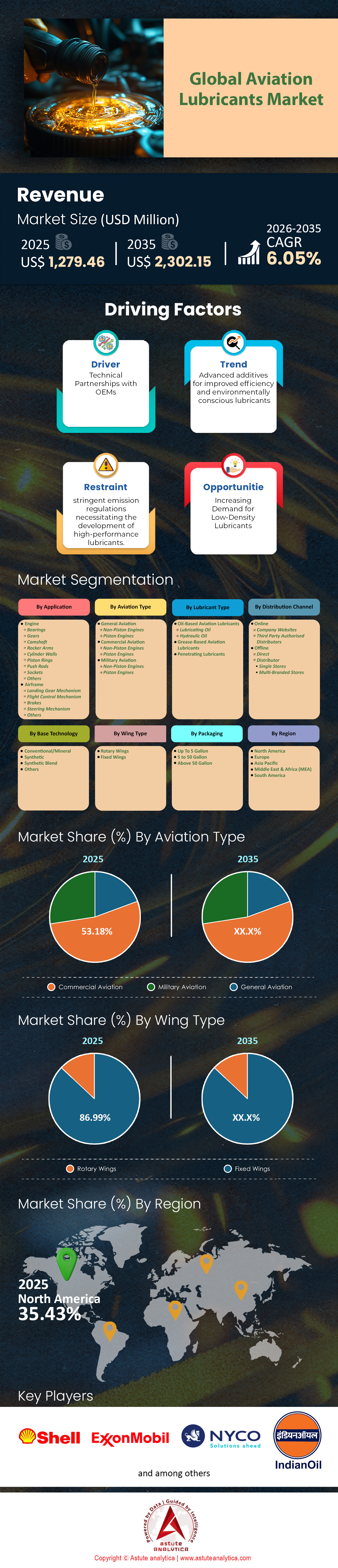
Aviation lubricants market was valued at US$ 1,279.46 million in 2025 and is projected to hit the market valuation of US$ 2,302.15 million by 2035 at a CAGR of 6.05% during the forecast period 2026–2035.
Key Findings
- By Lubricants Type, Oil-Based Aviation Lubricants with 83.46% Share Emerged as the Market Stranglehold
- By Base Technology, Synthetic Oil Accounts for 58.35% Markt Share
- By Application, Engine Drives Over 71.71% Demand For Aviation Lubricants Mainly Driven by the “Thermal Squeeze”
- By Aviation Type, Commercial Aviation Capture A 53.18% Share Propelled by the “High‑Cycle” Revolution
- North America is set to continue enjoying market dominance with over 35.53% revenue contribution.
The global aviation industry is entering an era of exceptional expansion, powered by surging passenger traffic, fleet modernization, and post-pandemic infrastructure revival. According to ACI World and ICAO, worldwide air passenger volumes are projected to reach 9.8 billion in 2025, marking one of the strongest recoveries in transport history. The United States is expected to handle nearly 950 million passengers, China 741 million, and the UK about 260 million, reflecting renewed momentum across both developed and emerging markets. High-frequency routes such as Jeju–Seoul (13.2 million passengers) and JFK–LAX (2.0 million passengers) underscore the heavy utilization of aircraft operating in short-haul, lubricant-intensive flight segments.
Production activity continues to define long-term market stability. Airbus delivered 766 aircraft in 2024 and Boeing 348, jointly heading toward an estimated 1,500 annual deliveries in 2025. Backlogs remain record-high with Airbus at 8,658 units and Boeing exceeding 5,600, ensuring sustained manufacturing throughput for the next decade. The active global commercial fleet now exceeds 30,000 aircraft, of which narrowbody jets dominate due to their growing deployment on regional and domestic routes—critical demand centers for engine and hydraulic lubricants.
Looking ahead, Airbus projects 43,420 new aircraft deliveries by 2044, including over 34,000 single-aisle models, signaling multi-decade consumption growth for aviation lubricants market. Complemented by robust private jet utilization and increased defense flying budgets, the market for synthetic turbine oils and specialty fluids is positioned for continuous expansion. In essence, aviation lubricants have become a vital enabler of global air mobility’s next growth phase.
To Get more Insights, Request A Free Sample
Which Powerhouse Products and Brands Command the Skies in 2025?
The global aviation lubricants market in 2025 relies on a select group of mission-critical fluids that ensure engines operate reliably under the extreme thermal and mechanical stresses of modern flight. Among the most sought-after products, Mobil Jet Oil II and Eastman Turbo Oil 2380 remain the undisputed gold standards for commercial turbine applications. For instance, Eastman Turbo Oil 2197 has now surpassed 400 million in-flight hours, underscoring its proven reliability across nearly every major airline worldwide.
In the grease segment, AeroShell Grease 33 and Nyco Grease GN 22 continue to be the preferred choices for airframe and wheel-bearing protection, offering optimal stability under extreme temperatures and high load conditions.
Leading this competitive arena of the aviation lubricants market are five dominant players — ExxonMobil, Eastman Chemical Company, Shell Aviation, Nyco, and Phillips 66. These companies manage the lifeblood of a global industry expected to record 50 million flight departures this year. ExxonMobil holds one of the widest aviation portfolios with over 20 specialized lubricant variants, while Nyco maintains leadership in the European defense segment with 35 active patents for high-temperature synthetic lubricants. Each of these brands consistently meets stringent MIL-PRF-23699 specifications for engines now operating at compression ratios exceeding 60:1.
How Does the Explosion in Global Air Traffic Directly Feed Lubricant Consumption?
A direct, linear relationship exists between the surge in global air traffic and increased lubricant consumption in the aviation lubricants market. With 5.2 billion passengers expected to fly in 2025, the frequency of lubricant “top-offs” has reached record levels across commercial fleets. A typical narrow-body engine, such as the CFM LEAP-1B, requires a 14.7-quart refill during standard maintenance cycles. As global flight activity approaches 88 million flight hours this year, the maintenance loop for oil replenishment and quality sampling continues to tighten.
The aviation lubricants market is simultaneously experiencing a “first-fill” boom, with manufacturers projected to deliver about 1,500 new aircraft in 2025 — each requiring full system flushing and filling prior to entry into service. Modern high-efficiency engines operate at peak core temperatures approaching 2,000 Kelvin, accelerating oxidation rates and increasing lubricant demand. While these engines are more fuel-efficient, they are also more lubricant-intensive, with shorter replacement intervals than previous-generation powerplants.
Which Three Nations Drive the Bulk of Global Lubricant Demand?
The United States, China, and India form the three primary pillars of global aviation lubricant market consumption — each driven by distinct structural factors.
The United States continues to hold the largest volume share, supported by a domestic market that handled approximately 876 million passengers in 2024 and an active combat aircraft fleet exceeding 2,100 units. The country’s extensive MRO network, through which nearly 29,000 commercial aircraft rotate annually, sustains consistent lubricant replenishment cycles.
China aviation lubricants market follows closely, propelled by significant infrastructure expansion. With around 741 million annual passengers and the world’s largest narrow-body aircraft base, China’s lubricant demand is heavily concentrated around high-utilization short-haul routes — including the Jeju–Seoul corridor, which serves more than 13.2 million travelers each year.
Meanwhile, India has emerged as the industry’s fastest-growing market. Its aircraft order backlog exceeding 1,600 units and over 50 new airports under construction are projected to drive 12% year-on-year growth in first-fill lubricant demand through 2025.
What Revolutionary Innovations and Trends Are Redefining the Future of Aviation Lubricants Market?
Innovation in 2025 extends well beyond friction reduction, focusing instead on chemical compatibility and digital intelligence. A major breakthrough is the development of SAF-ready lubricants. As airlines collectively ramp up consumption to around 175 million gallons of Sustainable Aviation Fuel (SAF) this year, lubricant chemistries are being reformulated to mitigate seal swelling and carbon deposition from bio-synthetic residues.
Parallel advancements include nano-additive lubricants, which enhance thermal conductivity and improve heat dissipation by up to 15% in high-load gearbox systems. Additionally, the integration of Real-Time Oil Health Monitoring (ROHM) technology marks a significant shift toward condition-based maintenance in the aviation lubricants market. By tracking acidity, oxidation, and metal particle contamination in real time, ROHM systems minimize unnecessary oil changes and reduce operational costs.
Finally, the industry’s growing embrace of the circular economy underscores its sustainability transition. Over 70 airlines have introduced hydraulic fluid recycling programs, reinforcing a broader commitment to greener operations across the aviation lubricants value chain.
Segmental Analysis
The Commercial Fleet: The Unrivaled Engine of Global Lubricant Demand
The commercial aviation sector currently commands a 53.18% share of the global aviation lubricants market, a dominance fueled by the relentless resurgence of international travel and the structural expansion of low-cost carrier (LCC) fleets. As we move through 2025, the aviation landscape has evolved past the recovery phase and into an era of aggressive fleet utilization. This dominance is best understood through the lens of flight frequency; modern narrow-body aircraft, such as the Airbus A320neo and Boeing 737 MAX families, are now operating at high-intensity cycles that frequently exceed 12 flight hours per day. Each take-off and landing cycle exerts immense thermal and mechanical stress on propulsion systems, necessitating rigorous lubrication schedules that do not apply to the more sporadic flight patterns of general aviation or private charter sectors.
With the global operational fleet now climbing toward 30,000 active aircraft, the sheer math of maintenance makes the commercial segment the primary engine of aviation lubricants market value. A single wide-body jet, such as the Airbus A350, requires significant oil top-offs and full drains every few hundred flight hours to maintain engine integrity. This demand is further solidified by the massive delivery backlogs at major OEMs. With over 13,000 aircraft currently on order, the industry is seeing a guaranteed stream of "first-fill" lubricant demand. This surge is particularly visible in the Asia-Pacific region, where the rapid entry of new aircraft into service is creating a secondary market for specialized, high-performance lubricants designed for the latest generation of fuel-efficient engines.
The Indispensable Fluid: Why Oil-Based Formulations Retain a Near-Monopoly
Oil-based lubricants represent the vast majority of the aviation lubricants market, accounting for a staggering 83.46% market share due to their indispensable role in turbine engine architecture. While the broader industrial world discusses electrification and alternative power, the reality of high-thrust flight remains tethered to the liquid-cooled, oil-lubricated internal combustion cycle. The dominance of oil-based products is not merely a matter of tradition but of chemical necessity; these fluids serve as the primary coolant for engine bearings that operate in environments where temperatures can fluctuate by hundreds of degrees in seconds. In 2025, the industry has shifted toward higher-purity polyol esters, which provide the oxidative stability required for modern ultra-long-haul operations.
The dominance is also anchored by the military sector’s continued reliance on standardized high-performance oils for supersonic jets and heavy-lift transport. Major players like ExxonMobil and Shell in the global aviation lubricants market have optimized their global supply chains to ensure these oils are available at every major hub, as a wide-body aircraft cannot afford "AOG" (Aircraft on Ground) status due to the lack of a specific turbine oil. This ubiquity, combined with the stringent certification processes required for any new fluid, creates a high barrier to entry for non-oil-based alternatives. Consequently, oil remains the bedrock of the market, providing the reliability that global logistics and passenger transport demand.
Molecular Superiority: The Strategic Shift Toward Synthetic Dominance
Synthetic base technology leads the aviation lubricants market with a 58.35% share, driven by the technical evolution of the "hot-and-high" operating environment of modern turbofans. The transition away from mineral-based oils was a turning point for the industry, necessitated by engines like the GE9X and the Rolls-Royce Trent XWB, which operate at higher pressures and temperatures to achieve peak fuel efficiency. Synthetic lubricants are engineered at a molecular level to resist breaking down under these extreme conditions, offering a level of thermal stability that naturally occurring mineral oils simply cannot match. This technical superiority translates directly into economic value for airlines; by using high-quality synthetics, operators can extend their drain intervals and significantly reduce "coking"—the carbon buildup that leads to premature engine wear.
The narrative of synthetic dominance in aviation lubricants market is also tied to sustainability and corporate ESG (Environmental, Social, and Governance) targets. Modern synthetic formulations are designed to be more biodegradable and to contribute to lower frictional losses within the engine. Even a fractional improvement in friction can lead to a measurable reduction in fuel burn, which is critical when fuel accounts for nearly 30% of an airline's total operating costs. As government regulations tighten regarding emissions and aircraft efficiency, the move toward 100% synthetic fluids has become the standard for any airline operating a modern fleet, ensuring this segment remains the most valuable technological pillar of the market.
Customize This Report + Validate with an Expert
Access only the sections you need—region-specific, company-level, or by use-case.
Includes a free consultation with a domain expert to help guide your decision.
The Heart of the Aircraft: Engine Lubrication as the Market’s Primary Value Driver
Engine applications remain the most critical segment of the aviation lubricants market, capturing 71.71% of the total revenue share. This dominance stems from the fact that the engine is a "living" component that consumes and degrades lubricant as a function of its operation, whereas airframe lubrication is largely static and secondary. In a modern geared turbofan, the lubricant must perform a dual role: protecting the core bearings and managing the intense shearing forces within the power gearbox. This complexity has led to a specialized market for high-performance engine oils that can handle loads exceeding several thousand horsepower.
The aviation lubricants market is currently seeing a significant shift toward "High Thermal Stability" (HTS) oils, as engines are pushed to run hotter to maximize thermodynamic efficiency. Because the engine is the most expensive asset on the aircraft—often valued at upwards of $20 million per unit—airlines are unwilling to compromise on lubricant quality. This "zero-failure" mentality ensures that the engine application segment remains insulated from price-sensitive fluctuations; the cost of a premium lubricant is negligible compared to the catastrophic expense of an uncontained engine failure or an unscheduled overhaul. As long as jet fuel is burned to create thrust, the lubrication of the engine will remain the most vital and high-value activity in the global aviation lubricants landscape.
To Understand More About this Research: Request A Free Sample
Regional Analysis
North America Commands Market Supremacy Through Advanced Business Aviation And Massive Maintenance Facilities
North America holds a dominant 35.53% share of the aviation lubricants market as of late 2025. Much of this regional power stems from its massive infrastructure, hosting over 15,500 active business jets. Private aviation flight hours in the region will likely exceed 5.2 million this year, creating a continuous need for high-performance turbine oils. Major chemical manufacturers like ExxonMobil and Eastman benefit from localized supply chains that feed into Tier 1 MRO hubs in Georgia and Texas. These facilities manage thousands of GE9X and LEAP engine overhauls annually. Because 1,500 global aircraft deliveries are expected throughout 2025, the North American "first-fill" market remains incredibly lucrative. Maintenance providers are seeing shorter turnaround times, yet the volume of "top-off" fluid sales stays high due to aging legacy fleets still in operation.
Asia Pacific Regional Growth Accelerates Via Rapid Fleet Expansion And New Airport Development
Shifting the focus to the East, the Asia Pacific aviation lubricants market is the fastest-growing contender. Wherein, China’s passenger throughput has surged to 741 million in 2025, forcing airlines to operate narrow-body fleets at maximum capacity. India contributes significantly with an aircraft order backlog now exceeding 1,600 units. Naturally, 50 new greenfield airports are opening across Asia by December 2025, which drives localized demand for hydraulic fluids and landing gear greases. Interestingly, short-haul routes in Southeast Asia result in engine service frequencies that are 15% higher than the global average. High cycle counts on A320 and 737 platforms mean lubricants reach their oxidative limits faster than on long-haul sectors. This intense utilization makes the region a primary target for synthetic ester suppliers looking for high-volume contracts.
Europe Maintains Significant Market Influence Driven By Sustainability Initiatives And Widebody Operations
Europe maintains its influence on the global aviation lubricants market by leading the transition toward eco-compatible chemical solutions. Daily flight volumes across the continent reached a 2025 peak of 31,000 movements, stressing oil life across dense long-haul corridors. Airbus is currently ramping up to produce 75 A320 aircraft per month, which directly bolsters the European supply chain. Additionally, the ReFuelEU mandate now requires a 2% SAF blend for all departures, necessitating lubricants that remain chemically stable when interacting with bio-synthetic fuel residues. Defense readiness also plays a major role, as NATO forces have scheduled 1.2 million flight hours for 2025. These military operations require specialized, corrosion-resistant greases for sea-based helicopter deployments. Consequently, European manufacturers focus on high-margin, specialized formulas that meet stringent environmental and defense specifications simultaneously.
Key Recent Developments in Aviation Lubricants Market
- TotalEnergies SAF Commitment: At the Paris Air Show in June 2025, TotalEnergies pledged to produce over 500,000 tons of sustainable aviation fuel annually from 2028 at sites like Normandy (280,000 tons), Grandpuits (80,000 tons), and Leuna (50,000 tons from 2026). This enables >10% SAF-blended jet fuel supply in Europe before the 2030 mandate, partnering with Air France-KLM for high-blend tests and immediate CO2 cuts via drop-in compatibility.
- ORLEN SAF Sales Launch: In July 2025, ORLEN began commercial SAF-blended aviation fuel sales in Poland, slashing GHG emissions in production and use versus traditional jet fuel. Fully engine-compatible, it meets ReFuelEU goals and supports LOT Polish Airlines' decarbonization, with HVO plans from used oils at Płock refinery.
- Shell Gadus Grease Innovation: Shell Lubricants, one of the key players in the aviation lubricants market, released Shell Gadus S3 V220C 2 grease in 2025, the first NLGI dual-certified (HPM/GC-LB) with +HL for heavy loads, suited for aviation. It cuts wear in extreme conditions, aiding sustainable aircraft maintenance worldwide.
- TotalEnergies Hydraulic Acquisition: In February 2025, TotalEnergies Lubrifiants bought HFA/HFC-E fire-resistant hydraulic fluid lines from Fluid Competence, bolstering mineral oil-free options for aviation hydraulics. Low-VOC design enhances safety in airframes and aligns with eco-targets.
- Liebherr-Aerospace Lubricant: Liebherr-Aerospace launched a new aviation lubricant in October 2025, engineered for stable friction in cold temps/high loads with OEMs. It improves flight control actuator reliability, elevating aircraft safety and efficiency.
- ExxonMobil Q3 Results Highlight: ExxonMobil's October 2025 press release emphasized aviation lubricants growth amid Q3 earnings, with expanded supply chains for sustainable formulations amid rising demand.
- ENEOS Aviation Updates: ENEOS announced FY2025 advancements in high-performance aviation lubricants via October press releases, focusing on thermal stability for next-gen engines.
Major Players in the Aviation Lubricants Market
- Aerospace Lubricants, Inc.
- Castrol
- China Petroleum & Chemical Corporation
- Curtiss-Wright Corporation
- Eastman Chemical Company
- Exxon Mobil Corporation
- Indian Oil Corporation Ltd.
- LANXESS AG
- NYCO Group
- Quaker Houghton
- Radco Industries, Inc.
- Sentinel Canada
- Shell plc
- The Chemours Company
- The Phillips 66 Company
- Total Energies
- Other Prominent Players
Market Segmentation Overview:
By Aviation Type
- General Aviation
- Non-Piston Engines
- Piston Engines
- Commercial Aviation
- Non-Piston Engines
- Piston Engines
- Military Aviation
- Non-Piston Engines
- Piston Engines
By Wing Type
- Rotary Wings
- Fixed Wings
By Lubricant Type
- Oil-Based Aviation Lubricants
- Lubricating Oil
- Hydraulic Oil
- Grease-Based Aviation Lubricants
- Penetrating Lubricants
By Base Technology
- Conventional/Mineral
- Synthetic
- Synthetic Blend
- Others
By Application
- Engine
- Bearings
- Gears
- Camshaft
- Rocker Arms
- Cylinder Walls
- Piston Rings
- Push Rods
- Sockets
- Others
- Airframe
- Landing Gear Mechanism
- Flight Control Mechanism
- Brakes
- Steering Mechanism
- Others
By Packaging
- Up To 5 Gallon
- 5 to 50 Gallon
- Above 50 Gallon
By Distribution Channel
- Online
- Company Websites
- Third Party Authorised Distributors
- Offline
- Direct
- Distributor
- Single Stores
- Multi-Branded Stores
By Region
- North America
- The U.S.
- Canada
- Mexico
- Europe
- Western Europe
- The UK
- Germany
- France
- Italy
- Spain
- Rest of Western Europe
- Eastern Europe
- Poland
- Russia
- Rest of Eastern Europe
- Western Europe
- Asia Pacific
- China
- India
- Japan
- Australia & New Zealand
- South Korea
- ASEAN
- Rest of Asia Pacific
- Middle East & Africa (MEA)
- Saudi Arabia
- South Africa
- UAE
- Rest of MEA
- South America
- Argentina
- Brazil
- Rest of South America
FREQUENTLY ASKED QUESTIONS
Demand is primarily fueled by a historic recovery in flight cycles and a massive commercial backlog. With over 5.2 billion passengers traveling in 2025, aircraft utilization has reached peak levels, necessitating more frequent top-off and full oil change intervals. Furthermore, the delivery of roughly 1,500 new aircraft this year creates a significant first-fill requirement that stabilizes the supply chain.
Next-generation Lean-Burn engines, such as the GE9X and Rolls-Royce Trent XWB, are the main catalysts for innovation. These engines operate at extreme pressure ratios of 60:1 and core temperatures hitting 2,000 Kelvin. Consequently, the aviation lubricants market has shifted toward High Thermal Stability (HTS) synthetic oils that can resist oxidation and carbon coke buildup under these blistering conditions.
The market is currently controlled by five powerhouse entities: ExxonMobil, Eastman Chemical Company, Shell Aviation, Nyco, and Phillips 66. These players maintain dominance through rigorous OEM approvals and extensive distribution networks. For example, Eastman’s Turbo Oil 2197 has accumulated over 400 million in-flight hours, making it a staple for major global carriers.
As SAF production scales to 175 million gallons in 2025, lubricants must now be SAF-compatible. Since bio-synthetic fuels have different chemical markers than traditional kerosene, new lubricant formulas are being tested to ensure they do not react poorly with SAF residues. This transition is a major trend, as carriers strive to meet the ReFuelEU mandates and global net-zero targets.
North America maintains a 35.53% market share due to its unparalleled aviation infrastructure and massive military presence. The region operates over 15,500 business jets and a combat fleet of 2,100 aircraft, both of which require high-frequency maintenance. Additionally, the U.S. is home to the world’s largest MRO (Maintenance, Repair, and Overhaul) network, servicing roughly 29,000 aircraft annually.
Narrow-body aircraft, specifically the Airbus A320 and Boeing 737 families, drive the highest consumption volumes. There are currently 18,495 active narrow-body jets globally. Because these planes perform multiple short-haul cycles per day (takeoffs and landings), their engines and landing gear systems undergo more mechanical stress than long-haul widebodies, leading to faster lubricant depletion.
Modern oils must meet the MIL-PRF-23699 Class HTS standards. Key performance metrics include an autogenous-ignition temperature of at least 404°C and a flash point of roughly 270°C. Moreover, they must maintain a stable kinematic viscosity of 11,000 mm²/s at -40°C to ensure engines can safely start in extreme arctic environments or after long high-altitude soaks.
The emergence of Real-Time Oil Health Monitoring (ROHM) is a potential game-changer. Instead of changing oil based on fixed flight hours, sensors now analyze acidity and metal debris in real-time to determine the fluid's actual remaining life. This shift toward condition-based maintenance could reduce total volume waste by 10–15%, while significantly increasing the safety and efficiency of engine operations.
LOOKING FOR COMPREHENSIVE MARKET KNOWLEDGE? ENGAGE OUR EXPERT SPECIALISTS.
SPEAK TO AN ANALYST
.svg)

 Schedule a Meeting

Features | Type of License | ||||
 Data Book | Single User |   Multi User |  Corporate | ||
| e-Access | ✓ | ✓ | ✓ | ✓ | |
User Sharing | 1 User Only | 1 User Only | Up to 7 Users | Unlimited User Access | |
⨉ | ⨉ | ⨉ | ✓ | ||
Free Customization | No Free Customization | Up To 30 hrs work | Up To 60 hrs work | Up To 80 hrs work | |
Deliverable |
| ⨉ | ✓ | ✓ | ✓ |
| ✓ | ⨉ | ✓ | ✓ | |
| ⨉ | ⨉ | ⨉ | ✓ | |
Analyst Support | 2-Months Analyst Support | 4-Months Analyst Support | 7-Months Analyst Support | One Year Analyst Support | |
Free Report update in next update cycle | ⨉ | ⨉ | ⨉ | ✓ | |
Free Industry Update (Within 180 days) | ⨉ | ⨉ | ⨉ | ✓ | |
Benefit | Up to 10% off on Post Purchase | Up to 20% off on Post Purchase | Up to 30% off on Post Purchase | Up to 40% off on Post Purchase | |