Market Scenario
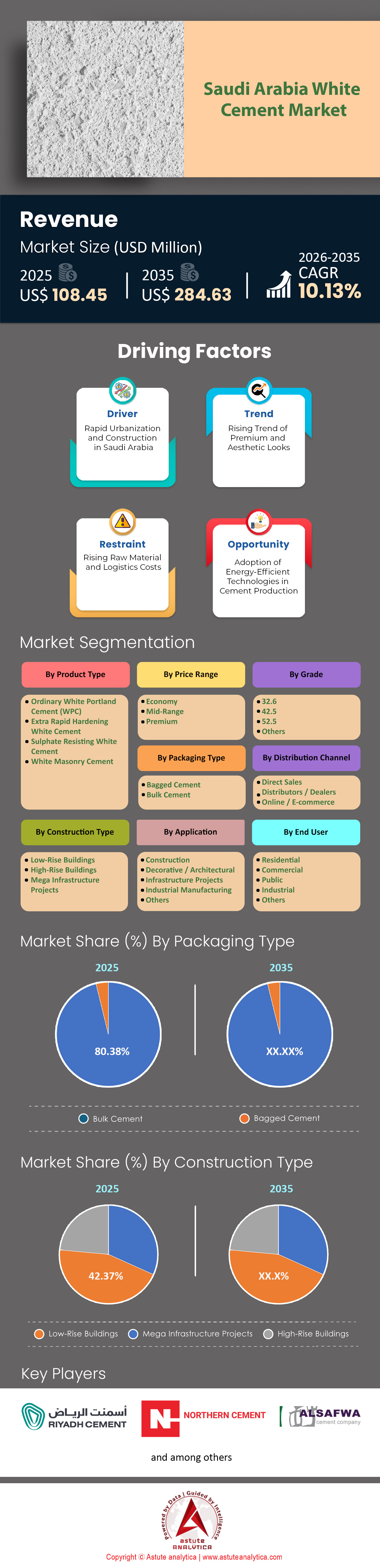
Saudi Arabia white cement market size was valued at USD 108.45 million in 2025 and is projected to hit the market valuation of USD 284.63 million by 2035 at a CAGR of 10.13% during the forecast period 2026–2035.
Key Market Insights
- Based on grade, white cement with 42.50 are the dominant grade in Saudi Arabia white cement market as it control nearly 49% market share
- Based on packaging, bulk packing is leading the market with over 80% market share.
- Based on construction, it has been found that over 42.37% of the white cement is consumed for construction of low rise building in the country.
- Based on price range, mid-range white cement category is currently dominating the Saudi Arabia white cement market with over 45.88% market share.
- Based on application, nearly 48% of the white cement is mainly used for construction application.
- Based on end users, residential users accounted for 43.11% market share.
- Based on distribution channel, distributors accounts for 55% market share.
As of 2026, the Saudi Arabia white cement market has fully transitioned from a niche architectural commodity to a foundational material, fundamentally driven by the aggressive execution of Vision 2030 infrastructure mandates. Operating within a tightly controlled oligopolistic landscape, the valuation of white cement is highly insulated from the extreme cyclicality and price wars typically seen in the standard Ordinary Portland Cement (OPC) sector.
Based on Q1 2026 granular supply-side capacity audits and demand-side consumption modeling, the market has reached an estimated valuation of USD 108.45 Million. This reflects a premium valuation dynamic driven by a high-margin product mix. Annual volume consumption currently stands at approximately 1.62 Million Metric Tons (MMT).
Furthermore, the domestic production ecosystem is operating at peak efficiency. The total installed clinker capacity across the Kingdom’s top producers remains relatively capped at roughly 2.1 MMT. Consequently, the Capacity Utilization Rate (CUR) has tightened to a robust 77% in 2026, up significantly from 68% in 2022. This market expansion is directly correlated with a structural shift in Saudi building codes, which now heavily favor reflective, high-albedo architectural materials to mitigate urban heat islands in mega-developments.
To Get more Insights, Request A Free Sample
What Macro-Economic and Operational Risks Threaten the KSA White Cement Market?
Despite the aggressive growth trajectory and premium pricing, a granular, veteran analysis of the market must acknowledge the systemic macroeconomic and operational risks looming over the sector in 2026.
The most prominent vulnerability is Project Phasing Risk. If sovereign-backed Giga-projects experience timeline extensions, budget re-scoping, or phased scaling (as recently observed in specific sub-phases of The Line), the anticipated hyper-demand for white cement could temporarily stall. This would rapidly trigger domestic overcapacity, forcing the three major producers into margin-destroying price wars to secure the remaining available contracts.
Furthermore, the Saudi Arabia white cement market remains highly exposed to external input shocks. Any accelerated removal of remaining government industrial energy subsidies poses a direct threat to the current 38% profit margins, given the massive natural gas requirements of the kilns. Finally, a persistent, downstream operational bottleneck exists in the form of skilled labor deficits. The high-end installation of white-cement-based GRC panels and complex Terrazzo surfaces requires specialized, artisanal labor. A shortage of imported, highly skilled installers can throttle actual consumption rates, leaving millions of riyals of premium white cement idling in silos.
How Are Vision 2030 Giga-Projects Accelerating White Cement Consumption?
The narrative of the Saudi white cement market in 2026 is virtually indistinguishable from the progress of the sovereign-backed Giga-projects. The Public Investment Fund (PIF) has established localized procurement mandates that are driving unprecedented, multi-year consumption cycles for high-grade aesthetic materials.
At the forefront is NEOM, encompassing The Line, Sindalah, and Trojena. The fundamental architectural blueprint of NEOM relies heavily on high-albedo, sunlight-reflecting surfaces to drastically minimize the cooling loads of its futuristic structures. Granular procurement data indicates that NEOM alone is absorbing approximately 220,000 Metric Tons of white cement annually in 2026.
Simultaneously, Red Sea Global and AMAALA, billed as ultra-luxury, regenerative tourism destinations, are utilizing white cement blended with localized aggregates to create environmentally integrated, unpainted concrete facades. These specialized white concrete blends in the white cement market are engineered to resist severe coastal salt-air corrosion without degrading aesthetically. Further inland, the Diriyah Gate project in Riyadh—while heavily reliant on traditional Najdi mud-brick aesthetics—requires massive underlying volumes of white masonry cement to ensure modern structural integrity without compromising the historical, light-earth color palettes of the mortar joints.
Who Dominates the Oligopolistic Saudi White Cement Market?
The domestic white cement manufacturing sector is characterized by notoriously high barriers to entry. The massive capital expenditure required for specialized, high-temperature kilns, combined with the scarcity of highly pure raw materials, has created a geographic oligopoly. In 2026, three formidable players control over 95% of the domestic production output.
The legacy market leader is the Saudi White Cement Co. (SWCC), strategically headquartered in Riyadh. Operating with an installed capacity exceeding 1 MMT, SWCC commands a dominant 48% domestic market share. Their primary competitive moat is their geographic proximity to the central region's relentless demand and their deeply entrenched, long-term supply contracts with the Kingdom's largest GRC pre-casters.
Acting as the critical swing producer in the Saudi Arabia white cement market is Riyadh Cement Company (formerly holding the Saudi Kayan legacy assets). Equipped with a highly advanced dual-capacity setup capable of switching production lines between standard grey and white clinker based on real-time market economics, Riyadh Cement comfortably holds roughly 32% of the market. The remaining 15% to 20% share is captured by Al Safwa Cement Co., which is strategically positioned in the Western Region (Jeddah). Al Safwa holds a distinct logistical monopoly in supplying the Red Sea coastal Giga-projects and dominates the lucrative export routes via the Jeddah Islamic Port.
What Are the Current Price Dynamics and Profit Margins per Ton in Saudi Arabia White Cement Market?
The pricing elasticity of white cement in the Kingdom is notably rigid, its unique architectural and chemical properties make it indispensable, allowing producers to pass price hikes directly onto mega-project contractors.
In the 2026 B2B procurement landscape, the Ex-Factory Bulk Price ranges tightly between SAR 850 and SAR 920 per Metric Ton. For smaller-scale contractors relying on retail, the 50kg bagged price translates to roughly SAR 1,050 to SAR 1,200 per MT, heavily dependent on regional distributor markups. To contextualize this premium, standard Ordinary Portland Cement (OPC) currently hovers around SAR 210 to SAR 240 per MT. Consequently, white cement commands a staggering 3.5x to 4x price multiplier over standard grey cement.
Despite these premium prices, profit margin economics are undergoing a period of recalibration across the white cement market. Historically, gross margins for local producers ranged comfortably between 40% and 45%. However, in 2026, these margins are facing slight compression down to the 38% range. This is primarily due to the KSA government's strategic, phased reduction of heavy fuel oil (HFO) subsidies. Because the calcination of white clinker requires extreme kiln temperatures of approximately 1,500°C—significantly higher than grey cement—energy remains the single largest variable expense. The transition toward market-rate natural gas has forced producers to optimize their thermal efficiency to protect bottom lines.
How Do Bottlenecks in Supply Chain and Logistics Impact Saudi Arabia White Cement Market Distribution?
Moving a sensitive, high-value powdered commodity across a geographical expanse the size of Western Europe presents severe logistical hurdles, turning transportation into a major geographic pricing lever.
The most critical bottleneck in 2026 is the Tabuk/NEOM logistical corridor. With the majority of the Kingdom’s white cement kilns deeply rooted in the Central (Riyadh) and Western (Jeddah) regions, transporting bulk powder to the Northwestern quadrant incurs heavy freight premiums. Dedicated trucking fleets add an estimated SAR 120 to SAR 150 per MT to the landed cost at NEOM sites.
Furthermore, the B2B supply chain across the country’s white cement market has witnessed a structural evolution in handling. Major tier-one contractors, such as Nesma & Partners and El Seif Engineering, have virtually abandoned traditional 50kg palletized bagging for their mega-projects. Instead, there has been a massive shift toward specialized pneumatic bulk silo trucks delivering directly to on-site computerized GRC batching plants. This logistical upgrade has reduced material wastage by up to 8% and drastically minimized the onsite manual labor required for mixing, a critical efficiency gain in the current tight labor market.
Are Local Raw Materials Sufficient to Sustain White Clinker Production?
To achieve a Hunter L optical value exceeding 90%, manufacturers cannot simply mine standard limestone. The raw meal formulation requires a highly specific, ultra-pure chemical composition, which ultimately dictates where white cement plants can viably operate.
While Saudi Arabia possesses globally significant reserves of high-calcium limestone (>97% CaCO3), discovering deposits where the natural Iron Oxide (Fe2O3) content is below the critical threshold of 0.05% is geologically challenging. Producers are heavily reliant on very select, tightly guarded quarries located in the central Najd plateau.
Furthermore, the domestic white cement market’s supply chain faces hurdles with silica and kaolin sourcing. The relative lack of high-purity, iron-free domestic clay forces producers to supplement their raw mix by importing high-grade kaolin from specialized mining sites in Egypt and Jordan. This reliance exposes the supply chain to marginal raw material price volatilities and cross-border freight fluctuations. In tandem, the fuel sourcing transition is actively shaping product quality; by 2026, top-tier kilns have fully transitioned from HFO to natural gas. Gas combustion produces significantly fewer soot particles, practically eliminating ash contamination within the kiln and ensuring maximum whiteness of the final clinker.
What is KSA's Position in GCC Trade Flows: Importer or Dominant Exporter in White Cement Market?
Despite the massive domestic consumption surge from Vision 2030, Saudi Arabia has successfully leveraged its manufacturing scale to solidify its status as a net exporter of white cement within the wider MENA region.
Due to superior production economies of scale and access to relatively subsidized energy (even factoring in post-reform rates), KSA manufacturers export approximately 250,000 to 300,000 MT of white clinker and finished cement annually in 2026. The primary export arteries flow directly into the UAE—specifically fueling Dubai's ultra-luxury coastal real estate sector—as well as Bahrain, Kuwait, and increasingly, post-conflict urban reconstruction zones in the Levant that demand high-quality finishing materials.
On the import side, Saudi Arabia white cement market maintains a highly protectionist stance. While the Kingdom does occasionally import ultra-specialty white cements (such as Aalborg White from Denmark) strictly for niche, ultra-high-strength architectural applications, bulk imports are virtually non-existent. Strict import tariffs and aggressive anti-dumping regulations effectively neutralize the threat of cheaper, lower-quality white cement flooding the market from overcapacitated producers in Egypt or Turkey.
How is the "Green Cement" Push Redefining High-Temperature Calcination in the Saudi Arabia White Cement Market?
Because of its extreme calcination temperature, white cement is notoriously carbon-intensive, presenting a direct conflict with the Saudi Green Initiative’s mandate to reach Net Zero by 2060. To maintain their preferred vendor status for PIF-backed mega-projects, the industry in 2026 is undergoing a rapid, capital-intensive technological overhaul.
The most immediate strategy deployed is the aggressive formulation of Blended White Cements (CEM II and CEM III). Producers are actively diluting the clinker factor by blending pure white clinker with finely milled white limestone powder, high-purity metakaolin, and specially processed light-colored slag. This metallurgical pivot reduces the CO2 emissions per ton by up to 20% while maintaining the requisite structural strength and optical whiteness required for dry-mix mortars and adhesives.
Simultaneously, the industry is entering the early stages of Carbon Capture, Utilization, and Storage (CCUS) integration. Leading plants, heavily subsidized by PIF-backed green technology funds, are piloting flue-gas capture systems. Successfully decarbonizing white cement is no longer just an environmental PR exercise; in 2026, possessing a low-carbon product line is a mandatory prerequisite to bidding on the next phase of green procurement contracts for NEOM and the Red Sea Project.
Segmental Analysis
By Grade: Why Does the 42.50 Grade Dominate the Saudi White Cement Market?
In the highly technical landscape of the Saudi Arabian construction sector, the specific compressive strength of building materials dictates their commercial viability. Based on 2026 procurement analytics, the 42.50 N/R grade has emerged as the undisputed workhorse of the white cement market, capturing a commanding 49% market share. While the ultra-high-strength 52.50 grade remains indispensable for highly specialized, fast-tracked mega-project facades, the 42.50 grade hits the absolute optimal intersection of structural performance, workable setting time, and cost-efficiency for the broader domestic market.
This dominance is driven by the metallurgical versatility of the 42.50 grade. It provides sufficient compressive strength to meet the rigorous safety and durability mandates of the Saudi Building Code (SBC) for non-load-bearing architectural elements, while simultaneously offering a more forgiving curing window in the Kingdom's extreme ambient heat compared to the rapid-setting 52.50 grade. Contractors heavily favor the 42.50 classification for the mass production of Glass-Fiber Reinforced Concrete (GRC) panels, high-end Terrazzo flooring matrices, and premium dry-mix tile adhesives. For procurement officers managing vast supply chains for residential and commercial developments, standardizing their purchasing around the 42.50 grade eliminates the need to silo multiple cement types on-site, thereby streamlining logistics and mitigating the risk of cross-contamination during batch mixing.
By End User: Why Do Low-Rise Buildings Consume Over 42% of the Kingdom's White Cement Market?
It has been found that over 42.37% of all white cement consumed in Saudi Arabia is deployed in the construction of low-rise buildings. To a casual observer, the Kingdom's skyline is defined by towering commercial skyscrapers in Riyadh and Jeddah, but the actual volume consumption of architectural white cement tells a highly localized, horizontal story. High-rise commercial towers typically rely on structural steel, standard Ordinary Portland Cement (OPC) cores, and prefabricated glass or aluminum curtain walls, relegating white cement to interior lobbies or ground-level plazas.
In stark contrast, the low-rise sector depends heavily on white cement for its aesthetic identity. This sector includes luxury private villas and expansive sovereign-backed residential communities such as ROSHN. It also covers low-density luxury resorts along the Red Sea and Diriyah Gate.
White cement is essential to achieving the clean, premium look these projects demand across the Saudi Arabia white cement market. In low-rise architecture, the exterior facades, perimeter boundary walls, intricate geometric parapets, and hardscaping are entirely visible and highly interactive at the human eye level. To achieve the mandated high-albedo (heat-reflecting) properties and the traditional, unpainted Najdi or contemporary Islamic aesthetic, massive volumes of white cement are blended into exterior stuccos, decorative precast panels, and pigmented mortars. This 42.37% market share highlights a pivotal reality for manufacturers: the sustained profitability of the white cement sector is intrinsically tethered to horizontal urban sprawl and the Kingdom's ongoing drive to elevate the aesthetic quality of its burgeoning residential housing stock.
By Price Range: What is Driving the Dominance of the Mid-Range Pricing Category at 45.88%?
In white cement market often characterized by ultra-luxury mega-projects, the pricing dynamics of white cement reveal a highly pragmatic procurement strategy among Saudi contractors. As of 2026, the mid-range price category has firmly established itself as the dominant financial segment, controlling an impressive 45.88% of the total market share. This segment perfectly encapsulates the "value engineering" matrix that defines modern B2B construction procurement, bridging the gap between exorbitant ultra-premium imports and subpar, low-grade domestic alternatives.
The mid-range category typically encompasses domestically produced white cement that boasts a highly respectable Hunter L whiteness index of 85% to 89%, combined with reliable 42.50 N/R structural integrity. For the vast majority of applications in the white cement market—such as formulating colored tile adhesives, foundational layers for Terrazzo, and structural white masonry where the concrete will eventually be lightly pigmented or texturized—paying the steep 15% to 20% premium for ultra-white (Hunter L > 90%) is an unnecessary capital expenditure. Procurement managers aggressively target this mid-range tier to optimize their project CapEx without falling afoul of the Saudi Standards, Metrology and Quality Organization (SASO) quality mandates. For local oligopoly players like Saudi White Cement Co. and Riyadh Cement Company, this 45.88% segment represents their most lucrative and stable revenue stream, allowing them to achieve massive economies of scale in their kilns without the exponentially higher energy costs required to burn ultra-pure, zero-iron clinker.
Customize This Report + Validate with an Expert
Access only the sections you need—region-specific, company-level, or by use-case.
Includes a free consultation with a domain expert to help guide your decision.
By Packaging: By How Has Bulk Packaging Captured Over 80% of the Market Share?
The logistical architecture of the Saudi white cement market has undergone a radical transformation, moving decisively away from traditional retail methodologies to highly industrialized, B2B supply chains. By 2026, bulk packaging has achieved an overwhelming dominance, controlling over 80% of the market share. The era of relying heavily on 50kg palletized paper bags has been eclipsed by the sheer scale and efficiency demands of Vision 2030 infrastructure initiatives. Today, the movement of white cement is defined by specialized pneumatic bulk silo trucks delivering directly to enclosed, computerized batching plants located directly on or adjacent to mega-project sites.
This massive shift toward bulk procurement is fundamentally rooted in operational economics and environmental compliance of the Saudi Arabia white cement market. Tier-one contracting firms such as Saudi Binladin Group and El Seif Engineering prioritize bulk silos because they drastically reduce material wastage, which historically hovered around 5% to 8% due to bag breakage, moisture ingress, and residue left in paper packaging. Furthermore, eliminating physical bags severely cuts down on the intensive manual labor required to open and load cement into mixers—a critical efficiency gain in an increasingly tight and highly regulated expatriate labor market.
From a regulatory standpoint, bulk pneumatic transfers align perfectly with the stringent dust-control and environmental mandates enforced by the Ministry of Environment, Water and Agriculture (MEWA), preventing localized airborne particulate pollution during the mixing of architectural concrete. The remaining sub-20% of the market relying on bagged cement is now strictly confined to retail distribution for localized masonry repairs and boutique architectural renovations.
To Understand More About this Research: Request A Free Sample
Top Companies in the Saudi Arabia White Cement Market
- Al Rashed Group
- Al Safwa Ltd
- Riyadh Cement
- Northern Cement Company
- Other Prominent Players
Market Segmentation Overview
By Product Type
- Ordinary White Portland Cement (WPC)
- Extra Rapid Hardening White Cement
- Sulphate Resisting White Cement
- White Masonry Cement
By Grade
- 32.6
- 42.5
- 52.5
- Others
By Packaging Type
- Bagged Cement
- Bulk Cement
By Constriction Type
- Low-Rise Buildings
- High-Rise Buildings
- Mega Infrastructure Projects
By Proce Range
- Economy
- Mid-Range
- Premium
By Application
- Construction
- Decorative / Architectural
- Infrastructure Projects
- Industrial Manufacturing
- Others
By End User
- Residential
- Commercial
- Public
- Industrial
- Others
By Distribution Channel
- Direct Sales
- Distributors / Dealers
- Online / E-commerce
FREQUENTLY ASKED QUESTIONS
Saudi Arabia white cement market size was valued at USD 108.45 million in 2025 and is projected to hit the market valuation of USD 284.63 million by 2035 at a CAGR of 10.13% during the forecast period 2026–2035.
White cement commands a 3.5x to 4x price premium over standard grey cement. This is due to the scarcity of high-purity raw materials (limestone with <0.05% iron oxide), highly controlled grinding processes, and calcination temperatures requiring ~1,500°C, which consumes substantially more fuel.
The market is an oligopoly dominated by three main players: Saudi White Cement Co. (holding roughly 48% of the market), Riyadh Cement Company (32%), and Al Safwa Cement Co. (15-20%).
Giga-projects like NEOM, Red Sea Global, and Diriyah Gate are aggressively procuring white cement for its high-albedo (heat reflecting) properties and high-end aesthetic finish. NEOM alone is estimated to consume over 220,000 MT annually for precast architectural facades and glass-fiber reinforced concrete (GRC).
Manufacturers and importers must strictly comply with SASO-GSO-EN-197-1 standards and the Saudi Building Code (SBC). These regulations mandate rigorous testing for compressive strength (primarily 52.5 N/R grades) and guarantee a minimum Hunter L (whiteness index) threshold.
Yes, Saudi Arabia is a net exporter in global white cement market. Benefitting from scale and relatively stable energy costs, KSA exports approximately 250,000 to 300,000 MT annually, primarily supplying the UAE, Bahrain, Kuwait, and other MENA region markets.
LOOKING FOR COMPREHENSIVE MARKET KNOWLEDGE? ENGAGE OUR EXPERT SPECIALISTS.
SPEAK TO AN ANALYST
.svg)
 Schedule a Meeting

Features | Type of License | ||||
 Data Book | Single User |   Multi User |  Corporate | ||
| e-Access | ✓ | ✓ | ✓ | ✓ | |
User Sharing | 1 User Only | 1 User Only | Up to 7 Users | Unlimited User Access | |
⨉ | ⨉ | ⨉ | ✓ | ||
Free Customization | No Free Customization | Up To 30 hrs work | Up To 60 hrs work | Up To 80 hrs work | |
Deliverable |
| ⨉ | ✓ | ✓ | ✓ |
| ✓ | ⨉ | ✓ | ✓ | |
| ⨉ | ⨉ | ⨉ | ✓ | |
Analyst Support | 2-Months Analyst Support | 4-Months Analyst Support | 7-Months Analyst Support | One Year Analyst Support | |
Free Report update in next update cycle | ⨉ | ⨉ | ⨉ | ✓ | |
Free Industry Update (Within 180 days) | ⨉ | ⨉ | ⨉ | ✓ | |
Benefit | Up to 10% off on Post Purchase | Up to 20% off on Post Purchase | Up to 30% off on Post Purchase | Up to 40% off on Post Purchase | |