Market Snapshot
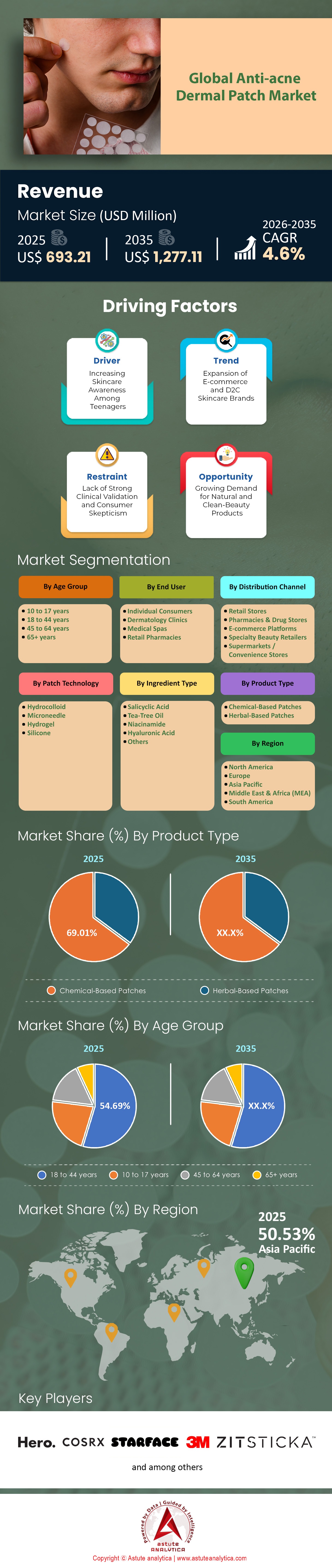
Anti-acne dermal patch market was valued at US$ 693.21 million in 2025 and is projected to hit the market valuation of US$ 1,277.11 million by 2035 at a CAGR of 4.6% during the forecast period 2026–2035.
Key Market Insights
- Based on product, chemical-based patches are set to generate the highest 69.01% market share.
- Based on patch technology, hydrocolloid is controlling over 55.84% market share.
- Based on age group, 18 to 44 years are the key and target consumers with more than 54.69% market revenue coming from this age group.
- Based on end users, individual consumers are the most prominent end users of the anti-acne dermal patches.
- Based on distribution channel, over 38.65% products are sold through e-commerce platforms.
- Asia Pacific is set to remain the largest regional market for anti-acne dermal patch with over 50.53% revenue contribution to global market.
The Anti-Acne Dermal Patch market is transitioning from a trend-driven novelty to a staple of the global skincare regimen. Success in the coming decade will rely on navigating the regulatory complexities of "active" microneedle delivery systems and leveraging the social commerce engines of TikTok and Instagram. For stakeholders, the value lies not in the patch itself, but in the efficiency of the delivery system it represents.
The Global Anti-Acne Dermal Patch market has transcended its origins as a niche K-Beauty import to become a dominant category within the wider Over-the-Counter (OTC) skincare sector. As of 2025, the market is no longer driven solely by efficacy, it is driven by the "accessory-fication" of acne treatment.
Key Strategic Takeaway
As per Astute Analytica, the market is bifurcating. One stream is moving toward commoditized, low-cost hydrocolloid patches (price wars), while the other is moving toward "clinical-grade" home solutions using dissolving microneedles. Stakeholders must decide whether to compete on volume (via TikTok Shop/Amazon) or technological efficacy (via Sephora/Dermatologists).
The "Lipstick Effect" in Acne Care:
Interestingly, the anti-acne dermal patch market has shown resilience against economic downturns, exhibiting the classic "Lipstick Effect." Consumers may forego expensive laser treatments or dermatologist visits during a recession, but they will continue to purchase $15 patch packs as an "affordable luxury" that offers immediate, visible gratification.
To Get more Insights, Request A Free Sample
How Do Regulatory Frameworks Impact Market Entry?
USA (FDA Regulations):
Non-medicated hydrocolloid patches in the global anti-acne dermal patch market are generally Class I Medical Devices (Wound Dressings) under product code KMF.
However, patches containing Salicylic Acid (0.5% - 2%) are regulated under the OTC Monograph for Acne Drug Products (21 CFR Part 333). This distinction is critical because "Drug" classification requires establishment registration, listing with the FDA, and strict adherence to Good Manufacturing Practices (GMP), creating a high barrier to entry for small indie brands attempting to launch "medicated" versions without significant capital.
EU (MDR Compliance) in the Anti-Acne Dermal Patch Market:
Under the new Medical Device Regulation (MDR), classification has become stricter, often requiring clinical evaluation reports even for Class I devices if they claim a specific medical benefit beyond simple protection.
Many brands are circumventing this by marketing their patches strictly as "Cosmetics" in the EU (avoiding claims like "heals acne" and using "improves appearance of skin"), but this limits their ability to compete on efficacy against established pharmaceutical brands.
Which Growth Vectors and Restraints are Steering Global Momentum?
What is the "Destigmatization" Driver?
The single biggest growth vector in the anti-acne dermal patch market is the psychological shift led by brands like Starface and Squish Beauty. By turning acne patches into bright yellow stars or floral shapes, the product moved from the medicine cabinet (hidden) to the face (public/social media).
This phenomenon has fundamentally altered the "usage occasions" metric, a consumer no longer waits for a severe, painful breakout to apply a patch overnight, but now wears them preventatively or aesthetically during the day ("Face Jewelry"), significantly increasing the Volume per User (VPU) and shortening the replenishment cycle.
How Does Manufacturing Complexity Act as a Restraint for the Anti-Acne Dermal Patch Market growth?
While demand for microneedles is high, the barrier to entry is the manufacturing yield and mold durability. Producing consistent, sharp microneedle arrays that do not break during the de-molding process requires sophisticated technologies.
High rejection rates in manufacturing (often exceeding 15% in lower-tier facilities) keep the Unit Economics (COGS) high. Furthermore, the hygroscopic nature of dissolving needles means they must be packaged in rigorous moisture-barrier foil pouches with desiccants, any breach in packaging integrity ruins the product, adding a layer of supply chain complexity that does not exist for flat hydrocolloid patches.
Why is Male Grooming a Critical Opportunity?
Data indicates a surge in male consumers purchasing acne patches, driven by the "utility" aspect of the product. Unlike concealers or creams, which carry a stigma of "makeup" for some male demographics in the anti-acne dermal patch market, patches are viewed as "tools," "tech," or "bandages."
Brands like Hero Cosmetics have capitalized on this by utilizing gender-neutral branding (medical blue and white aesthetics) and avoiding "beauty" terminology, successfully positioning the patch as a hygiene necessity rather than a cosmetic enhancement, thereby unlocking 50% of the population that was previously dormant.
Why Does Technology Architecture Dictate Market Winners?
This section analyzes the "Moat" surrounding patch technology, which serves as the primary differentiator in a crowded market.
How Has Hydrocolloid Technology Evolved?
The barrier to entry in the anti-acne dermal patch market for generic hydrocolloid is low, but the differentiation lies in the Polyurethane (PU) film backing and the beveling process.
The current market standard has shifted toward "beveled edges" (thinner at the rim, thicker in the center). This manufacturing technique is crucial because it prevents the patch from rolling up when it rubs against pillows or clothing, and it creates a seamless transition on the skin that makes the patch virtually invisible under makeup—a key selling point for the "daytime wear" segment.
What Are The Specifics of Microneedle (MN) Molding?
This is the high-value IP segment of the anti-acne dermal patch market where the future battles will be fought.
- Solid vs. Hollow: The market is dominated by solid, dissolving needles because hollow microneedles (used for vaccines/insulin) are prohibitively expensive ($10+ per unit) to manufacture for consumer goods.
Molding Techniques:
- Centrifugal Lithography: Uses centrifugal force to pull the viscous polymer into the mold tips. This method is highly accurate but slower and difficult to scale for mass retail.
- Droplet-born Air Blowing (DAB): A newer technique where the polymer is dispensed and then shaped via air blowing. This allows for faster production times and cooler temperatures, which protects heat-sensitive active ingredients (like Retinol or Vitamin C) from degrading during the manufacturing process.
Brands across the anti-acne dermal patch market investing in proprietary MN geometry—specifically needles with a higher aspect ratio (length vs. width) to penetrate deeper into cystic nodules—will command higher margins than those white-labeling standard, shorter arrays that only treat surface-level whiteheads.
Which Ingredient Formulations Are Driving Clinical Efficacy in Anti-Acne Dermal Patch Market?
The market is moving beyond simple "sucking out the gunk" (passive) to active treatment modulation.
Why is Salicylic Acid Still The Gold Standard?
The most common active ingredient is Beta Hydroxy Acid (Salicylic Acid). Formulations typically range from 0.5% (sensitive skin/regulatory floor) to 2% (maximum strength).
However, the challenge lies in crystallization, high concentrations of Salicylic Acid can crystallize within the microneedle matrix during the drying process, rendering the needle brittle and the ingredient less bioavailable. Advanced formulations now use encapsulation technologies (like cyclodextrins) to keep the acid stable and soluble, ensuring it releases effectively upon penetrating the skin's moisture-rich environment.
How is the "Clean & Soothing" Trend Impacting R&D?
- Centella Asiatica (Cica): Riding the K-Beauty wave, Cica is added for its triterpenoids (asiaticoside, madecassoside), which stimulate collagen synthesis and reduce inflammation. This is particularly vital for patches targeting the erythema (redness) associated with acne, offering a dual benefit of treatment plus immediate visual calming, which appeals heavily to consumers with sensitive or rosacea-prone skin.
- Niacinamide: Increasingly added to patches targeting Post-Inflammatory Hyperpigmentation (PIH), or the dark spots left behind after the zit is gone.
What Are The Emerging Bio-Actives in the Anti-Acne Dermal Patch Market?
- Oligopeptide-76: An antimicrobial peptide that targets Cutibacterium acnes bacteria.
- Retinol: Micro-dosed retinol patches for older consumers dealing with adult acne.
Who Dominates The Competitive Landscape and Market Share?
Who Are The Tier 1 Giants?
- Hero Cosmetics (Church & Dwight): The Western market leader in the anti-acne dermal patch market leverages retail distribution dominance through an “SKU Proliferation” strategy—offering variants like Mighty Patch Original, Invisible, Surface, Micropoint, and Face to cover every acne stage and block competitors by occupying shelf space under one brand umbrella.
- COSRX: The K-Beauty giant. Dominates the "cult favorite" segment and Amazon sales. COSRX wins on "Value Density." They offer larger pack sizes at lower price-per-patch ratios than US competitors, using their proximity to Korean manufacturing hubs to minimize supply chain costs and pass savings to consumers.
- 3M (Nexcare): The legacy player. They invented the technology (originally for medical wounds). However, 3M has failed to capture the Gen Z cultural zeitgeist. Their packaging is clinical and "un-instagrammable." They remain a staple in pharmacies but have lost the digital native demographic to brands like Starface and Hero.
Who Are The Tier 2 Disruptors?
- Starface: The branding genius holding the "Face Jewelry" niche.
- ZitSticka (Acquired by Heyday): The technology leader popularizing the microneedle patch for cystic acne.
How Are Supply Chain Vulnerabilities Impacting Production Cycles at Global Anti-Acne Dermal Patch Market Level?
Why is the OEM/ODM Model a Risk?
Very few brands manufacture in-house, the industry relies heavily on Contract Manufacturers. Supply chain concentration risk is critically high. A disruption in the supply of medical-grade Carboxymethyl Cellulose (CMC)—the primary gelling agent in hydrocolloids—from major chemical suppliers can halt production for 60% of global brands simultaneously.
How Are Raw Material Sourcing Strategies Shifting in the Anti-Acne Dermal Patch Market?
- Hydrocolloid Grading: Sourcing involves choosing between medical-grade (hypoallergenic, sterilized) and industrial-grade adhesives.
- Release Liners: The backing paper is a surprisingly complex component. There is a global shortage of high-quality, perforated release liners that allow for the "easy peel" experience. Poor-quality liners make patches fold during removal, causing a 10–15% waste rate and driving many negative Amazon reviews.
What Are The Unit Economics and Pricing Elasticities Driving Profitability?
This section provides granular financial insights for investors in the Anti-acne dermal patch market.
What is the Cost Structure of Hydrocolloid?
- Est. COGS (per patch): $0.01 - $0.03.
- Retail Price (per patch): $0.30 - $0.50.
- Gross Margin: ~90%+.
What are the Economics of Microneedle Patches?
- Est. COGS (per patch): $0.25 - $0.40.
- Retail Price (per patch): $2.50 - $3.50.
- Gross Margin: ~85%.
While margins are slightly lower due to manufacturing complexity (molding, drying times, sterilization), the Absolute Dollar Profit per unit is 10x higher than hydrocolloid.
Where Will The Next Wave of Technological Disruption Originate in Global Anti-Acne Dermal Patch Market?
Can Patches Be Diagnostic?
The next frontier is diagnostics. Prototypes exist for patches that change color based on the pH of the skin or the presence of specific bacteria.
Will 3D Printing Enable Hyper-Personalization?
As 3D printing speed increases, we foresee a future of "On-Demand" manufacturing. Consumers could scan their face via a smartphone app (using LiDAR), and a custom pattern of patches—mapped exactly to their breakout zones—would be printed and shipped.
What is the "Post-Biotic" Revolution?
Moving beyond killing bacteria, future patches will aim to restore the skin microbiome. Instead of sterile patches, the anti-acne dermal patch market is likely to see patches infused with live probiotics or post-biotic ferments (like Lactobacillus ferment).
Segmental Analysis
By Age Group, Who Are The Core Consumers and What Drives Their Purchasing Psychology?
As per Astute Analytica, consumers in the 18-44 years are controlling the largest 54.69% revenue share of the global anti-acne dermal patch market. following is the in depth analysis of the consumer class for better understanding of the market trend and consumption pattern by age group.
Why is Gen Z (Ages 12-27) The Volume Driver?
For Gen Z, the patch is a status symbol and a content creation tool. They prefer aesthetics (shapes, holographics) and high-volume packs. Their purchasing psychology is driven by "Social Proof", they are more likely to buy a brand they saw a TikTok influencer wear than a brand recommended by a dermatologist. Furthermore, they are highly price-elastic regarding per-unit cost, often calculating the "price per patch" and opting for brands that offer 30+ counts for under $15.
What Do Millennials (Ages 28-43) Seek?
Millennials suffer largely from hormonal or stress-induced acne (often deeper and cystic) in the anti-acne dermal patch market. They prefer discretion (invisible, matte-finish) and technology.
This demographic has higher disposable income and is the primary consumer of Microneedle Patches. They view the product as a medical intervention and are willing to pay a premium ($15+ for 6 patches) for arrays that target "blind pimples" (cysts that haven't surfaced), as they cannot afford to show up to professional environments with visible acne.
Why is the "Adult Acne" Segment Underserved?
Women aged 35+ are a rapidly growing demographic due to hormonal fluctuations (perimenopause). This group requires patches that address acne without drying out aging skin. Current market offerings often dry out the skin too aggressively for this demographic. There is a significant "White Space" opportunity for patches infused with Ceramides and Hyaluronic Acid that treat the breakout while simultaneously repairing the skin barrier.
By Distribution, Where Are Consumers Buying?
The route-to-market has shifted dramatically from traditional pharmacy aisles to algorithmic social commerce across the global anti-acne dermal patch market. Currently, the market is led by e-commerce as it accounts for over 38.65% of the global market share. Following analysis provides a deeper look at how the market is changing and moving from traditional model
How Has Social Commerce Changed The Funnel?
TikTok is no longer just for awareness, it is a direct Point of Sale (POS). "Pimple Popping" videos satisfy a psychological urge (grooming behaviors), and the immediate link to purchase a patch creates high conversion.
It has been found that brands that design their patches to make the absorbed exudate highly visible (opaque white on a clear background) perform significantly better on social commerce platforms than brands with opaque or colored patches where the result is hidden.
How Does Amazon Maintain Dominance in Anti-Acne Dermal Patch Market?
Amazon remains the volume king, but the marketplace is flooded with cheap, generic imports. Successful brands on Amazon utilize the "Subscribe & Save" mechanism to build a recurring revenue moat. Since acne is a chronic condition, the churn rate is lower than other beauty categories, brands that can get a user to subscribe to a monthly delivery of 30 patches effectively lock that customer out of the competitor ecosystem.
What is the "End-Cap" Strategy in Offline Retail?
Retailers across the global anti-acne dermal patch market like Ulta and Sephora are moving patches out of the "Acne Aisle" (where they sit next to harsh washes) and into "Impulse Buy" zones.
This is the "Grab-and-Go" strategy, treating acne patches like gum or candy at the checkout. Because the price point is accessible ($8-$15), it lowers the barrier to trial. Therefore, allowing consumers to toss a pack into their basket without significant deliberation. This, in turn, is increasing the retailer's Average Basket Size.
By Product Type, Which Formulations Are Winning the Efficacy War?
The "Medicalization" of skincare has driven a massive consumer shift toward active ingredients over passive treatments. Currently, Chemical-Based Patches dominate the global anti-acne dermal patch market, accounting for a commanding 69.01% market share. This dominance is not accidental; it is driven by the consumer demand for "Overnight Results" which only keratolytic agents can provide. The following analysis breaks down the mechanics of this dominance.
The market dominance is sustained by the widespread adoption of Salicylic Acid (Beta Hydroxy Acid) as the gold standard for acne treatment. Unlike herbal alternatives, chemical-based patches fall under OTC Drug regulations in major markets like the US (FDA Monograph), which allows brands to make stronger, legally defensible claims such as "treats acne" rather than just "soothes skin."
How is "Micro-Encapsulation" Solving the Irritation Paradox?
A critical barrier to growth for chemical patches in the anti-acne dermal patch market has been "Contact Dermatitis" caused by high concentrations of acid trapped against the skin.
Leading manufacturers are now utilizing Micro-Encapsulation Technology, where the Salicylic Acid is wrapped in a lipid or polymer shell that only breaks down upon contact with skin enzymes. This allows for a "Time-Release" delivery system, permitting brands to use higher concentrations (up to 2%) without causing the chemical burns associated with older generation patches.
Where Does the "Herbal" Segment Fit in a Chemical-Dominant World?
While chemical patches hold the volume, the remaining ~31% of the anti-acne dermal patch market (Herbal/Physical) is capturing the highest loyalty among the "Sensitive Skin" demographic.
Ingredients like Tea Tree Oil and Centella Asiatica (Cica) are not competing on speed; they are competing on "Barrier Repair." As the "Skin Barrier Health" trend explodes on social media (driven by over-exfoliation damage), we are seeing a strategic pivot where consumers use a Chemical Patch on Day 1 to kill the bacteria, and an Herbal Patch on Day 2 to heal the wound, suggesting the future is not substitution, but a "Two-Step" patch routine.
Customize This Report + Validate with an Expert
Access only the sections you need—region-specific, company-level, or by use-case.
Includes a free consultation with a domain expert to help guide your decision.
By Patch Technology, How Is The Manufacturing Landscape Evolving?
Despite the media buzz surrounding high-tech microneedles, Hydrocolloid Technology remains the undisputed volume leader in the anti-acne dermal patch market, accounting for the largest 55.84% market share. A standard hydrocolloid patch costs approximately $0.02 to manufacture, whereas a microneedle patch can cost upwards of $0.30. This price gap allows hydrocolloid brands to sell "Bulk Packs" (30-90 counts) for under $15, effectively acting as the "Daily Wear" option for consumers.
How is the "Beveled Edge" Manufacturing Process Increasing Retention?
The primary complaint with generic hydrocolloid patches is "Edge Lift"—where the patch peels off due to facial movement or sweat.
Market leaders dominating this 55.84% share have shifted from "Stamping" (cookie-cutter style) to "Liquid Casting" methods to create Beveled Edges. By making the patch measuring 0.1mm at the rim and 0.3mm at the center, the patch sits flush against the skin, becoming virtually invisible. Brands that have failed to upgrade their manufacturing lines to produce beveled edges are rapidly losing market share to competitors like Hero Cosmetics and COSRX who have standardized this feature.
To Understand More About this Research: Request A Free Sample
Regional Analysis of the Anti-Acne Dermal Patch Market
Asia Pacific Remain The Global Innovation Engine
Currently, Asia Pacific is the dominant region in the global market with over 50.53% market share.
Why is South Korea The "Foundry" of The Industry?
South Korea is to acne patches what Taiwan is to semiconductors. Approximately 75-80% of global OEM innovations originate here at the global anti-acne dermal patch market.
The ecosystem in Gyeonggi-do (a province in Korea) is dense with specialized manufacturers like Nicomed, Raphas, and Labottach. These ODMs (Original Design Manufacturers) own the patents for the most advanced hydrocolloid formulations and microneedle molding techniques, meaning that even top US brands are essentially marketing companies wrapping Korean IP in Western branding.
How is China Changing from Consumer to Competitor?
China represents a massive consumption anti-acne dermal patch market, but also a supply chain threat. Today, Chinese manufacturers are rapidly improving their hydrocolloid quality and undercutting Korean pricing by 20-30%. However, the regulatory hurdle of the NMPA (National Medical Products Administration) in China makes it incredibly difficult for foreign brands to sell into China without animal testing (though this is changing) or local manufacturing, effectively forcing global brands to partner with local distributors or face being locked out of the world's second-largest economy.
How is The North American Anti-Acne Dermal Patch Market Maturing Post-Consolidation?
North America holds the second largest revenue share (approx. 26.40%) and is the stage for major M&A activity.
What Did The "Hero Cosmetics" Acquisition Signal?
The acquisition of Hero Cosmetics by Church & Dwight for $630 million in 2022 (approx. 13x EBITDA) signaled the maturation of the market from "Indie" to "Institutional."
This acquisition provided Hero with the distribution muscle of a CPG giant, allowing them to penetrate mass-market grocery and convenience channels (Walmart, Kroger) that were previously inaccessible to niche beauty brands. It validated the category as a staple of personal care, akin to toothpaste or deodorant.
How Do Regulatory Barriers Protect Incumbents in the US Anti-Acne Dermal Patch Market?
The FDA's strict monitoring of "drug claims" prevents many Asian brands from entering the US market directly without reformulating.
To sell a "medicated" patch in the US, a brand must comply with the OTC Monograph, which limits the allowable active ingredients (Salicylic Acid, Benzoyl Peroxide, Sulfur, Resorcinol). Many innovative Korean patches use herbal actives or new peptides not listed in the monograph. To sell in the US, they must either remove these ingredients—reducing efficacy—or pursue a costly New Drug Application (NDA), which effectively protects established US brands.
What Regulatory Barriers Are Reshaping The European Landscape?
What is the Impact of the EU MDR?
Europe is slower to grow in the global anti-acne dermal patch market due to the Medical Device Regulation (MDR) which replaced the MDD. Classifying a patch as a medical device involves rigorous conformity assessments.
Specifically, Rule 4 of Annex VIII implies that invasive devices (like microneedles) have stricter classification rules. This has led to a bifurcation where microneedle patches are often marketed as "cosmetics" to avoid MDR costs, while hydrocolloid patches (which are non-invasive) are registered as Class I devices. Brands that fail to navigate this distinction risk having their products pulled from shelves by competent authorities in strict markets like Germany.
Why is Sustainability Non-Negotiable in the EU?
European consumers are the most vocal regarding waste, and the "Green Dot" compliance is just the baseline.
The standard patch consists of a PET (plastic) release liner, a plastic pouch, and a cardboard box. In the EU, brands are facing pressure to switch to perforated paper release liners and biodegradable pouches. Brands that launch in the UK or France without a clear "plastic reduction" strategy face significant backlash and delisting risks from retailers like Boots or Space NK who have strict sustainability charters.
Top Companies in the Anti-Acne Dermal Patch Market
- Peter Thomas Roth Labs LLC
- Rael
- ZitSticka
- 3M Company
- Starface
- DermaAngel
- Hero Cosmetics
- Sephora USA, Inc.
- Nurimedics Co., Ltd.
- Peach & Lily
- COSRX
- Alba Botanica
- Peace Out Skincare
- Other Prominent Players
Market Segmentation Overview
By Product Type
- Chemical-Based Patches
- Herbal-Based Patches
By Patch Technology
- Hydrocolloid
- Microneedle
- Hydrogel
- Silicone
By Ingredient Type
- Salicyclic Acid
- Tea-Tree Oil
- Niacinamide
- Hyaluronic Acid
- Others
By Age Group
- 10 to 17 years
- 18 to 44 years
- 45 to 64 years
- 65+ years
By End User
- Individual Consumers
- Dermatology Clinics
- Medical Spas
- Retail Pharmacies
By Distribution Channel
- Retail Stores
- Pharmacies & Drug Stores
- E-commerce Platforms
- Specialty Beauty Retailers
- Supermarkets / Convenience Stores
By Region
- North America
- The U.S.
- Canada
- Mexico
- Europe
- Western Europe
- The UK
- Germany
- France
- Italy
- Spain
- Rest of Western Europe
- Eastern Europe
- Poland
- Russia
- Rest of Eastern Europe
- Western Europe
- Asia Pacific
- China
- India
- Japan
- Australia & New Zealand
- South Korea
- ASEAN
- Rest of Asia Pacific
- Middle East & Africa (MEA)
- Saudi Arabia
- South Africa
- UAE
- Rest of MEA
- South America
- Argentina
- Brazil
- Rest of South America
FREQUENTLY ASKED QUESTIONS
The market is valued at around USD 693.21 million in 2025 and is projected to reach roughly USD 1277.11 million by 2035 at a CAGR of 6.48% from 2026–2035.
Hydrocolloid will remain the volume leader due to low COGS and bulk packs, while dissolving microneedle platforms, though costlier, deliver 10x higher absolute profit per unit and will anchor the premium, clinical-grade segment.
In the US, the acne OTC monograph and NDA pathway create high entry barriers for medicated and peptide-based patches; in the EU, MDR rules push brands to choose between strict medical device claims and lighter cosmetic positioning.
Destigmatization (face jewelry), social commerce on TikTok/Instagram, and the Lipstick Effect in recessions are lifting usage frequency, while male grooming and adult acne are unlocking underpenetrated demographics.
Heavy reliance on a few Korean and Chinese OEMs, sensitivity to CMC and liner shortages, and high microneedle rejection rates (>15% in weaker facilities) expose brands in the anti-acne dermal patch market to synchronized production disruptions and margin pressure.
Asia Pacific—especially South Korea and China—will remain the innovation and manufacturing hub, while e-commerce, TikTok Shop, and Amazon subscriptions drive global scale, with Sephora/Ulta and end‑caps supporting premium and impulse trial offline.
LOOKING FOR COMPREHENSIVE MARKET KNOWLEDGE? ENGAGE OUR EXPERT SPECIALISTS.
SPEAK TO AN ANALYST
.svg)

 Schedule a Meeting

Features | Type of License | ||||
 Data Book | Single User |   Multi User |  Corporate | ||
| e-Access | ✓ | ✓ | ✓ | ✓ | |
User Sharing | 1 User Only | 1 User Only | Up to 7 Users | Unlimited User Access | |
⨉ | ⨉ | ⨉ | ✓ | ||
Free Customization | No Free Customization | Up To 30 hrs work | Up To 60 hrs work | Up To 80 hrs work | |
Deliverable |
| ⨉ | ✓ | ✓ | ✓ |
| ✓ | ⨉ | ✓ | ✓ | |
| ⨉ | ⨉ | ⨉ | ✓ | |
Analyst Support | 2-Months Analyst Support | 4-Months Analyst Support | 7-Months Analyst Support | One Year Analyst Support | |
Free Report update in next update cycle | ⨉ | ⨉ | ⨉ | ✓ | |
Free Industry Update (Within 180 days) | ⨉ | ⨉ | ⨉ | ✓ | |
Benefit | Up to 10% off on Post Purchase | Up to 20% off on Post Purchase | Up to 30% off on Post Purchase | Up to 40% off on Post Purchase | |