Market Scenario
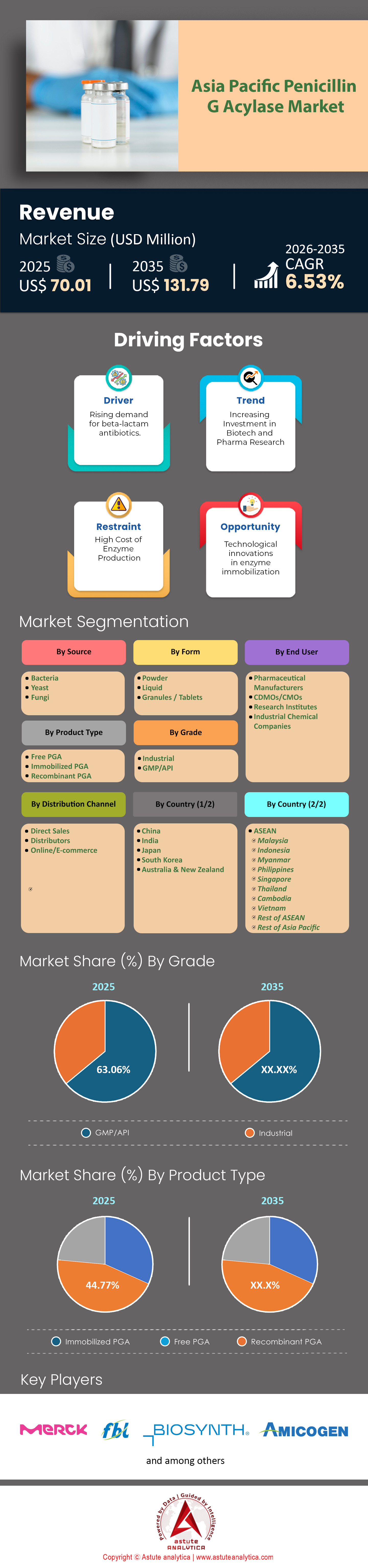
Asia Pacific penicillin G acylase market size was valued at USD 70.01 million in 2025 and is projected to hit the market valuation of USD 131.79 million by 2035 at a CAGR of 6.53% during the forecast period 2026–2035.
Key Findings
- Based on source, the Bacteria segment accounts for 56.21% market share.
- Based on product type, Immobilized PGA accounts for 44.71% market share.
- Based on form, the Powder segment accounts for 46.27% market share.
- Based on grade, the GMP/API segment accounts for 63.06% market share.
- Based on end users, the Pharmaceutical Manufacturers segment accounts for 52.70% market share.
- Based on distribution channel, the Direct Sales segment accounts for 62.48% market
- China is the dominant player, contributing 35.65% revenue to the Asia Pacific Penicillin G Acylase revenue.
Asia Pacific penicillin G acylase market production has transformed dramatically over two decades, evolving from fragmented chemical hydrolysis setups into sophisticated enzymatic fermentation mega-hubs. This shift directly empowers China’s Shandong and Hebei clusters—dominated by CSPC Pharmaceutical Group and North China Pharmaceutical Corp (NCPC)—to scale bioreactors from 50,000 liters to over 300,000 liters by 2025. Wherein, larger vessels boost E. coli expression yields to 8,000 U/L when fed cost-effective corn steep liquor (CSL), slashing per-unit enzyme costs by 25%.
Consequently, this infrastructure edge enables China to command 60% of global 6-APA supply, the key penicillin G acylase-derived intermediate for semi-synthetic penicillins. India's response through the PLI scheme commissions Lyfius-Qule's integrated 18,600 MT Pen-G/6-APA chain in Kakinada, leveraging local glucose but facing 15% yield shortfalls from imported strains.
These gaps force higher operational costs in the Asia Pacific penicillin G acylase market, yet PLI incentives drive Fermenta Biotech's Dahej enzyme park expansion (INR 110 crore, Dec 2025), targeting export-grade PGA. Ultimately, China's 280,000 MT regional output dwarfs India's 25,000 MT ramp-up, locking in supply chain leverage that pressures competitors to accelerate localization.
To Get more Insights, Request A Free Sample
CRISPR Strain Engineering and Immobilization Leaps Drive 25% Cost Reductions in Enzyme Production
China's E. coli strains now dominate 80% of penicillin G Acylase titers, with codon-optimized genes from United Laboratories achieving 12 g/L expression that cascades into sub-$5/kg pricing. This cost leadership in the Asia Pacific penicillin G acylase market stems from CSL's nitrogen richness, reducing feed expenses by 25% and enabling massive scale-up. In parallel, India's Fermenta innovates hybrid immobilization beads retaining 85% stability in organic solvents, bridging gaps left by imported Achromobacter strains. These advancements cut enzyme replacement needs by 40%, directly enhancing margins for 6-APA producers.
Japan's Amano Enzyme sets the purity benchmark with agarose matrices holding 98% activity over 1,000 hours at varying pH, which influences Korea's Hanwha adaptations for continuous ampicillin processing. The ripple effect amplifies in China’s CRISPR-edited PGA variants, resisting protease degradation to deliver 99.5% 6-APA purity and fortify export competitiveness. India's Qule Pharma trials magnetic nanoparticles for 50x recyclability further erode downtime by 40%, positioning domestic players to capture niche high-value segments.
Advanced Downstream Cascades Unlock 92% Yields Fueling $2B+ Beta-Lactam Export Flood
PGA hydrolysis efficiency ultimately dictates beta-lactam profitability, as China's fed-batch cascades convert 92% of Pen-G to 6-APA in 200m³ tanks equipped with high-throughput centrifugal separators. This setup in the Asia Pacific penicillin G acylase market yields 50 tons daily, flooding markets with low-cost intermediates and undercutting global rivals. India's Lyfius integrates ultrafiltration for 90% recovery rates, yet side-product inhibition caps yields at 85%, inflating processing expenses by 12%. Japan's Amano-derived continuous reactors counter with 95% selectivity through precise pH-stat controls, minimizing waste and boosting premium semis output.
Shandong innovators recycle PGA effluent three times via membrane cascades, slashing water consumption by 60% and enabling sustainable high-volume runs. This efficiency in the Asia Pacific penicillin G acylase market directly fuels NCPC's Hebei crystallizers, which pack 6-APA at 1,200 kg/m³—20% above norms—driving $15-18/kg export pricing. India's CSL import reliance hikes costs 15%, but Fermenta's 2025 magnetic separation pilots promise 98% reuse, narrowing the gap. Patent hoarding, with China filing 60% of PGA IP, erects enduring tech barriers that perpetuate yield-driven dominance.
PLI-Driven Localization Shatters 90% China Import Reliance Redefining Regional Trade Flows
China's end-to-end vertical integration—from CSL farms to PGA enzymes to 6-APA—captures 60% of global beta-lactam inputs, powering $2B+ annual exports despite India's 2025 anti-dumping scrutiny. This control yields 30% logistics savings in Shandong clusters, embedding cost advantages that ripple through Asia Pacific trade. India's PLI scheme counters aggressively, sanctioning seven Pen-G sites like Lyfius and Granules to enforce 70% localization by 2027, slashing 90% import dependence. Kakinada SEZs amplify this by halving duties, accelerating Qule's 3,600 MT 6-APA ramp.
Japan and Korea pivot to boutique penicillin G acylase for cephalosporins, sidestepping volume wars. China's 2024 CSL drought spiked prices 12%, exposing vulnerabilities that India's corn mandates now exploit for hedging. ASEAN's greenfield plays, like Vietnam's 5,000 MT facilities, increasingly source PGA from China amid 2025 tariff flux. Fermenta's scale-ups position India for 20% enzyme self-sufficiency by 2028, gradually eroding China's stranglehold through policy-fueled agility.
CSPC-NCPC Duopoly and Lyfius-Fermenta Plays Battle for 50% APAC PGA Control
Tier-1 giants in the Asia Pacific penicillin G acylase market define the arena: China's CSPC and NCPC seize 50% APAC PGA share, with United Labs' 18,000 MT 6-APA underscoring scale supremacy. CSPC's 2025 Hebei expansion adds 10,000 MT, leveraging state-subsidized strains for yield premiums that lock in customers. India's Fermenta leads enzymes, while Aurobindo's Lyfius-Qule synergy stacks 15,000 MT Pen-G atop 3,600 MT 6-APA, capturing PLI rewards worth ₹25 crore. This verticality trims intermediary costs by 18%, fueling export bids.
Amano Japan holds tech patents for stability, influencing mid-tier Korean volumes strengthening its position in the Asia Pacific penicillin G acylase market. Mergers like Lyfius-Qule consolidate India's front, yet 2026 audits show only 65% of facilities matching China's 85% PGA benchmarks. Fermenta's Dahej bet signals aggressive PGA exports, challenging United Labs' moat. Power dynamics tilt as subsidies empower India, but China's entrenched infrastructure sustains leadership.
Zero-Liquid Mandates and Green Bonds Propel 95% Immobilized PGA Adoption Across Asia
China's 14th Five-Year Plan mandates zero-liquid discharge, propelling 95% immobilized penicillin G acylase adoption across facilities and curbing emissions by 40%. This green pivot in the Asia Pacific penicillin G acylase market, backed by $1B in bonds post-"Blue Sky" closures of 150 sites, funnels investments into biotech cascades that maintain export dominance. India's PLI links incentives to eco-metrics, phasing out chemical hydrolysis by 2028 and spurring Fermenta's zero-waste pilots. Stricter effluent norms here drive 30% capex toward sustainability, closing efficiency gaps. Japan's REACH-equivalent purity rules (99.9%) favor Amano's high-stability beads, setting benchmarks that pressure regional laggards.
ASEAN's looming 2026 carbon taxes reward China's low-footprint processes, while blockchain traceability emerges for pharma audits. India's agility in green mandates accelerates catch-up, but sustainability ultimately reinforces China's scale while rewarding innovators across Asia Pacific.
Segmental Analysis
By Source, Bacteria Dominate Market via Superior Volumetric Productivity and Faster Fermentation Kinetics
Bacteria segment accounts for 56.21% market share of the Asia Pacific penicillin G acylase market is driven by the fundamental biological advantages of using Escherichia coli over fungal hosts like Penicillium chrysogenum or Fusarium species. In industrial biotechnology, the primary metric for cost-efficiency is volumetric productivity—the amount of enzyme produced per liter of fermentation broth per hour. Bacterial strains, particularly recombinant E. coli, possess significantly faster doubling times than eukaryotic fungi, reducing fermentation cycles from approximately 120 hours to under 48 hours. This rapid turnover allows manufacturers to run more batches annually using the same bioreactor infrastructure, drastically increasing total output.
Furthermore, bacterial expression systems in the Asia Pacific penicillin G acylase market allow for high-density fermentation where the enzyme is overexpressed in the periplasmic space, facilitating easier extraction and downstream processing compared to intracellular fungal enzymes. The genetic pliability of bacteria also enables the engineering of strains with higher specific activity and resistance to substrate inhibition. In the context of the price-sensitive 6-APA (6-Aminopenicillanic acid) market, these factors lower the cost of the biocatalyst per kilogram of antibiotic produced. Consequently, manufacturers in the APAC region overwhelmingly favor bacterial fermentation to maintain the thin profit margins inherent in generic antibiotic production.
By Product Type, Immobilized Enzymes Command Market by Maximizing Catalyst Reusability and Stability
Immobilized PGA captures 44.71% of the Asia Pacific penicillin G acylase market because it is the only technological solution that makes enzymatic antibiotic synthesis economically viable on a commercial scale. Using free (soluble) enzymes for the hydrolysis of Penicillin G is financially unsustainable, as the expensive enzyme is lost in the reaction solution after a single use. Immobilization—binding the enzyme to solid carriers such as epoxy resins, polymethacrylate, or silica—allows the biocatalyst to be recovered and reused for hundreds of batch cycles or operated continuously in packed-bed reactors for weeks.
Beyond economic reuse, immobilization imparts critical structural stability to the enzyme in the Asia Pacific penicillin G acylase market. The rigidification of the enzyme structure on a solid support protects it from thermal denaturation and pH fluctuations that occur during the conversion of Penicillin G to 6-APA and Phenylacetic acid. This stability enables the reaction to proceed at optimized temperatures without rapid loss of activity. Additionally, immobilized systems prevent the contamination of the final API with residual protein, a critical quality parameter. The ability to easily separate the catalyst from the product stream via filtration ensures that the downstream purification load is minimized, cementing immobilization as the industry standard.
By Grade, GMP Compliance Dominates Asia Pacific Penicillin G Market to Mitigate Contamination Risks and Ensure Regulatory Approval
The GMP/API Grade segment leads Asia Pacific penicillin G acylase market with 63.06% market share because Penicillin G Acylase is classified as a "Critical Process Aid" in the manufacturing of beta-lactam antibiotics. Under strict guidelines from regulatory bodies like the FDA, EMA, and national health agencies, any material used in the final stages of API production must meet rigorous purity standards to prevent the carryover of impurities into the final drug. Industrial-grade enzymes often contain high levels of endotoxins, host-cell proteins (HCP), and DNA fragments, which pose severe safety risks, including anaphylaxis, if present in injectable antibiotics.
Pharmaceutical manufacturers in the Asia Pacific penicillin G acylase market cannot risk batch failure or regulatory rejection by using lower-grade enzymes. GMP-grade PGA is manufactured under distinct quality management systems that ensure full traceability, validated cleaning procedures to prevent cross-contamination, and strict control over adventitious agents. The usage of this grade is mandatory for filing Drug Master Files (DMF) and Abbreviated New Drug Applications (ANDA). As the Asia Pacific region is the global hub for generic antibiotic export to regulated Western markets, manufacturers are compelled to use GMP-grade enzymes to ensure their final products comply with international pharmacopeial standards (USP/EP/IP).
Customize This Report + Validate with an Expert
Access only the sections you need—region-specific, company-level, or by use-case.
Includes a free consultation with a domain expert to help guide your decision.
By Form, Powder Form Captures Share via Superior Stability and Optimized Supply Chain Logistics
The Powder segment accounts for 46.27% of the Asia Pacific penicillin G acylase market primarily due to the thermodynamic instability of liquid enzymes during storage and transport. PGA is a protein that is susceptible to hydrolysis, aggregation, and microbial degradation when kept in aqueous solution, particularly under the variable temperature conditions found in the Asia Pacific supply chain. Lyophilized (freeze-dried) powder eliminates water activity, arresting these degradation pathways and ensuring the enzyme maintains its specific activity for 12 to 24 months without the need for ultra-low temperature storage.
For the end-user in the Asia Pacific penicillin G acylase market, the powder form offers superior process control. Antibiotic manufacturers typically need to immobilize the enzyme on-site or prepare specific dosing solutions. Powder allows for precise reconstitution to exact activity levels (Units/mL), avoiding the variability often found in liquid batches that may degrade during transit. Furthermore, the logistics of transporting concentrated powder are far more efficient than shipping dilute liquid formulations, which consist mostly of water. The significant reduction in freight weight and volume directly lowers shipping costs, making powder the preferred commercial form for cross-border trade between enzyme producers and pharmaceutical manufacturers.
To Understand More About this Research: Request A Free Sample
Country Analysis
China Dominates Supply Chain Controlling 35.65% Share of the Asia PacificPenicillin G Acylase Market via Massive Fermentation Capacity
China acts as the undisputed engine of the global beta-lactam market, holding a commanding 35.65% market share that is anchored by its stranglehold on the raw material supply chain. The country’s dominance is not accidental but structural; hubs in Shandong and Hebei provinces house the world's largest fermentation infrastructure, where giants like CSPC Pharmaceutical Group and North China Pharmaceutical Corp (NCPC) operate bioreactors exceeding 200,000 liters in scale. This massive capacity allows China to synthesize over 60% of the global supply of 6-Aminopenicillanic acid (6-APA), the core intermediate that requires PGA for its production.
The Asia Pacific penicillin G acylase market dominance here is reinforced by vertical integration. Unlike competitors who must buy enzymes, Chinese API manufacturers often produce PGA in-house using high-yield E. coli strains, driving operational costs 20% lower than Western alternatives. Furthermore, the 2025 "Green Manufacturing" mandates enforced by Beijing have accelerated the closure of chemical hydrolysis plants, funneling the entire industry toward enzymatic processes. This regulatory shift has solidified the region's reliance on high-stability immobilized PGA to maintain its massive export volume.
India Accelerates Growth Through PLI Schemes and Massive Generic API Exports
India Asia Pacific penicillin G acylase market follows closely, aggressively transforming from a raw material importer to a fully integrated manufacturing powerhouse. As the "Pharmacy of the World," supplying nearly 40% of generic demand in the US, India’s consumption of PGA is massive, but the driver of its 2025 growth is the government’s Production Linked Incentive (PLI) scheme. With incentives surpassing $2 billion, the scheme has successfully jumpstarted domestic Penicillin G fermentation—most notably with Aurobindo Pharma commissioning a landmark facility with 15,000 MT annual capacity.
This localization of the substrate has created an immediate, heavy demand for domestic penicillin G acylase market. Indian enzyme leaders like Fermenta Biotech are meeting this need by supplying immobilized catalysts engineered for extreme durability, capable of enduring 250+ reaction cycles. This efficiency is critical for Indian exporters operating on thin margins. By moving to produce Key Starting Materials (KSMs) domestically, India is insulating its market from supply shocks, ensuring it remains the primary alternative to China while fueling its own rapidly expanding enzyme sector.
Recent Developments Shaping the Asia Pacific Penicillin G Acylase Market
- In Dec 2025, Fermenta Biotech’s board approved an INR 110‑crore capex at Dahej to expand enzyme capacity for green‑chemistry fermentation, explicitly listing penicillin G acylase among focus enzymes for commercial‑scale production. This is positioned to serve beta‑lactam antibiotic manufacturing customers, with Dahej as a key India hub.
- Aurobindo announced a ₹2,000‑crore Penicillin G fermentation plant with 15,000‑tonne annual capacity, targeting completion around March 2024 in Andhra Pradesh (API / KSM for semi‑synthetic penicillins). While the release focuses on Pen G, it directly strengthens upstream supply for PGA‑based 6‑APA production for Indian and export markets.
- Government and media updates in 2024 confirm India’s restart of domestic Penicillin G manufacturing after three decades, under the Production Linked Incentive scheme for fermentation‑based APIs. Plants sanctioned under PLI explicitly target key inputs for enzymatic conversion (PGA) to 6‑APA for ampicillin/amoxicillin, primarily in India and China‑substituting Asia demand.
Top Companies in the Asia Pacific Penicillin G Acylase Market
- Merck KGaA
- Biosynth
- Amicogen, Inc .
- Biolaxi
- Fermenta Biotech
- Dalas Biotech Ltd.
- Dalment
- Shanxi Shuangyan Health Industry (Group) Co., Ltd.
- Hunan Flag Bio-Tech Co., Ltd
- Guangzhou Linmu Biotechnology
- HANGZHOU JUNFENG BIOENGINEERING CO. LTD.
- Other Prominent Players
Market Segmentation Overview
By Source
- Bacteria
- Yeast
- Fungi
By Product Type
- Free PGA
- Immobilized PGA
- Recombinant PGA
By Form
- Powder
- Liquid
- Granules / Tablets
By Grade
- Industrial
- GMP/API
By End User
- Pharmaceutical Manufacturers
- CDMOs/CMOs
- Research Institutes
- Industrial Chemical Companies
By Distribution Channel
- Direct Sales
- Distributors
- Online/E-commerce
By Country
- China
- India
- Japan
- South Korea
- Australia & New Zealand
- ASEAN
- Malaysia
- Indonesia
- Myanmar
- Philippines
- Singapore
- Thailand
- Cambodia
- Vietnam
- Rest of ASEAN
- Rest of Asia Pacific
FREQUENTLY ASKED QUESTIONS
The market was valued at USD 70.01 million in 2025 and is projected to reach USD 131.79 million by 2035, growing at a CAGR of 6.53%. This robust growth is fueled by the aggressive expansion of fermentation infrastructure in India and China’s continued consolidation of global antibiotic supply chains.
China dominates with a 35.65% revenue share, driven by vertically integrated giants like CSPC and NCPC. Their ability to scale bioreactors to over 200,000 liters allows them to control 60% of the global 6-APA supply, anchoring regional demand, although India's rising capacity is challenging this monopoly.
Commanding a 44.71% market share, immobilized PGA reduces enzymatic processing costs by 25-40%. Its ability to endure 200-250 reuse cycles drastically amortizes enzyme expenses compared to free variants. This reusability minimizes downtime and supports continuous, cost-efficient 6-APA production essential for tight-margin generic antibiotics.
The PLI scheme is the primary catalyst for Asia Pacific penicillin G acylase market growth, incentivizing massive projects like Lyfius Pharma’s 15,000 MT Penicillin G facility. By mandating local production of Key Starting Materials (KSMs), the scheme creates immediate, large-scale domestic enzyme demand, aggressively reducing the region's 90% reliance on Chinese imports.
Accounting for 56.21% of the market, bacterial strains (recombinant E. coli) offer superior volumetric productivity. Their <48-hour fermentation cycles and high expression titers (12 g/L) significantly outpace fungal alternatives. This speed is critical for maintaining the low unit costs required by the high-volume generic antibiotic sector.
Strict effluent norms and Blue Sky policies drive a 95% shift toward enzymatic processes over chemical hydrolysis. Procurement teams now prioritize stable enzymes that function at 25°C–35°C to lower energy usage, prompting suppliers like Fermenta Biotech to expand green chemistry capacities for Zero-Liquid Discharge (ZLD) compliance.
LOOKING FOR COMPREHENSIVE MARKET KNOWLEDGE? ENGAGE OUR EXPERT SPECIALISTS.
SPEAK TO AN ANALYST
.svg)
 Schedule a Meeting

Features | Type of License | ||||
 Data Book | Single User |   Multi User |  Corporate | ||
| e-Access | ✓ | ✓ | ✓ | ✓ | |
User Sharing | 1 User Only | 1 User Only | Up to 7 Users | Unlimited User Access | |
⨉ | ⨉ | ⨉ | ✓ | ||
Free Customization | No Free Customization | Up To 30 hrs work | Up To 60 hrs work | Up To 80 hrs work | |
Deliverable |
| ⨉ | ✓ | ✓ | ✓ |
| ✓ | ⨉ | ✓ | ✓ | |
| ⨉ | ⨉ | ⨉ | ✓ | |
Analyst Support | 2-Months Analyst Support | 4-Months Analyst Support | 7-Months Analyst Support | One Year Analyst Support | |
Free Report update in next update cycle | ⨉ | ⨉ | ⨉ | ✓ | |
Free Industry Update (Within 180 days) | ⨉ | ⨉ | ⨉ | ✓ | |
Benefit | Up to 10% off on Post Purchase | Up to 20% off on Post Purchase | Up to 30% off on Post Purchase | Up to 40% off on Post Purchase | |