Market Snapshot
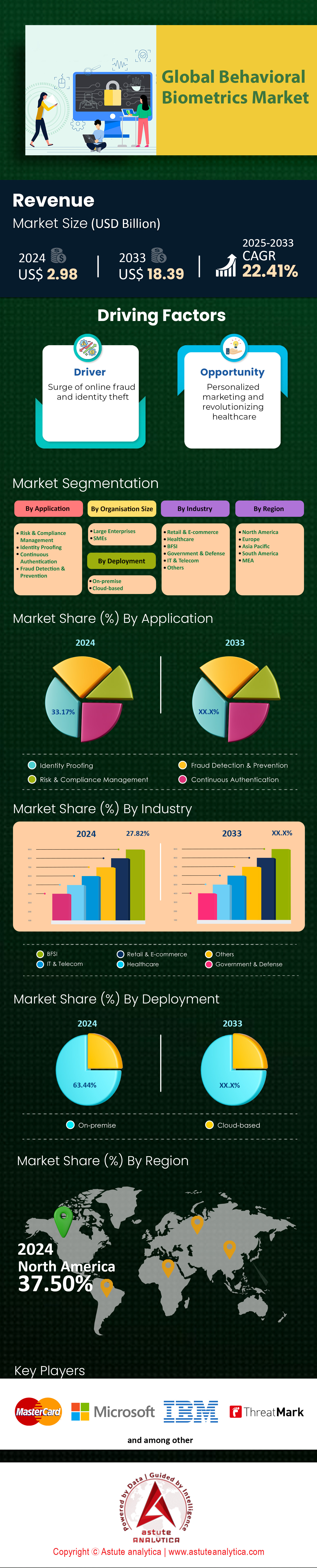
Behavioral biometrics market was valued at US$ 2.98 billion in 2024 and is projected to hit the market valuation of US$ 18.39 billion by 2033 at a CAGR of 22.41% during the forecast period 2025–2033.
Key Findings in Behavioral Biometrics Market
- Based on the type, the global market is led by voice recognition segment.
- By application, global behavioral biometrics market is dominated by identity-proofing with a revenue share of 33.17%.
- By industry, BFSI (Banking, Financial Services, and Insurance) industry is an undisputed early leader, contributing over 27.82% of global market revenue.
- Based on deployment, on-premise deployments of behavioral biometrics market dominated the market, generating over 63.44% of revenue.
- North America is leading the market by capturing the largest 37.50% market share.
The demand for behavioral biometrics market is being driven by an acute need to combat a relentlessly evolving and costly digital threat landscape. With global cybercrime costs projected to reach USD 9.5 trillion in 2024, traditional security measures are proving inadequate. This financial imperative, coupled with increasingly stringent data protection regulations that have resulted in fines such as the EUR 530 million penalty for TikTok in 2025, is compelling organizations to adopt more advanced, continuous authentication methods. The technology's ability to seamlessly differentiate between legitimate users and malicious actors without introducing friction is a critical factor behind its recent surge in adoption, addressing both security needs and consumer expectations for effortless digital experiences.
The primary consumers of behavioral biometrics market are institutions within the Banking, Financial Services, and Insurance (BFSI) sector, with their millions of customers being the ultimate end-users. Key players dominating this space include BioCatch and BehavioSec. As of mid-2025, market leader BioCatch actively protects over 525 million people globally across more than 280 financial institutions. Its platform analyzes over 15 billion user sessions monthly, demonstrating massive scalability. The competitive landscape is vibrant, with players like BehavioSec holding 59 patents, indicating a strong focus on innovation and intellectual property to secure market share within this rapidly expanding field.
The behavioral biometrics market is poised for significant growth in the coming years, a trajectory underscored by strong investor confidence and impressive financial performance. BioCatch's acquisition for USD 1.3 billion in 2024 and its annual recurring revenue surpassing USD 160 million by mid-2025 highlight the market's substantial value. The technology's proven effectiveness, having stopped an estimated USD 3.7 billion in fraud in 2024 alone, solidifies its return on investment. Continued rapid customer acquisition, with top providers onboarding dozens of new clients quarterly, and strategic expansion into new geographic regions indicate a sustained and robust growth pattern for the foreseeable future.
To Get more Insights, Request A Free Sample
Emerging Frontiers Create New Pathways For Market Expansion and Innovation
- Securing the Internet of Things (IoT) and Connected Devices: The exponential growth of IoT devices in smart homes and connected cars presents a major opportunity. These interconnected environments are vulnerable, and traditional security is often inadequate. Behavioral biometrics market can provide continuous, passive authentication by analyzing user interaction patterns with these devices, offering a frictionless yet robust security solution to protect personal data and prevent unauthorized access in an increasingly connected world.
- Identity Verification in the Metaverse and Web3: As virtual worlds and decentralized applications gain traction, establishing and securing digital identities is paramount. Behavioral biometrics offers a powerful solution for continuous authentication within these immersive environments, ensuring a user is who they claim to be throughout a session. By analyzing movement, interaction, and even typing patterns on virtual keyboards, it can prevent avatar hijacking and secure transactions, building a foundation of trust essential for these emerging digital realms.
Unrelenting Surge in Account Takeover Fraud Demands Advanced Defenses
The dramatic escalation of account takeover (ATO) attacks is a primary factor fueling demand in the behavioral biometrics market. Cybercriminals are increasingly successful at bypassing legacy authentication, leading to staggering financial losses. In 2024, ATO attacks surged, with some reports indicating a 24% year-over-year increase, while another analysis recorded a staggering 250% rise fueled by seasonal campaigns. This relentless assault has made ATO a top-four cyber threat for security leaders globally. Over 1.1 million identity theft reports were filed in the U.S. in 2024, translating to a new case approximately every 28 seconds.
The financial and operational impact on businesses is severe. By 2025, projected global losses from ATO are expected to reach USD 17 billion. Threat actors have organized into sophisticated groups, with one report identifying 22 distinct credential stuffing collectives that targeted over 1,000 major organizations. Even with defenses in place, 62% of monitored organizations experienced a successful ATO incident in 2024. It now takes an average of 194 days for a company to even detect a data breach, giving fraudsters ample time to inflict damage. Account takeover attempts targeted 99% of organizations in 2024, making advanced, continuous authentication a critical necessity.
Rampant Synthetic Identity Fraud Exposes Gaps In Traditional Verification
The rapid rise of synthetic identity fraud is another powerful driver compelling investment in the behavioral biometrics market. Unlike traditional identity theft, fraudsters create entirely new personas by combining real and fabricated information, making them exceptionally difficult for legacy systems to detect. In the UK, cases of false identity fraud increased by 60% in 2024 compared to the previous year. Losses from synthetic fraud are projected to reach nearly USD 5 billion in the U.S. alone in 2024. The problem is widespread, with an estimated 15 million Americans having been victimized over the last decade.
The financial repercussions are immense, as these fraudulent accounts are used to build credit before maxing out credit lines and disappearing. One estimate places the average loss for banks from a single synthetic identity at USD 15,000. The challenge is compounded by the sheer volume of compromised data available to criminals; there were 3,000 data breaches in the U.S. in 2024 alone. Disturbingly, it is estimated that 95% of synthetic identities go undetected by financial institutions during the new account creation process. This glaring vulnerability highlights the critical need for solutions that can analyze inherent user behavior to spot anomalies that static data checks miss.
Segmental Analysis
Voice Recognition Spearheads the Charge in Biometric Security
The voice recognition segment leads the global behavioral biometrics market, a dominance built on widespread adoption and its critical role in modern security frameworks. With more than 50 million consumers globally already enrolled in voice biometric systems, its footprint is extensive. This leadership is not merely about market penetration but is a direct answer to increasing security vulnerabilities. A significant USD 25 million theft in 2024, which successfully bypassed traditional caller ID checks, has pushed enterprises to adopt more sophisticated voice-liveness detection. Consequently, over half of all telecommunication firms in developed nations now use voice verification in their customer service centers. The anticipated rise of deepfake fraud, expected to cause over USD 250 million in annual losses by 2027, further reinforces the urgent need for reliable voice authentication.
The technology’s integration is deepening as user interaction models evolve across the global behavioral biometrics market. Projections for 2025 show that 30 out of every 100 browsing sessions will be screenless, making voice the primary interface. In response, two out of every five organizations with remote staff have now deployed voice verification for secure logins. Major banks that have embraced this technology report a marked increase in customer satisfaction, demonstrating its dual benefits of security and convenience. This trend extends to commerce, where 18 million consumers in the U.S. have already used their voice to authorize payments, signaling strong market acceptance. Such figures confirm that voice-based behavioral biometrics is an essential tool for securing a voice-activated digital world.
Identity-Proofing Stands as the Core of Digital Trust
With a commanding revenue share of 33.17%, identity-proofing is the undisputed leader among applications in the global behavioral biometrics market. Its dominance is justified by the sheer scale and growing complexity of digital verification demands. In 2024, the number of digital identity checks is projected to surpass 70 billion globally, with the banking industry alone responsible for 37 billion of them. This massive volume is driven by a stark increase in advanced fraud, as account takeover incidents have more than tripled since 2021. Organizations are compelled to integrate stronger security layers, where continuous and passive authentication offered by behavioral biometrics provides a powerful solution.
The immense financial consequences of failed identity verification further cement this segment’s leading position in the behavioral biometrics market. Losses from synthetic identity fraud are forecasted to approach USD 5 billion in 2024 and could escalate to at least USD 23 billion by 2030. The profitability for criminals is substantial, with the average fraudulent gain ranging from USD 81,000 to USD 98,000, and some attacks yielding millions. Fraudsters are also becoming more technologically adept; over half of all identity fraud in 2024 involved the use of AI-generated forgeries. This evolving threat landscape necessitates the sophisticated, real-time protection that identity-proofing applications deliver.
The BFSI Sector A Decisive Early Adopter and Market Frontrunner
The BFSI industry is the definitive early leader in the behavioral biometrics market, accounting for over 27.82% of worldwide revenue. This leadership stems from the sector’s non-negotiable requirement for stringent security in a high-risk environment. Reflecting this, nearly three-quarters of large banking institutions are actively deploying voice and other biometric technologies for fraud prevention. The results are compelling; one major global bank reduced its fraud-related costs by more than a third within six months of implementation. Moreover, North American banks saw new account fraud decline by almost two-thirds in the past year after integrating stronger identity controls, including behavioral biometric intelligence.
The sheer volume of financial transactions and the persistent threat of cyberattacks make the BFSI sector a natural fit for this technology. In 2025, more than USD 3 trillion in mobile payments will be secured using biometrics, showcasing the depth of its integration. The technology is also critical for mitigating internal risks, as more than three out of every ten data breaches are caused by insider threats. Leading banks have successfully lowered account takeover incidents by up to two-fifths by leveraging the continuous authentication capabilities of behavioral biometrics.
Initial studies show this technology is effective in identifying and halting money mule activity in 9 out of 10 cases. In the past year, U.S. firms, with financial institutions as a top target, lost a combined USD 112 billion to fraud. Since 2020, nearly 75% of banks and insurers have noted a significant increase in attempted cybercrimes.
Customize This Report + Validate with an Expert
Access only the sections you need—region-specific, company-level, or by use-case.
Includes a free consultation with a domain expert to help guide your decision.
On-Premise Solutions A Preferred Model for Security and Sovereignty
On-premise deployments have traditionally dominated the behavioral biometrics market, generating over 63.44% of revenue. This preference is firmly rooted in the superior security, control, and data sovereignty that on-premise models provide. For organizations in highly regulated industries, the capacity to maintain all sensitive biometric data and processing within their own infrastructure is a fundamental requirement. This gives them complete authority over their data, which is crucial for complying with strict privacy laws. This preference is further supported by consumer attitudes; in 2025, 43 out of every 100 consumers expressed significant apprehension about sharing their biometric information, a concern that on-premise solutions directly address.
The practical benefits of on-premise deployments also contribute to their market leadership. These systems often integrate more smoothly with an organization's existing legacy infrastructure, such as access control platforms, which are typically hosted on-premise. This alignment simplifies the creation of a unified security framework in the behavioral biometrics market. For large enterprises, on-premise options offer the robust capacity needed to manage massive data volumes while allowing for greater customization of servers and user templates. Although it demands a higher initial investment, choosing an on-premise deployment represents a strategic commitment to achieving the highest standards of data protection and operational command through a powerful behavioral biometrics defense.
To Understand More About this Research: Request A Free Sample
Regional Analysis
North America’s Escalating Fraud Losses Cement Its Market Dominance
North America commands the behavioral biometrics market, holding a share of over 37.50%, driven by an unrelenting and costly wave of digital crime. The sheer scale of financial losses in the region creates a powerful incentive for advanced security adoption. According to the FBI's Internet Crime Complaint Center (IC3), total reported cybercrime losses in the U.S. skyrocketed to a record USD 16.6 billion in 2024. The volume of incidents is equally staggering, with the IC3 receiving 859,532 complaints in the same year. Investment fraud alone accounted for USD 6.57 billion in losses, while damaging Business Email Compromise (BEC) scams added another USD 2.77 billion to the total.
The threat environment shows no signs of abating, forcing financial institutions to seek more dynamic defenses. In Canada, fraudsters were projected to steal over USD 643 million in 2024. Phishing remains a primary attack vector, with 193,407 incidents reported to the IC3 in 2024. Furthermore, tech support fraud resulted in USD 1.46 billion in losses. The average loss per complaint filed with the IC3 was a significant USD 19,372, illustrating the severe impact on individuals and businesses. This landscape, where nearly a quarter of unauthorized fraud occurs on trusted devices, solidifies the critical need for behavioral analysis.
Europe Grapples With Sophisticated Cross-Border Payment Fraud Schemes
Europe's mature digital economy faces a complex and evolving fraud landscape, making it a critical region for the behavioral biometrics market. According to a joint report from the European Banking Authority and the European Central Bank, payment fraud across the EEA amounted to a substantial EUR 2.0 billion in just the first half of 2023. Card payments and credit transfers were the primary sources of these losses. In the UK, fraudsters stole a total of £571.7 million through payment fraud in the first half of 2024 alone.
A significant portion of these criminal activities involves sophisticated, cross-border operations, pushing the behavioral biometrics market growth further. For instance, 71% of the total value of card fraud in the first half of 2023 was linked to cross-border transactions. In the UK, Authorized Push Payment (APP) fraud remains a major concern, with losses reaching £213.7 million in the first half of 2024 across 97,344 cases. Of this, £166.5 million were personal losses and £47.2 million were business losses. In response, banks successfully prevented £710.9 million in unauthorized fraud during the same period, demonstrating the value of robust security layers.
Asia Pacific’s Digital Boom Fuels Unprecedented Rise in Cybercrime
The Asia Pacific region is experiencing a dramatic surge in digital adoption, which has unfortunately been accompanied by a parallel explosion in financial scams and cybercrime. In India, the growth of the Unified Payments Interface (UPI) has been targeted by fraudsters, leading to 632,000 reported fraud incidents worth INR 4.85 billion in the first half of fiscal year 2025. The total value of UPI scams in the preceding fiscal year reached INR 10.87 billion across 1.34 million cases. The sheer volume of these attacks highlights a pressing need for stronger identity verification in the behavioral biometrics market.
Other countries in the region face similar challenges. Australians reported losing AUD 2 billion to scams in 2024, with investment scams accounting for AUD 945 million of that total. In Singapore, victims lost at least SGD 385.6 million in the first half of 2024, with authorities recording 26,587 separate scam cases. The island nation also saw over 21 million cyberattacks originate from its servers in 2024, making it a major hub for threat activity in Southeast Asia. This intense and high-volume threat environment is accelerating the demand for security solutions that can analyze behavior in real time.
Recent Developments Shaping the Behavioral Biometrics Market
- Cisco Acquires Splunk (March 2024): In a landmark deal, Cisco completed its acquisition of data analytics and security powerhouse Splunk for approximately USD 28 billion, enhancing its security and observability offerings.
- Thoma Bravo Acquires Darktrace (October 2024): Private equity firm Thoma Bravo finalized its acquisition of UK-based AI cybersecurity leader Darktrace in an all-cash deal valued at USD 5.3 billion.
- Hewlett Packard Enterprise Buys Juniper Networks (Announced Jan 2024): HPE announced its intent to acquire Juniper Networks for USD 14 billion, a move set to bolster its networking and security capabilities with Juniper's AI-native solutions.
- CyberArk Acquires Venafi (October 2024): Identity security leader CyberArk completed its acquisition of machine identity management firm Venafi from Thoma Bravo for USD 1.54 billion.
- Mastercard Acquires Recorded Future (Announced Sept 2024): Expanding beyond payments, Mastercard announced a deal to acquire threat intelligence firm Recorded Future for USD 2.65 billion.)
- Sophos Acquires SecureWorks (Announced Oct 2024): Sophos announced its plan to purchase SecureWorks, a leader in Extended Detection and Response (XDR), for USD 859 million.
- Palo Alto Networks Acquires IBM's QRadar SaaS (Announced May 2024): Palo Alto Networks agreed to acquire the SaaS assets of IBM's QRadar security analytics platform for USD 500 million.
- CrowdStrike Acquires Adaptive Shield (Announced Nov 2024): CrowdStrike moved to enhance its cloud and SaaS security posture by acquiring Adaptive Shield for approximately USD 300 million.
- CrowdStrike Acquires Flow Security (March 2024): Earlier in the year, CrowdStrike acquired data security posture management (DSPM) startup Flow Security for an estimated USD 200 million.
- Cyera Acquires Trail Security (October 2024): Data security startup Cyera acquired Trail Security, a next-generation data loss prevention (DLP) provider, for USD 162 million.
Top Players in Global Behavioral Biometrics Market
- Mastercard Incorporated.
- BioCatch Ltd.
- Ping Identity
- Prove Identity Inc.
- Fair Issac Corporation
- ThreatMark
- Plurilock Security Solutions Inc.
- SecureAuth Corporation
- Zighra
- IBM Corporation
- NEC Corporation
- Microsoft Corp.
- Other Prominent Players
Market Segmentation Overview:
By Component
- Software
- Services
By Type
- Voice Recognition
- Keystroke Dynamics
- Gait Analysis
- Signature Analysis
- Others
By Deployment
- On Premise
- Cloud
By Application
- Risk & Compliance Management
- Identity Proofing
- Continuous Authentication
- Fraud Detection & Prevention
By Organization Size
- Large Enterprises
- SMEs
By Industry
- Retail & E-commerce
- Healthcare
- BFSI
- Government & Defense
- IT & Telecom
- Others
By Region
- North America
- The U.S.
- Canada
- Mexico
- Europe
- Western Europe
- The UK
- Germany
- France
- Italy
- Spain
- Rest of Western Europe
- Eastern Europe
- Poland
- Russia
- Rest of Eastern Europe
- Western Europe
- Asia Pacific
- China
- India
- Japan
- Australia & New Zealand
- South Korea
- ASEAN
- Rest of Asia Pacific
- Middle East & Africa (MEA)
- Saudi Arabia
- South Africa
- UAE
- Rest of MEA
- South America
- Argentina
- Brazil
- Rest of South America
LOOKING FOR COMPREHENSIVE MARKET KNOWLEDGE? ENGAGE OUR EXPERT SPECIALISTS.
SPEAK TO AN ANALYST
.svg)

 Schedule a Meeting

Features | Type of License | ||||
 Data Book | Single User |   Multi User |  Corporate | ||
| e-Access | ✓ | ✓ | ✓ | ✓ | |
User Sharing | 1 User Only | 1 User Only | Up to 7 Users | Unlimited User Access | |
⨉ | ⨉ | ⨉ | ✓ | ||
Free Customization | No Free Customization | Up To 30 hrs work | Up To 60 hrs work | Up To 80 hrs work | |
Deliverable |
| ⨉ | ✓ | ✓ | ✓ |
| ✓ | ⨉ | ✓ | ✓ | |
| ⨉ | ⨉ | ⨉ | ✓ | |
Analyst Support | 2-Months Analyst Support | 4-Months Analyst Support | 7-Months Analyst Support | One Year Analyst Support | |
Free Report update in next update cycle | ⨉ | ⨉ | ⨉ | ✓ | |
Free Industry Update (Within 180 days) | ⨉ | ⨉ | ⨉ | ✓ | |
Benefit | Up to 10% off on Post Purchase | Up to 20% off on Post Purchase | Up to 30% off on Post Purchase | Up to 40% off on Post Purchase | |