Market Scenario
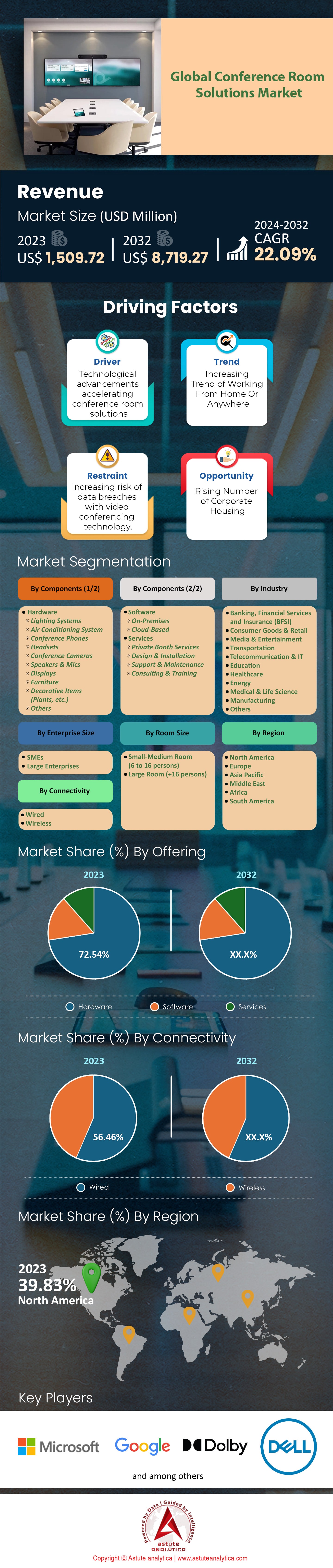
Conference room solutions market was valued at US$ 2.08 billion in 2025 and is projected to surpass the valuation of US$ 15.31 billion by 2035 at a CAGR of 22.09% over the forecast period of 2026–2035.
Key Findings in Conference Room Solutions Market
- Based on offering, hardware captured more than 72.54% of the conference room solution market.
- Based on end use industry, telecommunication and IT industry is at the forefront of the market, commanding an impressive 27.86% market share.
- Based on enterprise size, large enterprises emerged as the key consumers with the most deployment of these solutions. These enterprises captured more than 56.66% revenue share.
- Based on connectivity, wired connectivity continues to dominate the market with over 56.46% market share.
- North America is set to hold lion’s share of nearly 39.83%.
The global conference room solutions market stands at a pivotal inflection point, propelled by a staggering 44 million-room video enablement deficit that demands urgent hardware refreshes across Asia-Pacific and Western markets. As of mid-2024, only 3.1 million rooms feature native systems, with Microsoft Teams Rooms eclipsing 1 million active deployments, signaling explosive growth trajectories toward 4 million hardware shipments by end-2025. APAC emerges as the epicenter, boasting over 2 million equipped rooms—China at 800,000 and India surging past 300,000, fueled by tech startups outpacing mature Western infrastructures.
Affordable Android video bars, capturing half of 2024's USD 1.4 billion segment with sub-USD 1,000 pricing, democratize access. Therefore, reshaping competition in the conference room solutions market where Logitech commands 21% volume share. This is true amid 10 million cumulative shipments, and Cisco nets 4,000+ new clients. Premium tiers evolve with multi-camera behemoths like Yealink's 9-camera MVC S90 (34 TOPS AI processing) and Cisco's Room Kit EQX (4K, 83° FOV, 60fps), countering huddle-room densification amid 19.8% U.S. office vacancies and 70% small-space dominance.
Hybrid imperatives—Teams' 320 million MAUs, 5 billion daily meeting minutes, and 30,000 Copilot customizations—amplify upgrade cycles, slashing USD 34 billion in annual unproductive meeting costs. Shrinking footprints (100-150 sq ft huddles) and resurgent hybrid events (4.5 per planner, scaling to 100,000 virtual attendees) mandate flexible, AI-infused broadcast studios. Inflationary AV hikes (50% projected) yield USD 100 million savings for 5,000-employee firms via efficiencies.
To Get more Insights, Request A Free Sample
Why Are Intelligent Cinematic Experiences Defining New Standards For Corporate Collaboration?
In the conference room solutions market, intelligent cinematic experiences are setting new benchmarks for collaboration quality. AI-driven multi-camera systems, such as Cisco’s Room Kit EQX and Yealink’s MVC S90, automatically detect and frame active speakers, ensuring remote participants stay visually engaged. These setups bring broadcast-like precision to meetings, reducing dependency on manual camera control.
Alongside visual enhancements, advanced audio systems have transformed meeting environments. Beamforming microphones and AI-based noise suppression, seen in Logitech’s Rally series, minimize background noise and improve speech clarity. This combination of high-definition video and spatial audio creates realistic meeting experiences that reduce fatigue and improve participation equity. As hybrid work becomes mainstream, intelligent camera and sound solutions are now essential in modern collaboration setups across the conference room solutions market.
How Are Global Leaders Battling For Dominance Through Integrated Appliance Strategies?
Competition among leading players such as Logitech, Cisco, and Yealink is intensifying in the conference room solutions market, particularly in the all-in-one appliance category. Logitech continues to lead with strong sales of its Rally series and integrated AI features, while Cisco and Yealink expand their presence through modular and Android-based appliance solutions that simplify deployment for IT teams.
Software ecosystems like Microsoft Teams and Zoom exert significant influence by granting product certifications that encourage hardware interoperability. This has led to affordable, AI-equipped video bars—many priced under USD 1,000—gaining rapid adoption. In markets like India, cost-effective conferencing solutions with premium audio and video quality are driving further penetration, as enterprises seek reliable yet scalable hybrid meeting technologies.
Why is Rapid Digitization In India and China Fueling Market Expansion?
Asia-Pacific remains the fastest-growing region in the conference room solutions market, driven by accelerated digitization in India and China. China currently hosts around 800,000 equipped conference rooms, while India is witnessing rapid infrastructure development supported by over 75,000 startups and major government-led digital initiatives.
Unlike mature Western markets, Asia-Pacific regions often adopt next-generation technologies directly. Indian and Chinese enterprises are prioritizing plug-and-play, cloud-enabled conferencing systems that offer seamless integration and remote management. This strong demand, coupled with rising urbanization and hybrid work trends, is expected to sustain double-digit growth rates for the conference room solutions market through 2028.
How is The Supply Chain Shifting From Box Moving To Managed Services?
The conference room solutions market is evolving from a simple product sales model to a service-oriented ecosystem. Many AV integrators are transitioning into Managed Service Providers (MSPs), offering subscription-based solutions that bundle hardware, software, and technical support. This approach helps enterprises manage costs more efficiently by converting large capital expenditures into predictable operational costs.
Through models such as “Hardware-as-a-Service (HaaS),” clients can maintain up-to-date technology while ensuring consistent uptime through Service Level Agreements (SLAs). In fast-growing markets like India and China, where enterprises prioritize scalability and sustainability, MSPs are playing a crucial role in enabling flexible, long-term conferencing strategies.
How Do Strategic Forces Reveal High Buyer Power and Intense Competitive Rivalry?
The conference room solutions market is characterized by intense competition and increasing buyer influence. The growing use of standard platforms like Microsoft Teams and Zoom has reduced vendor lock-in, allowing buyers to mix hardware from different brands for cost and performance optimization.
Manufacturers are now competing through product differentiation, AI capabilities, and user-centric innovations, but price pressures remain high. Porter's Five Forces analysis highlights strong buyer power and fierce rivalry, while SWOT assessments indicate hybrid collaboration as a long-term strength and hardware dependency as a key challenge. Vendors that deliver interoperable and service-backed solutions will be best positioned to maintain long-term competitiveness.
Why Does The Cost Of Inaction Outweigh Investment As Prices Drop?
Delaying technology upgrades now carries higher financial risks than making timely investments in the conference room solutions market. Older systems with poor audio, video, and connectivity often lead to meeting inefficiencies that cost businesses millions in lost productivity. At the same time, advanced systems have become more affordable, with half of all video bars now priced below USD 1,000.
Organizations adopting modern, AI-powered conferencing tools can reduce travel expenses, recover lost meeting time, and enhance employee engagement. For Indian businesses, investing in scalable conferencing infrastructure also mitigates inflation impact and positions them for sustainable hybrid operations. As hardware costs decline and service flexibility increases, upgrading has become both a strategic and financial advantage.
Segmental Analysis
By Component, Hardware Component Take Up the Largest 72.54% Share of the Market
Hardware components remain the undisputed backbone of conference room solutions market, fundamentally capturing more than 72.54% share of the conference room solution market. Organizations prioritize physical assets because software applications require robust peripherals to function effectively, pushing global video conferencing hardware shipments to reach a forecast of 4 million units by late 2025. The sector valuation stood at USD 5.1 billion in 2024, driven by an accumulation of over 150 million conferencing devices shipped globally between 2022 and 2024. Companies are aggressively investing in visual clarity, evidenced by video conferencing camera sales hitting 12 million units in 2023. Ultra-high-definition displays also saw significant traction, with 8 million units sold globally to enhance visual engagement. Consequently, major vendors like Logitech reported full fiscal year 2024 sales of USD 4.30 billion, validating the heavy reliance on physical tools.
Interactive displays have simultaneously carved out a critical niche, with the interactive whiteboard market revenue estimated at USD 4.82 billion in 2024. Portable interactive whiteboards alone accounted for over 53% of segment revenue, highlighting a trend toward flexible meeting setups. The Conference room solutions market relies on these tangible endpoints to bridge the gap between remote and in-person attendees. North America currently hosts over 2.4 million hardware-enabled conference rooms, creating a massive base for replacement cycles. Furthermore, more than 5,000 educational institutions upgraded to smart meeting room hardware in 2024, expanding the addressable landscape beyond corporate offices. Such data confirms that while software connects users, hardware remains the primary investment vehicle fueling the market.
By Industry, Telecommunication and IT Industries Set to Continue Holding Market Prominence
Telecommunication and IT industries command an impressive 27.86% market share, acting as both the primary developers and heaviest users of advanced collaboration tools. These sectors require seamless connectivity to manage distributed workforce operations, evidenced by Microsoft Teams generating over USD 8 billion in revenue through its ecosystem in 2024. Operational scale is vast, with Teams reaching 320 million daily active users and Zoom hosting approximately 300 million daily meeting participants. Such volume necessitates enterprise-grade infrastructure, driving Zoom’s annual revenue to USD 4.66 billion for fiscal year 2024. Webex Calling supporting over 16 million users globally further illustrates the immense reliance telecom giants have on unified communication platforms. The Conference room solutions market expands rapidly as these tech-centric industries deploy integrated systems to maintain competitive agility.
Investment in infrastructure remains high within these verticals to support massive client bases. Cisco recently added over 4,000 new device customers, while Zoom serves approximately 504,900 business customers worldwide. Technology firms utilize these environments to showcase innovation, deploying over 20 million AI-enhanced conference camera units globally to their own sectors. Beyond corporate usage, the education sector alone—often serviced by IT providers—spent over USD 3 billion on IT conference solutions in 2023. Government deployments also exceeded 30,000 new installations, highlighting the critical role IT plays in public sector modernization. As a result, the Conference room solutions market continues to be shaped by the rigorous demands and massive spending power of the telecommunication and IT landscape.
By Enterprise Size, Large Enterprises Driving Global Infrastructure Upgrades
Large enterprises emerged as the key consumers with the most deployment of these solutions, capturing more than 56.66% revenue share of the conference room solutions market. These entities manage vast real estate portfolios, with approximately 60 million conference rooms worldwide identified as targets for technology upgrades. Standardization is a priority for multinational corporations, leading to over 1 million Microsoft Teams Rooms deployed globally to ensure consistent user experiences. The United States hosts over 1.5 million conference rooms equipped with advanced video technology, a large portion belonging to Fortune 500 companies. More than 5,000 multinational companies actively invested in upgrading room technology in 2024, signaling a strong move toward permanent hybrid setups. Medium-sized enterprises also contribute significantly, typically managing between 50 to 150 conference rooms each.
Global expansion strategies further fuel demand in the Conference room solutions market as companies connect international hubs. Asia Pacific now hosts over 2 million conference rooms incorporating digital technology, reflecting widespread corporate adoption. Specifically, China has equipped over 800,000 rooms with state-of-the-art video systems, while India has seen the establishment of over 300,000 modern corporate conference rooms. Collaboration platforms integrating with these room technologies boast over 25 million active enterprise users, proving high utilization rates. Additionally, global investment in AI research for enterprise conferencing reached USD 1.5 billion, as large firms seek automated features to improve meeting efficiency. These massive deployment volumes solidify large enterprises as the primary engine propelling the market.
Customize This Report + Validate with an Expert
Access only the sections you need—region-specific, company-level, or by use-case.
Includes a free consultation with a domain expert to help guide your decision.
By Connectivity, Wired Infrastructure Leads the Market Ensuring Mission Critical Stability
Wired connectivity continues to dominate the conference room solutions market with over 56.46% market share, driven by an absolute need for reliability and security. Commercial installations deployed over 2.8 million kilometers of network cable in 2024, reinforcing the physical grid that supports modern digital communication. The global Ethernet cable market size reached USD 11.5 billion in 2024, underscoring the value placed on stable, hardline connections. Wired "Room Systems" accounted for 58% of total video conferencing revenues, proving that enterprises prefer tethered solutions over wireless alternatives for primary meeting spaces. Audio quality is equally paramount, with wired conference microphones generating revenue of USD 1.7 billion in 2024. Consequently, the Conference room solutions market relies heavily on structured cabling to deliver latency-free experiences.
Peripherals and power delivery standards also heavily favor wired ecosystems. The HDMI cable market was valued at USD 3.17 billion in 2024, serving as the standard for high-definition video transmission. Standard kits, such as the Cisco Room Bar, include a 5-meter Ethernet cable, while Logitech Rally systems utilize a 10-meter extension cable, cementing the role of physical cords in premium setups. Power over Ethernet (PoE) technologies are expanding capabilities, with the global PoE lighting market valued at USD 420.45 million and commercial segments accounting for over 40% of PoE market share. IEEE 802.3bt standards now support up to 90 watts per port, allowing a single cable to power sophisticated room devices. Such innovations ensure wired solutions remain the bedrock of the Conference room solutions market.
To Understand More About this Research: Request A Free Sample
Regional Analysis
North America's Market Dominance Fueled By Strategic Enterprise Investment In Productivity
North America commands nearly 39.83% of the global conference room solutions market through unrelenting corporate tech investments and a fierce productivity ethos, undeterred by December 2024's 19.8% office vacancy rate. The stark reality of USD 34 billion lost annually to unproductive meetings has ignited a crusade for state-of-the-art conference room solutions, with Microsoft Teams Rooms—surpassing 1 million active globally by April 2024—concentrating heavily here.
Enterprises, led by tech titans, pioneer this charge: Cisco captured over 4,000 new video device customers from late 2023 to 2024 [Cavell, 2024], deploying AI-driven equity that ensures remote voices resonate equally while streamlining workflows to razor sharpness. This transcends mere video presence; it's about frictionless integration that transmutes every collaboration minute into strategic gold, populating U.S. and Canadian boardrooms and huddles with premium, feature-rich systems that align meetings with core business imperatives. Forward-looking leaders recognize that in hybrid eras, superior infrastructure isn't optional—it's the fulcrum of competitive edge, where occupied spaces yield outsized returns amid real estate flux.
Asia-Pacific's Ascent Driven By Massive Greenfield Projects and Digital Modernization Efforts
Asia-Pacific catapults to prominence in the conference room solutions market, propelled by seismic economic expansion and digital overhauls, hosting over 2 million equipped rooms by 2024. China spearheads with 800,000 modern setups via rampant new constructions modernizing its corporate expanse, while India's 300,000+ surge—ignited by a throbbing startup ecosystem and tech workforce—marks it as a velocity engine. This momentum pivots on greenfield supremacy: fresh offices wired for hybrid from inception, vaulting past Western retrofit drudgery to embrace AI video bars and smart systems on launch day.
The region’s strong position in the conference room solutions market anchors global video hardware's 4 million unit shipments forecast by 2025-end, sustained by youthful demographics, urbanization tsunamis, and policy-fueled digital economies. For vendors, APAC's volume vortex—bypassing AV generations—presents irresistible scale, demanding tailored strategies that harness new-build booms for enduring footprint in high-growth terrains where innovation deploys at lightspeed.
Europe's Market Shaped By Sustainability, Regulatory Compliance, And Hybrid Event Adoption
Europe etches a sophisticated niche in conference room solutions market, defined by sustainability zeal, ironclad regulatory adherence, and hybrid work finesse. Enterprises champion "Green AV"—low-power devices syncing with ESG edicts—vetting makers on lifecycle eco-credentials that sway procurement decisively. GDPR's vigilance mandates fortified security and local processing, prioritizing data sovereignty in every deployment. Hybrid events thrive at 4.5 per planner in 2024, birthing versatile rooms fluidly shifting from team huddles to broadcast spectacles; cost pressures drive 53% to secondary markets [Knowland, 2024], favoring agile tech. Logitech's USD 1.34 billion Q3 FY2025 revenue pulses from this exacting arena, amplified by Android video bars claiming half of 2024 shipments for plug-and-play prowess in small-medium dens. This alchemy—eco-conscious, compliant, event-ready—positions Europe as a bellwether, where simplicity meets sophistication to optimize myriad spaces amid fiscal scrutiny
Top 5 Recent Company Developments in Conference Room Solutions Market
- ClearOne's BMA 360DX Launch (Jan 2025): ClearOne announced its innovative all-in-one ceiling tile at ISE 2025, integrating beamforming mic array, DSP processor, Dante, and multi-channel amp—eliminating rack space for sustainable, pro-audio in any room size.
- ZTE's AI-Powered Video Conference Board (Sep 2025): ZTE unveiled at IBC2025 an all-in-one quad-lens 4K camera board with AI smart control, whiteboard integration, and open ecosystem compatibility for seamless global hybrid meetings.
- Yealink MeetingBar A40 Release (2025): Yealink launched the AI-enhanced all-in-one video bar with 3x4K cameras, IntelliFocus tracking, Video Fence, and 10m audio pickup—optimized for medium rooms with Microsoft Teams integration.
- INOGENI's Four New AV Innovations (Jun 2025): At InfoComm 2025, INOGENI introduced IP2USB NDI/RTSP converter, U-BRIDGE USB-C extender, U-BRIDGE 3 WP wallplate, and TOGGLE DOCK BYOM switcher for enhanced videoconferencing integration.
- ViewSonic's Visual Solutions Showcase (Jan 2025): ViewSonic revealed at ISE 2025 future-focused displays (75-263 inches) with integrated software for corporate collaboration, emphasizing user-centric, sustainable AV in hybrid workspaces
Top Players in the Conference Room Solutions Market
- Hardware
- Avaya, Inc.
- Dell Technologies, Inc.
- Dolby Laboratories
- HP Inc.
- Huawei Technologies Co., Ltd.
- HygroMatik GmbH
- Koninklijke Philips N.V.
- Logitech, Inc.
- Panasonic Corporation Electric Works, Inc.
- RingCentral, Inc.
- Tridonic GmbH & Co KG
- TRILUX GmbH & Co. KG
- XAL
- Other Prominent Players
- Software & Services
- 8x8, Inc.
- Cisco Systems, Inc
- Google LLC
- Inbox Booth
- Lifesize Inc.
- LogMeIn, Inc.
- Microsoft Inc.
- TalkBox Booth LLC
- TrueConf LLC
- V-cube, Inc.
- WeWork Inc.
- Zoom Video Communications
- Other Prominent Players
Market Segmentation Overview:
By Offering
- Hardware
- Lighting Systems
- Air Conditioning System
- Conference Phones
- Headsets
- Conference Cameras
- Speakers & Mics
- Displays
- Furniture
- Decorative Items (Plants, etc.)
- Others
- Software
- On-Premises
- Cloud Based
- Services
- Private Booth Services
- Design & Installation
- Support & Maintenance
- Consulting & Training
By Connectivity
- Wired
- Wireless
By Enterprise Size
- Small Medium Enterprise (SMEs)
- Large Enterprise
By Room Size
- Small-Medium Room (6 to 16 persons)
- Large Room (+16 persons)
By Industry
- Banking, Financial Services and Insurance (BFSI)
- Consumer Goods & Retail
- Media & Entertainment
- Transportation
- Telecommunication & IT
- Education
- Healthcare
- Energy
- Medical & Life Science
- Manufacturing
- Others
By Region
- North America
- U.S.
- Canada
- Mexico
- Europe
- Western Europe
- The UK
- Germany
- France
- Italy
- Spain
- Rest of Western Europe
- Eastern Europe
- Poland
- Russia
- Rest of Eastern Europe
- Western Europe
- Asia Pacific
- China
- South Korea
- India
- Japan
- Australia & New Zealand
- ASEAN
- Rest of Asia Pacific
- Middle East
- UAE
- Saudi Arabia
- Kuwait
- Qatar
- Oman
- Bahrain
- Rest of MEA
- Africa
- South Africa
- Nigeria
- Kenya
- Rest of Africa
- South America
- Brazil
- Argentina
- Rest of South America
REPORT SCOPE
| Report Attribute | Details |
|---|---|
| Market Size Value in 2025 | US$ 2.08 Billion |
| Expected Revenue in 2035 | US$ 15.31 Billion |
| Historic Data | 2020-2024 |
| Base Year | 2025 |
| Forecast Period | 2026-2035 |
| Unit | Value (USD Bn) |
| CAGR | 22.09%% |
| Segments covered | By Offerings, By Connectivity, By Enterprise Size, By Room Size, By End-User, By Region |
| Key Companies | Avaya, Inc., Dell Technologies, Inc., Dolby Laboratories, HP Inc., Huawei Technologies Co., Ltd., HygroMatik GmbH, Koninklijke Philips N.V., Logitech, Inc., Panasonic Corporation Electric Works, Inc., RingCentral, Inc., Tridonic GmbH & Co KG, TRILUX GmbH & Co. KG , XAL, 8x8, Inc., Cisco Systems, Inc, Google LLC, Inbox Booth, Lifesize Inc. , LogMeIn, Inc., Microsoft Inc., TalkBox Booth LLC, TrueConf LLC, V-cube, Inc., WeWork Inc. , Zoom Video Communications , Other Prominent Players |
| Customization Scope | Get your customized report as per your preference. Ask for customization |
FREQUENTLY ASKED QUESTIONS
Market data reveals a significant democratization of technology. In the second half of 2024, 1 out of 2 video bars sold retailed for under USD 1,000. This price compression allows organizations to scale deployment across huddle rooms without CapEx bloat, shifting the focus from one expensive telepresence room to mass enablement of small spaces.
The ROI is measured in reclaimed productivity and reduced travel. With unproductive meetings costing global businesses USD 34 billion annually, AI features like Intelligent Recap and automated minutes (via Microsoft Copilot) directly reduce administrative time. For companies with 5,000 employees, optimizing meeting efficiency can yield over USD 100 million in annual savings.
Simplicity and scalability drive this trend in the conference room solutions market. Android-based video bars accounted for nearly half of global shipment volumes in 2024 because they offer an appliance mode—a plug-and-play experience that is easier for IT to manage remotely, consumes less power, and reduces failure points compared to complex Windows-based modular setups.
The focus must shift to densification. While overall office vacancy hovers near 20%, the utilization of small meeting spaces is rising. 7 out of 10 active meeting rooms are now small-to-medium huddle spaces (100–150 sq. ft.). Stakeholders should prioritize high-volume, wide-angle (120° FOV) video bars over expensive, long-throw systems designed for empty boardrooms.
Yes. Legacy audiovisual equipment lacks the local compute power required for modern AI in the conference room solutions market. New systems, such as the Yealink MVC S90, utilize AI PCs with 34 TOPS (Trillions of Operations Per Second) to handle real-time processing for voice isolation and multi-stream people tracking, capabilities that cloud processing alone cannot deliver with low latency.
APAC is driven by greenfield expansion rather than retrofit. With India establishing over 300,000 new modern rooms and China accounting for 800,000, the region buys for new builds. In contrast, North America (holding ~40% share) focuses on refreshing existing installed bases to meet return-to-office mandates and hybrid equity standards.
LOOKING FOR COMPREHENSIVE MARKET KNOWLEDGE? ENGAGE OUR EXPERT SPECIALISTS.
SPEAK TO AN ANALYST
.svg)

 Schedule a Meeting

Features | Type of License | ||||
 Data Book | Single User |   Multi User |  Corporate | ||
| e-Access | ✓ | ✓ | ✓ | ✓ | |
User Sharing | 1 User Only | 1 User Only | Up to 7 Users | Unlimited User Access | |
⨉ | ⨉ | ⨉ | ✓ | ||
Free Customization | No Free Customization | Up To 30 hrs work | Up To 60 hrs work | Up To 80 hrs work | |
Deliverable |
| ⨉ | ✓ | ✓ | ✓ |
| ✓ | ⨉ | ✓ | ✓ | |
| ⨉ | ⨉ | ⨉ | ✓ | |
Analyst Support | 2-Months Analyst Support | 4-Months Analyst Support | 7-Months Analyst Support | One Year Analyst Support | |
Free Report update in next update cycle | ⨉ | ⨉ | ⨉ | ✓ | |
Free Industry Update (Within 180 days) | ⨉ | ⨉ | ⨉ | ✓ | |
Benefit | Up to 10% off on Post Purchase | Up to 20% off on Post Purchase | Up to 30% off on Post Purchase | Up to 40% off on Post Purchase | |