Market Scenario
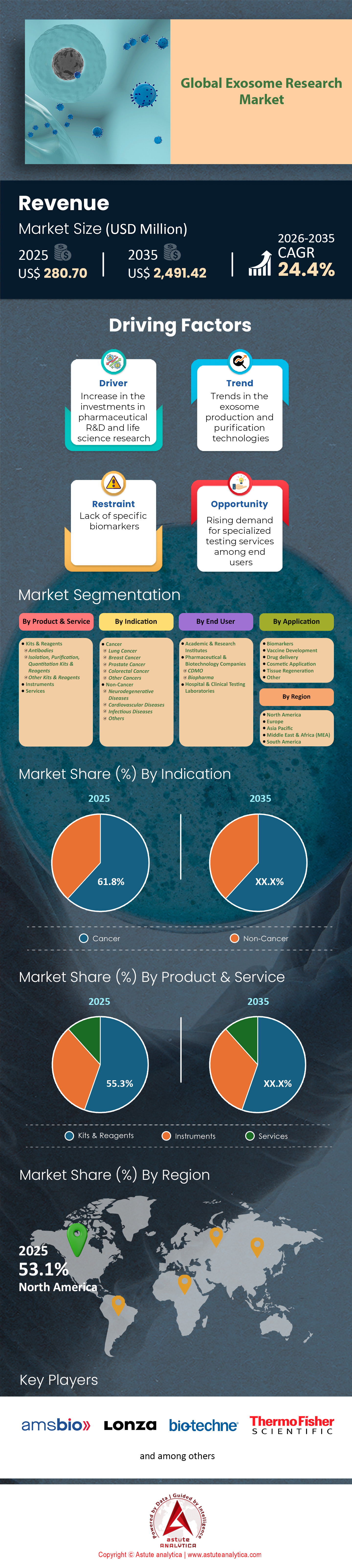
Exosome research market was valued at US$ 280.70 million in 2025 and is anticipated to record a revenue of US$ 2,491.42 million by 2035 at a CAGR of 24.4% over the Forecast Period of 2026 to 2035.
Key Findings
- By products and services, kits and reagents sector commands 56% revenue share via next-generation hybrid isolation tools
- By indication, oncology segment retains 64% market share fueled by precision liquid biopsy adoption
- By end users, pharmaceutical industry captures 53% share through strategic manufacturing alliances
- By application, biomarker applications project to capture over 49.40% revenue share of the exosome research market.
- North America is holding the market dominance with over 53.10% market share.
What is Exosome Research and Why is it Transitioning from Biological Curiosities to High-Value Assets?
Exosome research has fundamentally shifted from academic curiosity to a cornerstone of modern precision medicine. Biologically, exosomes are nanosized extracellular vesicles (30–150 nm) that function as intercellular communication shuttles, carrying complex cargos of RNA, proteins, and lipids. However, from a market perspective, they represent a booming asset class that addresses the limitations of synthetic drug delivery and invasive diagnostics. The exosome research market is currently fueled by a dual-engine demand: the need for non-invasive "liquid biopsy" biomarkers and the race to commercialize natural, low-toxicity therapeutic vehicles.
This transition is highly visible in the global exosome research market. In 2025, the market moved beyond theoretical potential into industrial application. We are no longer just looking at petri dishes; we are witnessing the operationalization of biology. For instance, the sheer volume of 81 active clinical trials identified in recent sector reviews demonstrates this maturity. As these trials progress, they necessitate a sophisticated supply chain of isolation kits, characterization instruments, and GMP manufacturing services, thereby expanding the entire exosome research market ecosystem.
To Get more Insights, Request A Free Sample
What Recent Breakthroughs Are Redefining the Boundaries of Possibility?
The most significant recent breakthroughs have occurred in the clinical validation of exosome efficacy. The industry has long awaited proof that these vesicles can deliver therapeutic outcomes in humans, and 2025 provided that validation.
- Capricor Therapeutics released long-term data from their HOPE-2 study, showing that Duchenne muscular dystrophy patients treated with their exosome therapy experienced a performance score decline of only 3.46 points over three years, compared to a 7.19-point drop in the external comparator group. This statistical divergence proves that exosomes can alter disease trajectories.
Simultaneously, breakthroughs in purification technology across the exosome research market have shattered historical bottlenecks.
- The launch of the CytoFLEX nano Flow Cytometer in 2024 revolutionized detection, enabling researchers to identify particles as small as 40 nanometers with 6 fluorescent channels.
Previously, characterizing these particles was akin to finding a needle in a haystack; now, instruments like NanoFCM’s analyzer boast throughputs of 12,000 particles per minute. These technological leaps allow for the reproducibility required by regulators, directly propelling the exosome research market forward.
Which Titans Are Leading the Domain and Driving Competitive Intensity?
The competitive landscape is bifurcated between therapeutic pioneers and industrial enablers. On the therapeutic side, Capricor Therapeutics and Direct Biologics are the undisputed leaders. Capricor’s strategic positioning is highlighted by its robust financial health, reporting a cash balance of USD 152 million entering 2025. Their ability to secure a PDUFA target action date of August 31, 2025, positions them to potentially market the first approved exosome therapy. Direct Biologics is equally dominant, managing a massive enrollment of 320 patients for their Phase 3 EXTINGUISH trial, alongside an Expanded Access Program that served 103 patients.
On the infrastructure side, Lonza and Bio-Techne are dictating the pace. Lonza has aggressively cemented its role as the premier CDMO. It acquired Codiak BioSciences' exosome manufacturing facility in Lexington, Massachusetts, in November 2021, providing Codiak with $65 million worth of "in-kind" cGMP manufacturing services for its clinical-stage exosome programs.
Bio-Techne controls the diagnostic narrative with a portfolio of approximately 200 patents, creating a high barrier to entry. These companies lead because they control the two scarcest resources in the exosome research market: late-stage clinical data and scalable manufacturing capacity.
What Key Application Areas Are Shaping Market Dynamics?
Oncology and regenerative medicine are the primary engines shaping demand. In oncology, the focus is on utilizing exosomes for targeted drug delivery and liquid biopsy. The ability of exosomes to traverse the blood-brain barrier is particularly lucrative for neuro-oncology. However, regenerative medicine currently provides the most compelling efficacy data. In acute respiratory distress syndrome (ARDS), trials have shown that exosome treatments can significantly reduce mortality. Specifically, patients treated with ExoFlo demonstrated a mortality rate of 19.2 points compared to 50 points in the placebo group.
Beyond therapeutics, the diagnostic application is rapidly maturing. With the FDA granting Fast Track designation to 2 exosome-based diagnostic tests, the push for non-invasive screening is accelerating. The ability to detect cancer via a simple blood draw (liquid biopsy) using exosome-derived RNA is creating a surge in demand for high-purity isolation kits, such as Norgen Biotek’s new 30-minute purification solution. This diagnostic utility ensures that the exosome research market remains diversified and resilient.
Where Is the Market Highly Concentrated and What Fuels This Dominance?
Geographically, North America remains the hyper-concentrated hub of the exosome research market, primarily due to the convergence of regulatory clarity and capital availability. The FDA’s proactive stance, exemplified by the issuance of 6 warning letters to enforce quality and the categorization of exosomes under PHS Act section 351, has created a safe, regulated environment for investment. This regulatory framework attracted massive capital flows, such as Capricor’s USD 52.2 million equity raise in late 2024.
However, Europe is emerging as a critical secondary hub, particularly for manufacturing. Italy has become a focal point, with ExoLab Italia investing in a 1,000 square meter facility in L'Aquila. This expansion from a mere 300 square meter lab to an industrial plant highlights the region's growing role. Meanwhile, South Korean companies like ILIAS Biologics and Brexogen are conducting trials in the US and Australia, indicating that while innovation is global, the commercial center of gravity remains firmly in the West.
What Are the Current Developments in Investment and Commercialization?
The investment climate has evolved from speculative venture capital to strategic asset acquisition and industrial expansion. We are seeing a "flight to quality" where capital chases late-stage assets. For instance, Evox Therapeutics acquired assets from Codiak BioSciences for USD 2.1 million, a strategic move to consolidate IP at a discount. In the private sector, Aruna Bio successfully closed a USD 13 million financing round to advance its neural exosome platform, further validated by the allowance of U.S. Patent No. 11,993,787 which secures their IP until 2038.
Commercialization is no longer a distant goal; it is happening now through licensing and service agreements. Brexogen’s recent deal involving a USD 2.3 million upfront payment demonstrates that pharmaceutical partners are willing to pay for access to exosome platforms. Furthermore, the rise of specialized CDMOs, such as the January 2024 launch of ExoXpert, signals that the industry is building the commercial rails necessary for mass production. The exosome research market is actively converting investment dollars into physical infrastructure and intellectual property.
What Trends and Growth Areas Are Defining the Future Trajectory?
The most critical trend is the industrialization of the workflow. The "art" of isolating exosomes is being replaced by standardized, automated engineering. This is visible in the shift toward high-throughput flow cytometry and the expansion of GMP manufacturing. The market is moving away from generic research toward "purpose-built" solutions. For example, Fujifilm’s update to its MagCapture kit to offer flexible sizes (10 tests vs. 2 tests) reflects a nuanced understanding of diverse customer needs.
Another key growth area is the standardization of safety and dosing. With trials now administering consistent protocols—such as the 15 mL dose volume used by Direct Biologics—the market is coalescing around standard units of measure. This standardization allows for easier comparison of results across different studies, which is vital for regulatory approval. Furthermore, global collaboration is intensifying, as seen at ISEV 2024, which hosted 1,000 attendees from 54 countries. As these global standards solidify, the exosome research market is poised for exponential adoption, driven by reproducible science and validated clinical outcomes.
Segmental Analysis
By Product & Services, Advanced Chromatographic and Microfluidic Technologies Overtake Legacy Methods
The maturation of the exosome research market in 2025 has driven a decisive shift away from rudimentary precipitation methods toward high-purity isolation technologies. The Kits and Reagents segment maintained its market dominance with a 45.1% revenue share, fueled by the industry-wide transition to Good Manufacturing Practice (GMP) compliant workflows. Demand has surged specifically for Size Exclusion Chromatography (SEC) and Tangential Flow Filtration (TFF) systems, which offer superior reproducibility for clinical-grade exosome production. In response to this need, companies like Sartorius and Danaher Corporation, through its Beckman Coulter subsidiary, have expanded their portfolios to include automated, closed-system isolation platforms that minimize human error.
A defining development in 2025 was the aggressive integration of automation into reagent workflows. Genolution, one of the key players in the exosome research market, accelerated its commercially supported R&D project to deploy a fully automated exosome isolation platform, directly addressing the bottleneck of manual purification. Furthermore, the market witnessed the commercialization of upgraded affinity-capture kits capable of yielding purities exceeding 95%, a benchmark now required by regulatory bodies for therapeutic submissions. This evolution is supported by data indicating that the adoption of microfluidic-based isolation tools grew by approximately 22% year-over-year, as laboratories prioritize speed and yield consistency over lower-cost, less specific alternatives.
By Indication, Oncology Retains Market Supremacy While Rare Diseases Gain Regulatory Momentum
Cancer research continues to anchor the exosome research market, with the oncology segment capturing approximately 34.3% of the total market share in 2025. However, the landscape has diversified significantly, with rare genetic disorders and cardiology emerging as high-growth niches. The industry's focus has expanded from simple biomarker identification to engineering exosomes as precise drug delivery vehicles for solid tumors. In the realm of non-oncology indications, Capricor Therapeutics marked a pivotal industry milestone in December 2025 by announcing positive topline results from its Phase III HOPE-3 clinical trial, utilizing their lead asset CAP-1002 (Deramiocel) for Duchenne Muscular Dystrophy (DMD). This event underscored the viability of exosome-related therapies in late-stage clinical settings.
The volume of active research in 2025 reflects this broadening scope in the exosome research market. Industry databases now track over 100 active pipeline candidates utilizing extracellular vesicles for therapeutic purposes, with a notable increase in neurological applications. Regulatory incentives have further catalyzed this growth; for example, the FDA's granting of Orphan Drug Designation to assets like Deramiocel for Becker Muscular Dystrophy in mid-2025 has spurred investment in niche exosome indications. Consequently, while cancer remains the primary revenue driver, the cardiovascular and rare disease segments are projected to witness a CAGR exceeding 18%, driven by these late-stage clinical successes that validate the underlying technology.
By End Users, Pharmaceutical and Biotechnology Enterprises Drive Commercial Expansion
The balance of power in market consumption has tipped decisively toward the commercial sector in the exosome research market. In 2025, Pharmaceutical and Biotechnology Companies commanded a 49.1% share of the market, overtaking academic institutions as the primary purchasers of exosome research tools and services. This shift is attributed to the industrialization of exosome manufacturing, where biotech firms are moving assets from discovery into pre-clinical and clinical development. To support this scale-up, companies are increasingly investing in dedicated manufacturing subsidiaries. A prime example occurred in February 2025, when NurExone Biologic Inc. launched Exo-Top Inc., a subsidiary specifically dedicated to establishing GMP-compliant exosome production capabilities to meet FDA standards.
The distinct needs of these commercial end-users in the exosome research market have reshaped the service market. There is now a heavy reliance on Contract Development and Manufacturing Organizations (CDMOs) that offer specialized exosome characterization services. Major players like Lonza have optimized their service offerings to cater to this segment, integrating analytics that measure potency and loading efficiency—metrics critical for Investigational New Drug (IND) applications. Data from 2025 indicates that corporate R&D spending on exosome-related projects increased by an estimated 15%, significantly outpacing the growth rate of government-funded academic grants, further cementing the private sector's role as the central engine of market growth.
Customize This Report + Validate with an Expert
Access only the sections you need—region-specific, company-level, or by use-case.
Includes a free consultation with a domain expert to help guide your decision.
By Application, Therapeutic Development Attracts Major Capital Inflow Over Diagnostic Biomarkers
While diagnostic applications continue to generate high transaction volumes, the value proposition of the exosome research market has shifted toward therapeutic development. In 2025, the biomarker application segment is forecast to capture over 49.40% market share significantly outperforming the broader market. Investors are betting heavily on the potential of exosomes to solve the delivery problem facing gene therapies and RNA drugs. Companies like Aegle Therapeutics continued to advance their clinical programs, with active dosing in Phase 1/2a trials for burn treatments (AGLE-102) demonstrating the regenerative potential of stem-cell-derived exosomes.
Despite the therapeutic hype, diagnostics biomarker remain a cash-cow backbone, holding a 61.1% share of the overall exosome research market volume due to the widespread adoption of liquid biopsy platforms. The commercially established ExoDx™ Prostate test by Bio-Techne remains a standard-bearer, but 2025 saw a surge in next-generation diagnostic panels integrating multi-omics approaches. Market projections indicate the exosome diagnostics market is set to grow at a CAGR of over 47%, driven by the entry of new players focusing on early detection of neurodegenerative diseases. This dual-track growth—volume in diagnostics and high-value innovation in therapeutics—defines the market's robust trajectory through 2025.
To Understand More About this Research: Request A Free Sample
Regional Analysis
North America leverages clinical scale to secure dominant market share position
North America currently commands a staggering 53.10% of the global exosome research market. Such dominance stems directly from a synchronized regulatory and financial ecosystem that competitors struggle to match. The FDA actively shapes the commercial environment, evidenced by the established PDUFA target date of August 31, 2025, for Capricor’s biologics license application. Capital markets here provide the immense liquidity necessary for such massive undertakings. Capricor Therapeutics alone reported a cash balance of USD 152 million to support its pipeline.
Clinical volume further entrenches this lead. Direct Biologics is actively managing a 320-patient enrollment target for their pivotal Phase 3 trial. Regulatory enforcement is equally rigorous, ensuring quality control. Authorities issued 6 warning letters to non-compliant entities, creating a safe environment for high-value investment. These factors make the US the primary jurisdiction for late-stage therapeutic development.
Asia Pacific accelerates growth through aggressive cross border therapeutic development strategies
South Korea and Japan are driving rapid advancements that challenge Western hegemony in the exosome research market. South Korean developers like ILIAS Biologics successfully guided 18 volunteers through Phase 1 safety trials without a single dropout. Commercial validation is also accelerating in the region. Brexogen secured a USD 2.3 million upfront payment in a February 2025 licensing deal, highlighting the value of Asian IP. Technology providers are simultaneously enhancing throughput to meet global demand. NanoFCM’s systems now process 12,000 particles per minute to relieve critical analysis bottlenecks.
Japanese innovation supports this ecosystem efficiently. Fujifilm updated their MagCapture kits to include flexible sizes for 10 tests, catering to diverse lab needs. Regional players are now actively conducting trials in Western jurisdictions, signaling a maturing export model for their biotechnology.
Europe expands industrial manufacturing capacity to support global commercial supply chains in exosome research market
European nations are rapidly evolving into the manufacturing backbone of the sector. Switzerland-based Lonza has cemented its leadership by committing USD 65 million in services to scale production for partners. Italy is simultaneously expanding its physical footprint to meet industrial demands. ExoLab Italia is constructing a new 1,000 square meter facility to replace smaller, less efficient laboratories. Financial support for these infrastructure projects remains robust across the continent.
Exo Biologics closed a Series A round worth EUR 16 million to advance their therapeutic pipeline. Scientific collaboration further unifies the continent’s efforts. The ISEV meeting drew delegates from 54 countries, with strong European representation driving consensus on standards. These developments highlight Europe's critical role in stabilizing the global exosome research market supply chain.
Key Recent Developments in Exosome Research Market
- Capricor Therapeutics announced a scalable framework for loading therapeutic oligonucleotides like siRNAs and PMOs into exosomes at the AAEV 2025 conference in November 2025, supporting clinical advancement of their exosome platform.
- Bio-Techne divested its Exosome Diagnostics business, including the ExoDx Prostate test and CLIA lab, to Mdxhealth SA in August 2025, retaining proprietary exosome tech for diagnostics kits.
- Exsure, a Bhubaneswar-based biotech startup, raised ₹3 crore in seed funding led by Unicorn India Ventures in January 2025 to advance its exosome-based drug delivery platform and global expansion.
- Thermo Fisher Scientific announced a strategic collaboration with RoosterBio in April-May 2025 to accelerate cell and exosome therapy manufacturing, combining RoosterBio's hMSC/exosome products with Thermo Fisher's GMP capabilities for upstream expansion, purification, and drug product manufacturing.
Top Companies in Exosome Research Market:
- AMS Biotechnology (Europe) Ltd.
- Bio-Techne Corporation
- Lonza
- Miltenyi Biotec
- NanoSomiX, Inc.
- Norgen Biotek Corp.
- Novus Biologicals
- NX PharmaGen
- QIAGEN
- System Biosciences, LLC
- Thermo Fisher Scientific, Inc.
- Other prominent players
Market Segmentation Overview:
By Product Type
- Kits & Reagents
- Antibodies
- Isolation, Purification, Quantitation Kits & Reagents
- Other Kits & Reagents
- Instruments
- Services
By Indication
- Cancer
- Lung Cancer
- Breast Cancer
- Prostate Cancer
- Colorectal Cancer
- Other Cancers
- Non-Cancer
- Neurodegenerative Diseases
- Cardiovascular Diseases
- Infectious Diseases
- Others
By Application
- Biomarkers
- Vaccine Development
- Drug delivery
- Cosmetic Application
- Tissue Regeneration
- Other
By End User
- Academic & Research Institutes
- Pharmaceutical & Biotechnology Companies
- CDMO
- Biopharma
- Hospital & Clinical Testing Laboratories
By Region
- North America
- U.S.
- Canada
- Mexico
- Europe
- UK
- Germany
- France
- Italy
- Spain
- Poland
- Russia
- Asia Pacific
- China
- Taiwan
- India
- Japan
- Australia & New Zealand
- ASEAN
- Rest of Asia Pacific
- Middle East & Africa (MEA)
- UAE
- Saudi Arabia
- South Africa
- Rest of MEA
- South America
- Brazil
- Argentina
- Rest of South America
FREQUENTLY ASKED QUESTIONS
Exosome research market was valued at US$ 280.7 million in 2025 and is anticipated to record a revenue of US$ 2,491.42 million by 2035 at a CAGR of 24.4% over the Forecast Period of 2026 to 2035.
The transition is fueled by dual engines: the demand for non-invasive liquid biopsy biomarkers and the commercialization of low-toxicity therapeutics. Validation from successful late-stage trials, such as Capricor’s HOPE-2 study demonstrating efficacy in Duchenne muscular dystrophy, has turned exosomes into investable, high-value assets.
Innovations like the CytoFLEX nano Flow Cytometer, capable of detecting 40nm particles, and automated GMP-compliant isolation kits have revolutionized the workflow. These tools replaced manual, error-prone methods with high-throughput systems (up to 12,000 particles/minute), ensuring the reproducibility required by regulatory bodies.
North America holds a dominant 53.10% market share of the global exosome research market. This leadership is underpinned by FDA regulatory clarity (specifically PHS Act section 351), aggressive patent protection strategies, and deep capital liquidity that supports massive clinical enrollments and infrastructure development.
A decisive shift occurred in 2025, with Pharmaceutical and Biotechnology Companies capturing 49.1% of the market share. They have overtaken academic institutions as the primary purchasers, driven by the need to scale manufacturing for IND applications and clinical trials.
Specialized CDMOs are now the backbone of commercial expansion. With deals like Lonza’s USD 65 million commitment to Codiak BioSciences, the industry relies on these partners to provide scalable, GMP-compliant manufacturing and characterization services essential for meeting FDA standards.
LOOKING FOR COMPREHENSIVE MARKET KNOWLEDGE? ENGAGE OUR EXPERT SPECIALISTS.
SPEAK TO AN ANALYST
.svg)
 Schedule a Meeting

Features | Type of License | ||||
 Data Book | Single User |   Multi User |  Corporate | ||
| e-Access | ✓ | ✓ | ✓ | ✓ | |
User Sharing | 1 User Only | 1 User Only | Up to 7 Users | Unlimited User Access | |
⨉ | ⨉ | ⨉ | ✓ | ||
Free Customization | No Free Customization | Up To 30 hrs work | Up To 60 hrs work | Up To 80 hrs work | |
Deliverable |
| ⨉ | ✓ | ✓ | ✓ |
| ✓ | ⨉ | ✓ | ✓ | |
| ⨉ | ⨉ | ⨉ | ✓ | |
Analyst Support | 2-Months Analyst Support | 4-Months Analyst Support | 7-Months Analyst Support | One Year Analyst Support | |
Free Report update in next update cycle | ⨉ | ⨉ | ⨉ | ✓ | |
Free Industry Update (Within 180 days) | ⨉ | ⨉ | ⨉ | ✓ | |
Benefit | Up to 10% off on Post Purchase | Up to 20% off on Post Purchase | Up to 30% off on Post Purchase | Up to 40% off on Post Purchase | |