Market Scenario
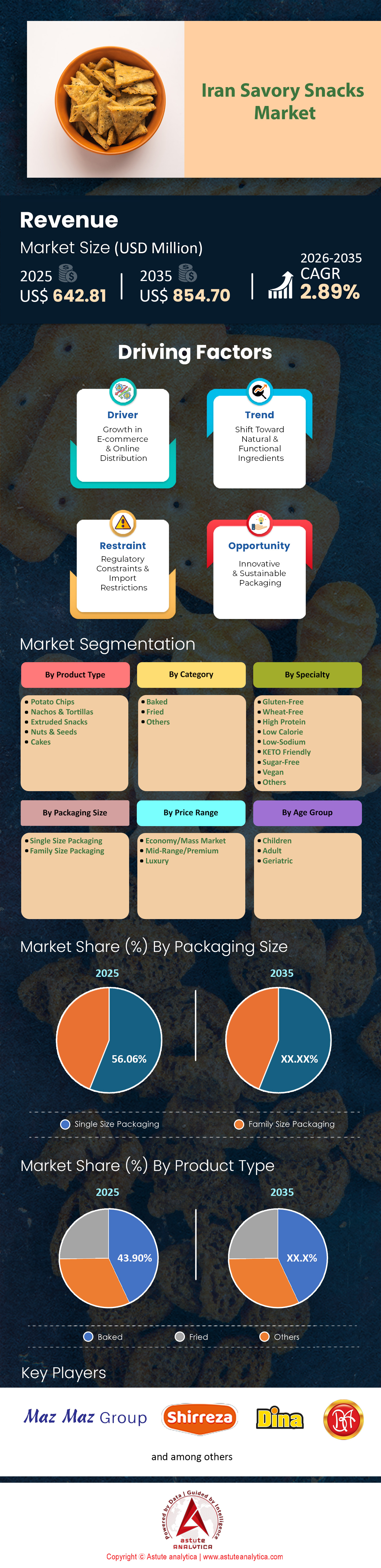
Iran savory snacks market size was valued at USD 642.81 million in 2025 and is projected to hit the market valuation of USD 854.70 million by 2035 at a CAGR of 2.89% during the forecast period 2026–2035.
Key Findings
- Based on category, baked savory snacks are set to capture the highest 43.90% market share.
- Based on specialty gluten-Free savory snacks keep dominating the market by accounting for more than 24% market share.
- Based on packaging, savory snacks packed in single packaging dominate the market and control the highest 56.06% market share.
- Based on price range, Economy/Mass Market segment of the savory snacks in the Iran market is holding the largest 54.60% market share.
- Based on age group of the consumers, adult emerged as the key consumers of the savory snacks in Iran. They accounts for the 65.49% market share.
The Iran savory snacks market in late 2025 presents a fascinating paradox. While the broader economy grapples with severe inflationary pressures and currency devaluation, the snack sector has not only survived but evolved into a critical component of the national food basket. It is no longer just about indulgence; for many, it has become a matter of affordable caloric sustenance.
Is the Market Actually Thriving Amidst Economic Pressure?
To understand the "goodness" or viability of this market, one must look beyond traditional GDP metrics and focus on volume resilience. In 2025, the Iranian savory snacks market is characterized by a "lipstick effect"—where consumers, priced out of big-ticket purchases like cars or electronics, still find room in their budget for affordable treats. Consequently, the market has seen a volume surge, particularly in the export sector.
Domestic producers have pivoted aggressively toward neighboring markets to bypass the weak Iranian Rial. As of late 2024, Iran cemented its status as a regional snack hub, exporting over 10,000 tons of potato chips annually, with a staggering 96% of this volume flowing directly into the Iraqi market. This isn't a stagnant industry; it is a vital trade artery. With fresh potato exports valued at $52 million in just the first five months of the fiscal year, the supply chain supporting this market is robust, proving that the sector is well-established and highly active.
To Get more Insights, Request A Free Sample
What is Fueling Relentless Demand?
The demand drivers in the Iran savory snacks market are fundamentally different from those in Western markets. Here, it is driven by economic substitution and demographic youth.
The cost of living has fundamentally altered dietary habits. With premium mixed nuts reaching a wholesale price of 6.66 million IRR per kilogram in December 2025—a roughly 40% year-over-year increase—traditional healthy snacks have become luxury items. In response, consumers have mass-migrated toward potato chips and extruded corn snacks, which offer a significantly lower entry price. When a kilogram of fresh potatoes trades at roughly 24,000 IRR (USD 0.15–0.25) in the wholesale market, the resulting processed chips remain one of the few inflation-resistant commodities available to the working class.
Moreover, the "snackification" of meals is rampant among Iran’s youth. With a monthly base wage hovering around $115 for a worker with two children, full restaurant meals are increasingly rare in the Iran savory snacks market. Instead, high-calorie snacks, often packing 500 kcal per 100g (as seen in standard cheese corn puffs), are being used as meal replacements or supplementary energy sources during the workday.
Which Products are Dominating the Shelves?
While the variety is vast, the Iran savory snacks market is structurally dominated by two categories: Potato Chips and Extruded Corn Snacks (Puffs).
The flavor palette in Iran is distinct. While salted chips remain the baseline, delivering 164.6 kcal per 30g serving, the market has seen a massive trend toward localized flavors. "Ketchup" and "Yogurt & Basil" are not niche; they are volume drivers. However, 2025 has been the year of the spicy variant. Products like Cheetoz’s "Crunchy Chili," sold in specific 95-gram packs, have captured the younger demographic’s palate.
On the packaging front, size matters. To combat shrinking wallets, companies like MazMaz have introduced "micro-packs" weighing as little as 22 grams, effectively creating a price floor that allows even low-income school children to remain consumers. conversely, for social gatherings, the 170-gram "Jumbo" or family packs remain popular, particularly for the Cheetoz "Motori" line, serving as a cheap entertainment staple.
How Mature is the Competitive Landscape of Iran Savory Snacks Market?
This is not a fragmented market of garage industries, it is a duopoly-led battlefield with high industrial maturity. The two giants, Dina Food Group (Cheetoz) and MazMaz, operate with Western-level efficiency. For instance, Dina Food upgraded its production capabilities in 2024/2025, achieving line speeds of 9,000 pieces per hour. Their operation is massive, comprising 10 distinct subsidiary entities to manage everything from raw material procurement to distribution. They are not merely surviving sanctions; they are innovating around them. By installing onsite nitrogen generators, Dina Food reportedly cut gas flushing costs by 50% in 2025, a move that protects their margins against currency fluctuation.
Furthermore, the barrier to entry for foreign competitors in the Iran savory snacks market is impossibly high due to pricing. Imported potato chips averaged US$ 5,193 per tonin 2024, whereas Iranian export−grade chips averaged justUS$ 2,036 per ton. This 2.5x price differential effectively walls off the market from international giants like Lays or Pringles, leaving the domestic playground entirely to local conglomerates.
How are Consumers Behaving in 2025?
Iranian consumer behavior is currently defined by price sensitivity and brand loyalty. Shoppers are increasingly channel-shifting. While traditional bazaars still exist, 41% of households now prefer purchasing snacks from supermarkets where shelf stability is guaranteed in the savory snacks market.
There is also a strong scrutiny of value. Consumers are acutely aware of "shrinkflation." When the standard chip bag weight fluctuates between 60g and 80g, shoppers are quick to switch brands if they feel the "air-to-chip" ratio is increasing. Additionally, health consciousness is rising, albeit slowly. The "traffic light" labeling system is strictly monitored by the Ministry of Health, with sodium levels (capped at 106.5 mg per 30g serving for salted chips) being a key check for parents buying for children.
What are the Key Challenges Holding the Iran Savory Snacks MarketBack?
Despite the growth, the road is paved with obstacles. The primary challenge is production cost volatility. The price of vegetable oil, a non-negotiable input for frying, skyrocketed by 167% in late 2024. This forces manufacturers to constantly recalibrate pricing strategies, risking consumer backlash.
Logistics also present a severe bottleneck in the savory snacks market. While export demand is high, getting the product out is difficult. Producers face hurdles at border crossings, particularly with Iraq, where tariff enforcement can vary daily. Moreover, the industry relies on imported machinery parts. With the Rial trading at roughly 1.31 million IRR to the USD in the open market, maintaining automated lines—like the new flour silos with depth sensors that reduce downtime by 30 minutes per shift—becomes an exorbitantly expensive affair.
Segmental Analysis
Gluten-Free Savory Snacks Expand Influence through Local Raw Material Advantage
With more than 24% market share, gluten-free savory snacks carve out a dominant position in the savory snacks market —supported not only by dietary preferences but also by Iran’s abundant corn and rice resources. These raw materials form the backbone of top products like popcorn and cheese puffs, already gluten-free by design. Corn imports surpassed 4 million tons in 2024, supplying manufacturers the flexibility to scale domestically at low cost.
Kaleh Dairy leveraged this supply advantage by launching three certified gluten-free Celino cheese puff variants that attract broad consumer segments. Domestic gluten-free corn chips sell at around 350,000 Rials, contrasting sharply with imported Schär chips costing 5,000,000 Rials, effectively excluding foreign competition.
Traditional formats play a reinforcing role in the Iran savory snacks market. The production of Chickpea flour (Nokhodchi) cookies doubled in Yazd, while rice-based savory crackers from Gilan province gained distribution in Mashhad and Tabriz. Meanwhile, Tehran’s specialized “Diet & Diabetic” shops surpassed 200 outlets, intensifying accessibility. Local quinoa cultivation expanded to 100 hectares, cutting dependency on costly grains.
Health trust has deepened consumer attachment to this segment. The Iranian Celiac Association recorded record membership, prompting mainstream brands like Maz Maz to print "Corn Only" seals on packs—a move aligning everyday affordability with health-driven assurance.
Single Packaging Commands Retail with Price Accessibility and Urban Practicality
Accounting for a dominant 56.06% market share, single-packaged snacks reign supreme in the savory snacks market as Iran’s essential value proposition. Under inflationary pressure, brands refined unit sizes from 80g to 45g, holding entry prices at a crucial 50,000 Rials—a psychological comfort zone for most shoppers. Multipacks of 20g mini-bags are breaking online sales records on SnappMarket, proving that households prefer controlled buying volumes over bulk purchases.
Manufacturers in the savory snacks market rapidly adapted supply chains. Lina Industrial Group, for instance, retooled half of its machinery to produce tube-style single packs catering to mass retail and impulse buyers. The sheer structure of Iran’s retail ecosystem consolidates this dominance—over 1,200 kiosk vendors across Tehran Metro operate exclusively with hanging single packs, sidelining bulk boxes entirely.
Institutional norms continue reinforcing this preference. School canteens in 15 provinces now mandate single-serving formats for hygiene compliance, while corporate vending machines stock only under-50g variants. Even seed producers joined the wave—sunflower seed brands upped production of “pocket-size” packs by 2 million units annually for stadium and event sales. Waste audits across Tehran parks reveal single-use wrappers as the most common litter—a visible marker of where and how consumers snack. Single packaging is thus not only the market’s fastest-moving format but also the most embedded in daily routines.
Economy and Mass Market Segment Sustains Leadership through Inflation Resilience
Holding 54.60% market share, the economy or mass market segment of the Iran savory snacks market anchors the entire Iranian savory snacks ecosystem. As inflation redefines consumption priorities, affordability has overtaken novelty as the key driver of purchase. With staple foods like Barbari bread up to 46,000 Rials per loaf, consumers treat snacks as essential comfort foods under austerity.
Volume retail chains mirror this demand shift. Ofogh Koorosh discount stores report economy-tier snacks as their top sales category. Government policy bolsters this segment—continued subsidized flour allocations for local biscuit producers enable giants like Maz Maz to price 40% lower than smuggled imports. Import tariffs have pushed Pringles cans to an unattainable 1,800,000 Rials, effectively leaving the market to domestic players.
Rural and informal retail channels amplify this pattern in the Iran savory snacks market. Bulk-bin savory snacks now outsell packaged alternatives in smaller towns, while street vendors selling roasted corn have doubled daily footfall counts. Industry players respond with dedicated budget lines—Batata’s “Budget” series uses inexpensive local potatoes to deliver calorie value cheaply. Cooperative retailers such as Etka have increased shelf space for price-capped snacks by five times, supported by “Buy 2 Get 1 Free” campaigns that keep shoppers loyal. This segment endures because it ensures continuous access to affordable calories for working-class consumers—a matter of survival, not luxury.
Adult Consumers Power Market Demand through Lifestyle and Social Rituals
Adults dominate consumption patterns in the Iran savory snacks market, representing 65.49% of total market share. Unlike Western markets centered on children, Iran’s savory snacks align deeply with adult rituals and social interactions. The country’s thriving café culture—now exceeding 8,000 cafés in Tehran—has elevated savory biscuits as a common accompaniment to coffee and tea. Late-night snacking behaviors are particularly strong; SnappFood reports order peaks for salty items between 10 PM and 1 AM.
Social environments further entrench adult demand. Hookah lounges and tobacco shops rank among leading retail points for flavored seeds and nuts. Survey data show taxi drivers across major cities choose sunflower seeds as their go-to energy source, linking snack use directly with daily professional life. These habits establish a steady consumption rhythm that younger demographics rarely match.
Manufacturers in the savory snacks market have adapted to these preferences with bolder flavor experimentation. According to Dina Food’s internal data, spice-forward profiles such as “Spicy Ketchup” and “Pepper” dominate sales among consumers aged 25 and above. The rising popularity of non-alcoholic beer also spurred pretzel stick demand, pairing traditional indulgence with modern social habits. Widespread “stress-eating” tendencies among urban professionals have driven a sustained spike in crunchy formats expressing satisfaction through texture.
Economic pressures have reshaped this demographic’s snack priorities but not its participation level. Middle-income adults increasingly substitute expensive “Ajil” nut mixes with peanuts while maintaining consumption frequency. Tech-zone breakrooms reinforce continuous adult snacking, stocking vending machines primarily with savory and baked options. This entrenched behavioral base solidifies adult consumers as the core value pillar of Iran’s savory snacks market.
Customize This Report + Validate with an Expert
Access only the sections you need—region-specific, company-level, or by use-case.
Includes a free consultation with a domain expert to help guide your decision.
Baked Savory Snacks Drive Market Leadership through Cultural Alignment and Value
Commanding 43.90% market share, baked savory snacks have firmly established their dominance in the Iran savory snacks market by fusing traditional dietary preferences with affordability. Major producers continue to expand aggressively—Minoo Industrial Group added two new production lines dedicated exclusively to baked cracker varieties, tracking a consumer shift away from oily fried snacks. This category thrives because it perfectly complements Iran’s deep-rooted tea culture. Products like "Saghe Talaie" whole wheat biscuits now top non-sweet sales charts in Tehran’s wholesale hubs.
Retail behavior reinforces this supremacy. Hyperstar markets expanded baked snack shelf space by three full aisles to manage high turnover, while Isfahan alone added 150 new bakeries producing fresh savory rusks, ensuring strong presence across both industrial and artisanal fronts.
The resilience of baked goods acts as the segment’s economic engine in the Iran savory snacks market. Compared with imported baked rice crackers priced at 2,500,000 Rials, domestic baked potato snacks remain affordable around 150,000 Rials per pack. Brands have sustained this perception by slightly reducing standard weights—baked pretzel packs dropped to 60 grams, keeping retail prices stable for middle-income consumers. Dina Food Industries exemplifies this value strategy with its oven-baked Cheetoz chips, now marketed as the “smarter” choice versus air-filled fried alternatives.
Government regulation further strengthens baked snacks’ dominance in the savory snacks market. The Iranian National Standards Organization recently capped salt levels below 1.5 grams, enabling brands to claim health-friendly positioning. Gorji Biscuits reported that savory lines now outsell their sweet products in northern provinces, confirming consumers’ pivot toward perceived wellness without premium pricing.
To Understand More About this Research: Request A Free Sample
Top Companies in the Iran Savory Snacks Market
Manufacturer
- Golnoosh Bakhtar Food Industries
- Talachin Agro-Industrial (Bato)
- ADM
- Tak Makaron Company
- Golestan Company
- Maz Maz Industerial Group
- Minoo Industrial Group
- Linanik Crop
Retail
- Bakkali
- Shahrvand Chain Stores
- ShopiPersia
- Other Prominent Players
Market Segmentation Overview
By Product Type
- Potato Chips
- Nachos & Tortillas
- Extruded Snacks
- Nuts & Seeds
- Cakes
By Category
- Baked
- Fried
- Others
By Specialty
- Gluten-Free
- Wheat-Free
- High Protein
- Low Calorie
- Low-Sodium
- KETO Friendly
- Sugar-Free
- Vegan
- Others
By Packaging Type
- Single Size Packaging
- Family Size Packaging
By Price Range
- Economy/Mass Market
- Mid-Range/Premium
- Luxury
By Age Group
- Children
- Adult
- Geriatric
FREQUENTLY ASKED QUESTIONS
The market remains resilient despite economic headwinds. Valued at USD 642.81 million in 2025, it is projected to reach USD 854.70 million by 2035, growing at a CAGR of 2.86%. Growth is driven by volume resilience as consumers prioritize affordable snacks over big-ticket items.
Demand is fueled by the Lipstick Effect and economic substitution. With premium nuts seeing a 40% price hike, consumers have shifted to affordable chips and corn puffs. Additionally, high-calorie snacks (500 kcal/100g) are increasingly used by the working class as low-cost meal replacements.
Baked Savory Snacks lead with a 43.90% market share, favored for their alignment with Iran's tea culture and perceived health benefits. Gluten-Free snacks also hold a significant 24% share, supported by abundant local corn supplies that keep prices far below imported alternatives.
Adults are the dominant consumer base, accounting for 65.49% of the market share, driven by social snacking in cafés and workplaces. To accommodate price sensitivity, Single Packaging controls 56.06% of sales, offering an affordable entry price (approx. 50,000 Rials) for daily buyers.
The barrier to entry is almost exclusively pricing. In 2024, imported chips averaged US$ 5,193 per ton, while Iranian export−grade chips averaged justUS$ 2,036 per ton. This 2.5x price differential makes foreign brands unaffordable for the mass market, securing a duopoly for local giants like Dina Food and MazMaz.
Production cost volatility is the main hurdle, with vegetable oil prices spiking 167% in late 2024. Additionally, currency devaluation (approx. 1.31 million IRR/USD) and logistical bottlenecks at border crossings create significant operational friction for exporters.
LOOKING FOR COMPREHENSIVE MARKET KNOWLEDGE? ENGAGE OUR EXPERT SPECIALISTS.
SPEAK TO AN ANALYST
.svg)

 Schedule a Meeting

Features | Type of License | ||||
 Data Book | Single User |   Multi User |  Corporate | ||
| e-Access | ✓ | ✓ | ✓ | ✓ | |
User Sharing | 1 User Only | 1 User Only | Up to 7 Users | Unlimited User Access | |
⨉ | ⨉ | ⨉ | ✓ | ||
Free Customization | No Free Customization | Up To 30 hrs work | Up To 60 hrs work | Up To 80 hrs work | |
Deliverable |
| ⨉ | ✓ | ✓ | ✓ |
| ✓ | ⨉ | ✓ | ✓ | |
| ⨉ | ⨉ | ⨉ | ✓ | |
Analyst Support | 2-Months Analyst Support | 4-Months Analyst Support | 7-Months Analyst Support | One Year Analyst Support | |
Free Report update in next update cycle | ⨉ | ⨉ | ⨉ | ✓ | |
Free Industry Update (Within 180 days) | ⨉ | ⨉ | ⨉ | ✓ | |
Benefit | Up to 10% off on Post Purchase | Up to 20% off on Post Purchase | Up to 30% off on Post Purchase | Up to 40% off on Post Purchase | |