Market Scenario
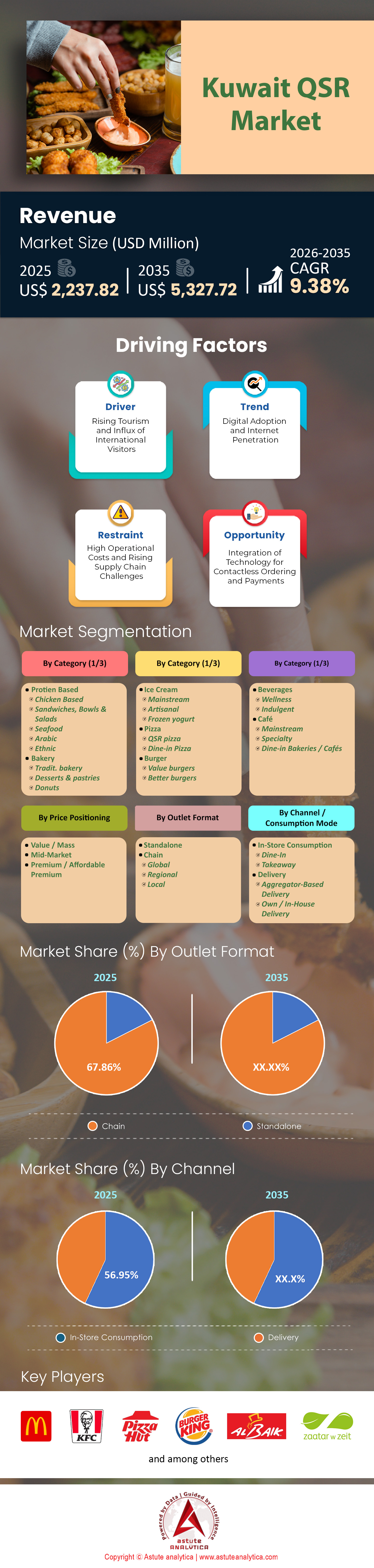
Kuwait QSR Market size was valued at USD 2,237.82 million in 2025 and is projected to hit the market valuation of USD 5,327.72 million by 2035 at a CAGR of 9.38% during the forecast period 2026–2035.
Key Findings:
- Digital Penetration: Online food delivery penetration has hit 99% among Gen Z and Millennials.
- Market Shift: The "Burger" segment is saturated; growth is shifting toward "Specialty Coffee" and "Healthy/Functional" QSR concepts.
- Primary Threat: Labor shortages due to strict "Kuwaitization" quotas are forcing a pivot toward automation and Kiosks.
- Based on product category: Protein based products are leading the Kuwait’s QSR market by capturing over 30% market share.
- Based on price positioning: Value/Mass pricing currently dominates the market with over 49.52% market share.
- Based on outlet format: Chain outlets are controlling the highest 67.86% stake in Kuwait QSR market.
- Based on channel: In-Store Consumption poised to continue holding the market lead with over 56.95% market share.
The Kuwaiti Quick Service Restaurant (QSR) sector represents one of the most high-density, high-value food ecosystems in the GCC. Despite a relatively small population of ~4.9 million, Kuwait commands a disproportionately high per-capita spend on food service, driven by high disposable income, a lack of alternative entertainment options, and a deeply ingrained "ordering-out" culture.
As of early 2026, the Kuwaiti Food Service market is valued at approximately $3.54 Billion (USD), with Kuwait QSR Market accounting for a dominant nearly 63% market share. The sector is projected to grow at a CAGR of 8.1% through 2031. However, the market is no longer defined simply by the expansion of Western franchises. The current era is characterized by "Hyper-Localization"—where homegrown Kuwaiti brands are displacing international giants—and "Digital Saturation," where cloud kitchens and aggregators have fundamentally altered unit economics.
To Get more Insights, Request A Free Sample
Macro-Economic Backdrop
As per Astute Analytica’s latest findings, Kuwait remains a rentier state heavily reliant on oil, yet its consumer economy is insulated by a massive public sector wage bill.
- Disposable Income: Kuwait boasts one of the highest GDP per capita figures globally (approx. $32,000+). This liquidity allows for a high Average Order Value (AOV). In Kuwait, a "fast food" meal is often priced at a premium (3.5 - 5.0 KWD /11−16 USD) compared to global averages, yet resistance to price hikes remains low compared to other QSR markets.
- Demographic Dividend: The population is heavily skewed young, with over 25% under the age of 14 and a massive working-age expat population. This dual demographic in the Kuwait QSR Market drives two distinct QSR tiers:
- Premium QSR: Targeted at Nationals (e.g., Shake Shack, Elevation Burger).
- Value QSR: Targeted at the expat labor force (e.g., Jollibee, McDonald's Value Meals).
- Vision 2035: The government's push for "New Kuwait" (Vision 2035) has led to the development of massive entertainment hubs (like the expansion of The Avenues and Winter Wonderland Kuwait). These hubs act as anchors for QSR cluster development, moving traffic away from traditional street-side retail.
Consumer Behavior & The "Diwaniya" Effect on Kuwait QSR Market
Understanding the psychology of the Kuwaiti diner is critical for stakeholders in the Kuwait QSR Market.
The Diwaniya Culture:
Unique to Kuwait is the "Diwaniya"—a traditional weekly male gathering. These gatherings are massive drivers of Late-Night Bulk Orders. QSRs that fail to offer "Gathering Boxes" or "Diwaniya Packs" (12+ sliders, family fries, 2-liter drinks) lose significant market share. Marketing campaigns in Kuwait often specifically target the 9:00 PM – 2:00 AM window to capture this audience.
The "Instagrammability" Factor Having Strong Impact on the Kuwait QSR Market:
Kuwait is arguably the "Food Capital" of the Arab world regarding social media influence. A new QSR concept cannot survive without a "viral" product.
The lifecycle of a food trend in Kuwait is short (6-8 months). Brands must innovate rapidly. The market witnessed this with the "Cronut" craze, followed by "Brisket Sliders," and recently "Matcha-infused" desserts.
The Health Paradox:
Kuwait QSR Market suffers from one of the highest obesity rates in the world (approx. 78% overweight/obese). Paradoxically, this has created a booming market for "Healthy QSR." Brands like Pick (offering macro-counted bowls and frozen yogurt) have scaled as rapidly as burger chains. The consumer creates a cycle: "Cheat meals" (Premium Burgers) on weekends and "Keto/Healthy" meals on weekdays.
What Are the Growth Forecasts For Kuwait QSR Market: Dine-In vs. Delivery?
The post-pandemic era has permanently altered the revenue split. In 2026, Kuwait is a "Delivery-First" nation.
| Channel | 2024 Share | 2026 Share (Est.) | 2035 Forecast | Trend Analysis |
| Dine-In | 45% | 38% | 35% | Becoming "Experience" based. Mall locations remain strong; street dining declines. |
| Delivery | 50% | 55% | 60% | Driven by aggregator dominance and late-night culture. |
| Drive-Thru | 5% | 7% | 5% | High yield per sq/meter. Crucial for summer months (May-Sept). |
The growth is not in the number of mouths to feed, but the frequency of transactions. The average active user in Kuwait orders delivery 4.2 times per week, one of the highest frequencies globally.
Competitive Landscape
The Giants
The Kuwait QSR Market is an oligopoly dominated by three major conglomerates that control the master franchise rights for global brands.
1. Americana Restaurants (The Legacy Titan):
- Portfolio: KFC, Hardee’s, Pizza Hut (MENA rights), Krispy Kreme, Wimpy.
- Strategy: Americana wins on Volume and Real Estate. They possess the best drive-thru locations in the country. Their strategy recently has been digital integration, pushing users to the "Americana App" to bypass aggregator commissions.
- Key Strength: KFC remains the undisputed leader in the chicken segment in Kuwait.
2. Alshaya Group (The Premium Lifestyle Player):
- Portfolio: Starbucks, Shake Shack, Chipotle (New Entry), Raising Cane's, P.F. Chang's.
- Strategy: Alshaya positions its QSRs as "Fast Casual" or "Premium." They dominate the Mall Ecosystem (The Avenues, 360 Mall).
- Key Move: The acquisition of Chipotle rights is a strategic play to capture the customized/fresh-mex market which was previously fragmented among local players.
3. Kout Food Group (The King of Burgers):
- Portfolio: Burger King, Pizza Hut (Kuwait Operations), Taco Bell, Applebee's.
- Strategy: Kout in the Kuwait QSR Market focuses heavily on Product Innovation within Burger King, frequently releasing Kuwait-exclusive limited-time offers (LTOs) that cater to local spicy palettes.
The Rise of "Homegrown" Players
Unlike other GCC markets where US franchises dominate 90% of the sector, Kuwait QSR Market has a fierce local startup scene that often outperforms global brands.
- Elevation Burger: While originally US-based, its execution in Kuwait (by Tabco) revolutionized the market, proving Kuwaitis would pay double for organic/grass-fed beef.
- BBT (Best Burger in Town): A local concept that scaled through high-quality, simple menus and aggressive social media marketing.
- Pick: A specialized healthy-eating concept that expanded from a single outlet to a ubiquitous presence in co-ops and gas stations, effectively creating the "Grab-and-Go" healthy vertical.
Study suggests that investors are increasingly looking to acquire successful Kuwaiti concepts to franchise them across the GCC (Saudi Arabia and UAE), rather than bringing US brands into Kuwait.
Menu Trends: The Premiumization & Health Paradox
The "Slider" Economy:
Kuwait invented the "Slider" obsession in the region. Full-sized burgers are secondary to boxes of 6, 12, or 24 sliders. This format facilitates sharing (Diwaniya culture) and increases AOV across the Kuwait QSR market.
Chicken is the New Beef:
While burgers dominated 2015-2020, the 2024-2026 period is seeing a surge in Fried Chicken concepts (Nashville Hot Chicken). Raising Cane’s success proved the demand for premium chicken tenders, sparking dozens of local copycats.
Coffee as a QSR:
Specialty coffee is not just a beverage sector; it is a QSR category. Brands like Arabica (started in Kyoto but scaled massively in Kuwait) and Vol.1 operate with QSR speed. The "Drive-Thru Coffee" model is currently the highest yield-per-square-meter sub-sector in Kuwaiti F&B.
Is the "Burger Craze" Over in the Kuwait QSR Market? (Menu Engineering Trends)
While burgers remain a staple, the market is saturated. The "Blue Ocean" opportunities lie elsewhere.
- The Fried Chicken Renaissance: Following the success of Raising Cane’s, there is a massive surge in "Nashville Hot Chicken" concepts. The local palate loves spice, making this a high-growth vertical.
- Coffee as QSR: Brands in the Kuwait QSR market like Vol.1 and Arabica operate with QSR speed. The "Drive-Thru Coffee" model creates the highest revenue per square meter in the industry.
- The Slider Economy: Full-sized burgers are losing share to sliders, which facilitate the "sharing culture" essential for Diwaniyas and family meals.
Talabat vs. Deliveroo: Who Wins the Aggregator War?
Kuwait is a duopoly Kuwait QSR market with fierce competition.
- Talabat: The incumbent market leader. It holds an emotional monopoly but faces backlash from restaurant owners due to high commissions (reaching 25-30%).
- Deliveroo: Positions itself as the premium alternative with faster logistics and better rider tracking.
- The Disruptor (Cari): Cari has entered with a focus on "Zero Commission" models and 30-minute delivery promises, gaining rapid traction among local SMEs who cannot afford Talabat's margins.
Large QSR groups are investing heavily in Direct-to-Consumer (D2C) apps to own the customer data and avoid the "Aggregator Tax."
Is Kuwait the Global Testbed for Cloud Kitchens?
Yes. Kuwait QSR market has one of the highest densities of Cloud Kitchens (Dark Kitchens) in EMEA.
- The Players: Kitopi is the dominant force, operating "Managed Cloud Kitchens" where they cook for 60+ brands under one roof.
- The Economics: With commercial rents in areas like Salmiya and Kuwait City skyrocketing, new entrants are bypassing brick-and-mortar. Launching a "Virtual Brand" costs approx. USD 15,000 compared to USD 250,000+ for a physical store.
- The Risk: Discoverability. Without a physical storefront, brands are entirely at the mercy of the Talabat/Deliveroo algorithm.
Strategies for Mitigating Risk in a Market Dependent on 90% Food Imports and Volatile Logistics
Kuwait’s food security is fragile. With virtually no arable land, the QSR sector is entirely at the mercy of global supply chains. The winners in this market are those who master Inventory Engineering.
The "Co-op" Price Ceiling:
A unique feature of the Kuwaiti QSR market is the influence of the Union of Consumer Cooperative Societies. While QSRs are not directly regulated by Co-op pricing, the Co-ops set the "psychological price anchor" for the consumer. If the price of raw chicken in the Co-op remains stable (subsidized), QSRs face immense resistance if they attempt to pass on inflationary costs to diners.
Strategic Stockpiling in Shuaiba Across Kuwait QSR Market:
The most sophisticated operators (Americana, Kout, Alshaya) have moved beyond "Just-in-Time" inventory.
- The Strategy: They are utilizing massive cold-storage facilities in the Shuaiba Industrial Area to hold 4-6 months of strategic stock (frozen proteins, fries, oil).
- Hedging Inflation: By bulk-buying during global price dips and storing locally, these giants hedge against the 5-7% annual food inflation, allowing them to undercut smaller competitors who are buying at spot prices.
Menu Re-Engineering:
Astute Analytica findings suggest that Kuwait QSR market is witnessing a shift away from US/European sourcing toward Regional Sourcing. For instance, beef imports are shifting from expensive US shipments to high-quality alternatives from Brazil or regional partners, specifically to circumvent Red Sea logistics risks that have plagued the sector since 2024.
The Battle for Prime Real Estate: Analyzing the Shift from Mega-Malls to Community Drive-Thru Clusters
The real estate strategy for QSRs in Kuwait has bifurcated into two distinct, non-overlapping asset classes: The "Billboard" and The "Cash Cow."
The "Billboard": The Avenues & 360 Mall
Opening in Phase 4 of The Avenues in the Kuwait QSR market is a marketing expense, not a profit center.
Rents here can exceed 250 KWD per square meter, among the highest in the world. However, presence is mandatory for brand equity. It serves as the "Flagship" that validates the brand to the consumer, driving delivery orders in residential areas.
The "Cash Cow": The Rise of the Community Drive-Thru in Kuwait QSR Market
The real profitability lies in the "virgin territories" of new residential cities like Al Mutlaa and West Abdullah Al-Mubarak.
- The Opportunity: These areas are densely populated by Kuwaiti families (high purchasing power) but are severely underserved by F&B retail.
- The "Pod" Model: Instead of building large dine-in restaurants, operators are leasing small plots in co-op parking lots to install "Container Drive-Thrus." These units have a CapEx of 30% of a traditional store but generate 80% of the revenue due to the intense demand for convenience in Kuwait’s car-centric culture.
Key Money (Khulu) Trends:
While Key Money in malls is stabilizing, Key Money for prime street-side drive-thru locations (e.g., Arabian Gulf Street, Ardiya Craft Zone) is exploding across the Kuwait QSR market, often exceeding 150,000 KWD just to secure the lease transfer.
Understanding the Labyrinth of Regulatory Compliance, Health Inspections, and Foreign Direct Investment Laws
For foreign investors, Kuwait QSR market presents a regulatory paradox: High potential returns guarded by a complex bureaucratic fortress.
The FDI Landscape (KDIPA):
Historically, foreign ownership was impossible without a local sponsor (51% ownership). However, the Kuwait Direct Investment Promotion Authority (KDIPA) now allows 100% foreign ownership if the business adds specific value (e.g., technology transfer, job creation for nationals).
- The Hurdle: For a standard QSR, qualifying for KDIPA is difficult unless it involves significant manufacturing or food tech infrastructure. Most entrants still rely on the Franchise model or a silent partner structure.
The "Municipality" Factor:
The Kuwait Municipality operates with high autonomy and aggression regarding food safety.
- Zero Tolerance: Unlike other jurisdictions that issue warnings, Kuwaiti inspectors frequently close restaurants immediately for violations and publish the closure on social media. This "Digital Shaming" can permanently destroy brand equity in the Kuwait QSR market.
- Halal Strictness: The Ministry of Awqaf plays a role in verifying Halal certificates. "Pork-free" is not enough; the entire supply chain must be Halal certified, and recent crackdowns on "Alcohol-based" vanilla extracts or cooking wines have caught many Western franchises off guard.
Assessing the Capital Expenditure Requirements and Return on Investment Timelines for New Market Entrants In the Kuwait QSR Market
The financial profile of a Kuwaiti QSR opening in 2026 differs significantly from the pre-2020 era.
CapEx Inflation:
The cost to build a premium QSR unit (150 sqm) has risen to approx. $350,000 - $500,000 USD (excluding key money). This is driven by increased costs in construction materials and the requirement for high-end fit-outs to compete with the "Instagrammable" standards of the market.
ROI Extension:
- 2020 Era: Target payback period was 18-24 months.
- 2026 Era: Target payback period is now 36-42 months.
- Why? Margin compression: While topline revenue remains high (thanks to high AOV), the "Middle of the P&L" (Aggregator commissions, Labor visa costs, Rent) has thickened.
Valuation Multiples:
Despite the tougher margins, successful Kuwaiti QSR groups are exiting at healthy multiples. Private Equity firms (regional) are acquiring consolidated QSR portfolios at 7x - 9x EBITDA, valuing the cash flow consistency and the potential to franchise the brand into Saudi Arabia (KSA).
Segmental Analysis of the Kuwait QSR Market
By Product Protein Keep the Dominance as Chicken and Beef Products Anchor the Kuwaiti Palate
The protein-based products commanding 30% market share. The dominance is driven by Kuwait’s status as one of the highest per-capita meat consumers in the GCC. This segment’s dominance is structurally secured by the aggressive expansion of major franchise operators who prioritize "core protein" items over experimental menus. For instance, Americana Restaurants, the largest operator in the region, reported in their recent financial disclosures that their chicken-centric brands (primarily KFC) remained the primary revenue driver across Kuwait in 2024-2025.
This consumption in the Kuwait QSR market is not just about volume; it is about format. The local "Slider Culture"—pioneered by brands like Elevation Burger and Pick—has normalized high-frequency beef consumption. Furthermore, recent supply chain adjustments have stabilized protein costs. According to Americana’s 2024 Annual Report, the group successfully opened 200+ net new stores regionally, with a heavy emphasis on protein-heavy menus to cater to this specific demand. The dominance is further solidified by the local preference for "bone-in" fried chicken, which remains a staple for family gatherings (Diwaniyas).
By Price Positioning, Value Pricing is Maintaining Supremacy
Value pricing controls 49.52% of the Kuwait QSR market because it bridges the gap between Kuwait’s bifurcated demographics: the affluent national population and the massive expatriate labor force. With inflation impacting disposable income, major players have engaged in a "Price War" to protect market share. McDonald’s Kuwait and KFC have strategically pivoted to "Bundle Economics," aggressively marketing meals in the 1.500 KWD to 2.500 KWD range to capture the lunch-break crowd.
This shift is a direct response to macroeconomic pressures in the Kuwait QSR market. Data from the Kuwait Central Statistical Bureau (CSB) indicated that Food & Beverage inflation hovered around 3-4% in 2024, pushing consumers toward "Smart Saver" menus. Operational insights from Alshaya Group suggest that while their premium brands drive brand equity, their value-tier transactions ensure cash flow consistency. High-volume, low-margin value meals act as the defensive moat against the rising cost of living, making this segment the undisputed leader in transaction count.
By Outlet Format, Chain Outlets Hold Monopoly in the Kuwait QSR Market Thanks to Power of Franchise Scalability and Real Estate
Chain outlets hold a 67.86% stake primarily because independent operators can no longer survive the "Triple Squeeze" of rent, regulation, and recruitment. The Kuwaiti market favors conglomerates like Kout Food Group and Americana because they control the prime real estate supply chain. In 2025, access to "Drive-Thru" locations—the most profitable asset class—is almost exclusively locked by major chains due to exorbitant "Key Money" requirements that SMEs cannot afford.
Furthermore, regulatory complexities regarding "Kuwaitization" favor large chains that can absorb higher labor costs through economies of scale in the Kuwait QSR market. A 2025 operational update from Mabanee Company (owners of The Avenues) revealed that occupancy rates remain near 97%, with major chains securing long-term leases that crowd out smaller players. This dominance is not accidental; it is a result of capital barriers. Chains leverage centralized kitchens to maintain consistency, a capability that single-unit outlets lack, ensuring their continued hegemony over the market structure.
Customize This Report + Validate with an Expert
Access only the sections you need—region-specific, company-level, or by use-case.
Includes a free consultation with a domain expert to help guide your decision.
By Channel, In-Store Consumption Accounts for the Highest Market Share
Despite the digital surge, In-Store Consumption retains a 56.95% market share in the Kuwait QSR market because dining in Kuwait is an "entertainment activity," not just a caloric necessity. This segment captures the high-ticket social spending that occurs within Kuwait’s mega-malls. The Avenues, visited by millions annually, serves as the primary social hub due to the country’s harsh weather conditions, making indoor dining the default leisure option for families.
Recent footfall data from Mabanee’s 2024 Earnings Call highlighted a record surge in visitor numbers, directly correlating to increased dine-in revenues for tenant QSRs. While delivery dominates frequency, in-store dining dominates basket size. Families dining at Cheesecake Factory or Shake Shack (Alshaya) generate a significantly higher Average Order Value (AOV) compared to solo delivery orders. The "Experience Economy" keeps this channel vital, as QSR operators invest heavily in "Instagrammable" interiors to lure Gen Z customers back into physical locations, ensuring the channel’s continued leadership.
To Understand More About this Research: Request A Free Sample
Top Companies in the Kuwait Quick Service Restaurant Market
- McDonald's
- KFC
- Pizza Hut
- Burger King
- ALBAIK
- Zaatar w Zeit
- Starbucks Corporation
- Other Prominent Players
Market Segmentation Overview
By Category
- Protien Based
- Chicken Based
- Sandwiches, Bowls & Salads
- Seafood
- Arabic
- Ethnic
- Bakery
- Tradit. bakery
- Desserts & pastries
- Donuts
- Ice Cream
- Mainstream
- Artisanal
- Frozen yogurt
- Pizza
- QSR pizza
- Dine-in Pizza
- Burger
- Value burgers
- Better burgers
- Beverages
- Wellness
- Indulgent
- Café
- Mainstream
- Specialty
- Dine-in Bakeries / Cafés
By Price positioning
- Value / Mass
- Mid-Market
- Premium / Affordable Premium
By Outlet Format
- Standalone
- Chain
- Global
- Regional
- Local
By Channel/Consumption Mode
- In-Store Consumption
- Dine-In
- Takeaway
- Delivery
- Aggregator-Based Delivery
- Own / In-House Delivery
FREQUENTLY ASKED QUESTIONS
Valued at USD 2,237.82 million in 2025, it's projected to reach USD 5,327.72 million by 2035, growing at a CAGR of 9.38% (2026–2035), fueled by high per-capita spend and digital delivery.
Burger saturation pushes growth to fried chicken (e.g., Nashville Hot), sliders for Diwaniya sharing, and specialty coffee QSRs like Arabica, yielding highest revenue per sqm via drive-thrus.
Delivery surges to 60% share by 2035 (from 50% in 2024), dominating late-night orders at 4.2x weekly frequency; dine-in holds 35% as experiential mall anchor.
Oligopoly of Americana (KFC volume), Alshaya (premium like Shake Shack), and Kout (Burger King innovation); homegrown like Elevation Burger and Pick challenge via localization.
Kuwaitization quotas spur kiosks/automation; 90% import reliance demands Shuaiba stockpiling (4-6 months) and regional sourcing (e.g., Brazil beef) to hedge 5-7% inflation.
CapEx for a 150 sqm unit: $350K–$500K; payback now 36-42 months (vs. 18-24 pre-2020) due to commissions/rents; chains exit at 7-9x EBITDA via GCC franchising.
LOOKING FOR COMPREHENSIVE MARKET KNOWLEDGE? ENGAGE OUR EXPERT SPECIALISTS.
SPEAK TO AN ANALYST
.svg)

 Schedule a Meeting

Features | Type of License | ||||
 Data Book | Single User |   Multi User |  Corporate | ||
| e-Access | ✓ | ✓ | ✓ | ✓ | |
User Sharing | 1 User Only | 1 User Only | Up to 7 Users | Unlimited User Access | |
⨉ | ⨉ | ⨉ | ✓ | ||
Free Customization | No Free Customization | Up To 30 hrs work | Up To 60 hrs work | Up To 80 hrs work | |
Deliverable |
| ⨉ | ✓ | ✓ | ✓ |
| ✓ | ⨉ | ✓ | ✓ | |
| ⨉ | ⨉ | ⨉ | ✓ | |
Analyst Support | 2-Months Analyst Support | 4-Months Analyst Support | 7-Months Analyst Support | One Year Analyst Support | |
Free Report update in next update cycle | ⨉ | ⨉ | ⨉ | ✓ | |
Free Industry Update (Within 180 days) | ⨉ | ⨉ | ⨉ | ✓ | |
Benefit | Up to 10% off on Post Purchase | Up to 20% off on Post Purchase | Up to 30% off on Post Purchase | Up to 40% off on Post Purchase | |