Market Scenario
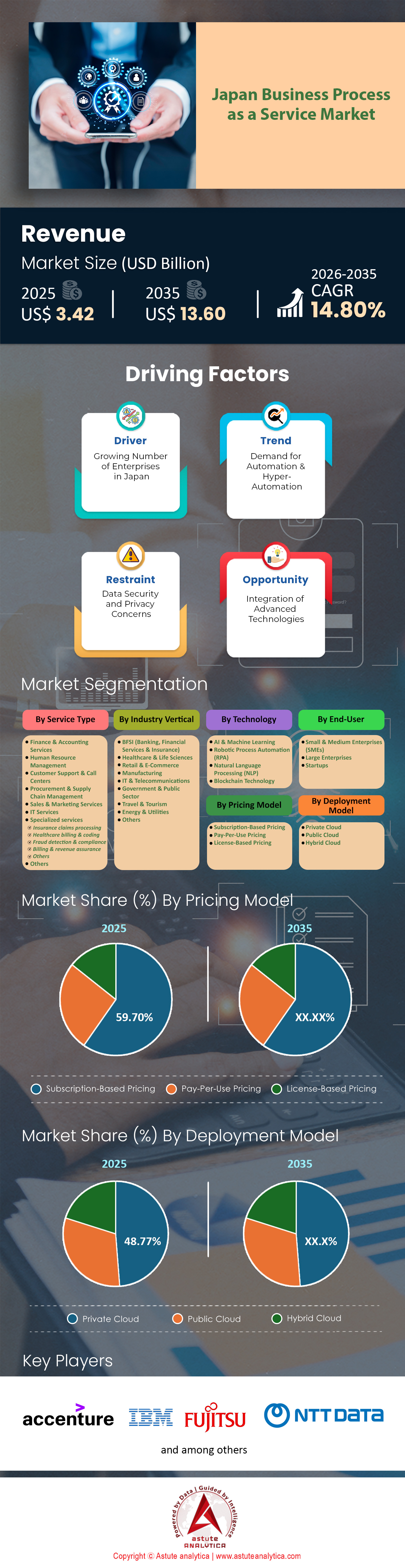
Japan business process as a service market size was valued at USD 3.42 billion in 2025 and is projected to hit the market valuation of USD 13.60 billion by 2035 at a CAGR of 14.80% during the forecast period 2026–2035.
Key Market Highlights
- By Service Type, Finance & Accounting Services segment holds highest share 24.97% of the Japan business as a service market.
- By Technology, Robotic Process Automation (RPA) segment holds highest share 44.76%.
- By pricing model, Subscription-Based Pricing segment holds highest share 59.70%.
- By Deployment Model, Private Cloud segment holds highest share 48.77%.
- By Industry verticals, BFSI (Banking, Financial Services & Insurance) segment holds highest share 23.17%.
- By Enterprise Size, Large Enterprises segment holds highest share 64.43%.
- By Region, Kanto accounts for 40% revenue share of the Japan business as a service market.
What is Business Process as a Service and Why Its Demand is On the Rise?
Business Process as a Service (BPaaS) represents the next evolutionary step in outsourcing, moving beyond simple software access to the complete delivery of business outcomes through cloud-based platforms. Unlike traditional SaaS, which provides the tool, or traditional BPO, which provides the people, BPaaS combines both—delivering automated, standardized processes for HR, payroll, accounting, and logistics. In the context of the Japan business process as a service sector, this model is rapidly becoming the operational backbone for a nation facing a demographic crisis.
The shift in the Japan business process as a service market is visible at the macroeconomic level. Companies in the Japan business process as a service market are no longer simply "using software"—they're outsourcing entire layers of complexity, allowing them to focus on core strategy while the cloud handles the regulatory and operational heavy lifting. Japan recorded a record 6.46 trillion yen digital trade deficit in 2024, a figure that has tripled since 2014. While this indicates a heavy reliance on foreign tech giants, it also signals a massive, aggressive consumption of cloud services as Japanese enterprises race to modernize their infrastructure.
To Get more Insights, Request A Free Sample
Why is Japan's BPaaS Market Experiencing Explosive Growth?
The explosive growth of Japan business process as a service market is not driven by mere trend-chasing but by existential necessity. Japan is grappling with the "2024 Problem," a regulatory and demographic collision that has made manual back-office management nearly impossible. Strict labor laws enforced since April 2024 now cap annual overtime at 960 hours for truck drivers and 720 hours for construction workers. With the average truck driver now aged 54 years, the logistics and construction sectors are physically running out of manpower. The Japan business process as a service market provides the automation required to maintain productivity despite a shortfall of 140,000 drivers.
Furthermore, the economic pressure on non-digitalized firms is severe. Fiscal year 2024 saw 10,144 corporate bankruptcies, the highest in over a decade. Notably, 309 of these were specifically attributed to labor shortages. In this environment, BPaaS is no longer a luxury; it is a survival mechanism. Companies are adopting these services to automate tasks that they simply cannot hire humans to perform anymore.
Which Services Are Witnessing the Strongest Demand?
The demand across the Japan business process as a service market is heavily skewed toward "Compliance Tech"—specifically HR, payroll, and invoice management. This surge is fueled by the introduction of the Qualified Invoice System and the complexities of managing a shrinking, increasingly diverse workforce. SmartHR, a leader in this segment, has seen its user base swell to 70,000 companies, achieving an Annual Recurring Revenue (ARR) of 15 billion yen. The platform's ability to automate social insurance and tax documentation is critical for firms that lack specialized HR staff.
Simultaneously, financial digitization is experiencing velocity unseen in other sectors. Sansan's "Bill One" invoice solution reported a staggering 58.7 percent year-over-year sales growth, contributing 5.9 billion yen to the company's revenue. Similarly, freee K.K. has grown its subscriber base to 600,000 customers, adding 15,000 new subscribers annually. These figures illustrate that Japanese businesses are prioritizing the automation of financial and legal compliance above all other processes to avoid the heavy penalties associated with regulatory breaches.
Who Are the Leading Consumers Driving Adoption in Japan Business Process As A Service Market?
While large enterprises are major volume buyers, the most desperate and rapidly adopting segment is the Small to Medium Enterprise (SME) sector, particularly in service and construction industries. The service sector alone accounted for 3,329 bankruptcies in FY2024, creating a "digitize or die" atmosphere. These smaller firms lack the capital to build proprietary systems, making the pay-as-you-go model of the Japan business process as a service market highly attractive.
Additionally, industries relying on foreign labor are becoming key consumers. With a record 2.3 million foreign workers now in Japan, and 342,000 firms employing them, there is a distinct spike in demand for multilingual BPaaS interfaces that can handle complex visa processing and cross-border payroll compliance. The "Specified Skilled Worker" program, which has expanded to include 200,000 workers, further mandates rigorous administrative reporting that only automated platforms can manage efficiently.
Who Are the Major Companies Dominating the Market Landscape?
The Japan business process as a service market is defined by a fierce battle between agile domestic SaaS unicorns and global infrastructure giants. On the domestic front, SmartHR (valued at USD 1.6 billion), freee K.K., and Money Forward (with quarterly sales of 9.81 billion yen) are dominating the application layer. These companies understand the nuances of Japanese law better than foreign competitors. For instance, Obic Business Consultants has successfully pivoted its legacy base to the cloud, employing 2,240 people to support this transition.
Sansan's expansion demonstrates successful platform extension. The company's "Bill One" solution achieved 58.7% year-over-year growth, validating its ability to leverage existing customer relationships into adjacent compliance-driven markets. Cybozu, Inc., headquartered in Tokyo, serves over 23,000 corporate clients using its Kintone platform, generating revenue of 24.8 billion yen in fiscal 2024.
However, the infrastructure powering these services in the Japan business process as a service market is overwhelmingly global. AWS has committed 2.26 trillion yen to Japan's cloud infrastructure by 2027, supporting 30,500 jobs. Microsoft follows closely with a USD 2.9 billion investment pledged in 2024, and Oracle has earmarked USD 8 billion for sovereign cloud expansion. These global players provide the hyperscale compute power that allows domestic Japanese vendors to build and scale their BPaaS offerings.
Where Is Demand Most Heavily Concentrated?
Geographically, the physical infrastructure of the Japan business process as a service market is heavily concentrated in the Kanto region (Tokyo) and Kansai region (Osaka), specifically in data center hubs like Inzai-Shiroi. The demand for server capacity here is so high that the wait time for new power grid connections is currently 7 to 10 years. The total IT load capacity in Japan reached 1,688.5 MW in 2024, with a race to cross 2,000 MW shortly.
However, while the infrastructure is centralized, the usage demand is nationwide. Regional revitalization efforts are pushing BPaaS into rural areas where depopulation is most severe. For example, SoftBank is constructing a 50 MW data center in Hokkaido, and Google is investing 100 billion yen in Hiroshima. These moves aim to decentralize the digital grid, ensuring that remote construction sites and logistics hubs in the provinces can access the same high-speed, low-latency business processes as firms in central Tokyo.
What Growth Opportunities Is Japan Offering to Market Players?
The most significant growth opportunity across the Japan business process as a service market lies in "AI-Augmented BPaaS." With the labor market tighter than ever—evidenced by 1.54 million unemployed persons vs. millions of open roles—companies are looking to move beyond simple digitization to proactive AI assistance. Fujitsu has already delivered 7,000 commercial AI use cases, proving the market's readiness. Microsoft has committed to training 3 million people in AI skills by 2027, creating a workforce capable of utilizing advanced BPaaS tools.
Opportunities also abound in cybersecurity-as-a-service. With 447 government-reported cyber incidents in 2024 and web attacks in the region hitting 51 billion, there is a massive gap in the market for managed security services that protect these new cloud-based workflows. The estimated "lost economic opportunities" due to labor shortages reach 16 trillion yen annually, creating massive financial incentive for businesses to reclaim productivity through automation.
What Are the Key Trends Enabling Strong Growth Momentum in 2025?
The converging trend of "Generative AI" and "Sovereign Cloud" is the primary engine of growth behind the Japan business process as a service market. Oracle's USD 8 billion commitment to sovereign cloud expansion and AWS's 2.26 trillion yen infrastructure investment both respond to demand for localized data centers that comply with Japanese data residency and security requirements. Microsoft has committed to training 3 million people in AI skills by 2027, creating a workforce capable of utilizing advanced BPaaS tools.
Furthermore, the trend of "Vertical SaaS" (industry-specific clouds) is accelerating. Rather than generic tools, we are seeing specialized solutions for logistics (addressing the driver shortage) and medical care (addressing the 1,860-hour doctor overtime cap). These vertical offerings create specialized clouds for sectors facing acute compliance and capacity constraints.
Finally, the government's push for digital invoices and legal compliance is a relentless tailwind. The Qualified Invoice System implementation and electronic bookkeeping mandates effectively require software adoption for tax compliance. The Japan business process as a service market is benefiting from a regulatory environment that effectively mandates software adoption. With the "lost economic opportunities" due to labor shortages estimated at 16 trillion yen annually, the trend is clear: Japanese businesses are automating not just to grow, but to reclaim the productivity lost to a shrinking population.
Segmental Analysis
By Service Type: Finance & Accounting Services
Legal Mandates and Labor Shortages Force Rapid Digitization of Japanese Accounting
The Finance & Accounting segment dominates Japan business process as a service market, driven by rigorous enforcement of the Electronic Book Preservation Act (revised January 2024), which mandates digital retention of transaction data, compelling Japanese enterprises to abandon paper-based systems. This regulatory pressure coincides with Japan's acute labor crisis—the country forfeited an estimated USD 103.2 billion in economic opportunity in 2024 due to workforce shortages, forcing companies to automate back-office functions.
Leading domestic players in the Japan business process as a service market like freee K.K. and Money Forward are capitalizing on this shift, reporting approximately 20-25% annualized customer growth as they replace legacy on-premise systems with cloud-based automated accounting. Financial reports from freee indicate surging adoption among the 6.6 million potential SME customers, driven by the need to comply with the new "Invoice System" consumption tax rules. The Japan Institute for Labor Policy and Training highlights that the "2024 Problem" (stricter overtime regulations) is accelerating outsourcing of non-core financial tasks to BaaS platforms. This convergence of strict compliance requirements and physical lack of accountants cements this segment's market supremacy.
By Technology: Robotic Process Automation (RPA) (Largest)
Automation Becomes Essential Survival Strategy Amidst Shrinking Workforce and Reform Pressures
RPA's commanding 44.76% market share of the Japan business process as a service market is the direct technological response to Japan's "Work Style Reform" (Hatarakikata Kaikaku) legislation, which aggressively caps overtime hours to combat karoshi (death by overwork). With the working-age population in steep decline, RPA is critical infrastructure for business continuity. UiPath Japan, a market leader, reported strong revenue growth in fiscal 2024, driven by high penetration in banking and local government sectors where legacy data entry is prevalent.
Unlike Western markets focused on simple task reduction, Japanese enterprises utilize "Japanese-style RPA" to automate complex, non-standardized workflows inherent in their unique corporate culture. Major domestic integrator NTT Data has expanded its WinActor RPA solutions specifically to bridge the gap between aging mainframe systems and modern cloud applications. Recent industry surveys reveal that over 63% of banking decision-makers in Japan view automation combined with Generative AI as the primary vehicle for modernizing operations.
By Pricing Model: Subscription-Based Pricing (Largest)
SaaS Explosion and Predictable Opex Models Displace Traditional Perpetual Licensing
The dominance of the subscription pricing with 59.70% market share reflects the decisive shift of the Japan business process as a service market from perpetual license models to recurring revenue models (SaaS). This transition is spearheaded by rapid adoption of cloud platforms like SanSan, Cybozu, and SmartHR, which have normalized monthly per-user fees for Japanese SMEs. The model's dominance is justified by preference for Operating Expense (OpEx) over Capital Expense (CapEx), allowing risk-averse Japanese firms to digitize with minimal upfront risk.
Money Forward and freee successfully implemented price increases in 2024 with minimal churn (~90% retention rates), proving market stickiness and maturity. Additionally, global giants like Microsoft and Adobe have fully transitioned their massive Japanese user bases to subscription models. The Ministry of Economy, Trade and Industry (METI) notes that subscription models are critical for the "Digital Garden City Nation" initiative, allowing smaller regional businesses to access enterprise-grade tools.
By Industry Verticals: BFSI (Largest)
Megabanks Drive BaaS Growth Through Open Banking and Fintech Partnerships
The BFSI sector's top rank in the Japan business process as a service market is fueled by aggressive digital transformation of Japan's "Megabanks"—MUFG, SMBC, and Mizuho—which are racing to modernize legacy infrastructures to compete with agile neobanks. A prime example is the 2024 strategic alliance between SMBC and Money Forward to establish a joint venture for BaaS and digital banking, aiming to embed financial functions directly into corporate ERP systems.
The segment’s dominance in the Japan business process as a service market is bolstered by the Japanese Bankers Association's push for Open API adoption, which has forced traditional banks to unbundle services and offer them as BaaS APIs. MUFG Bank has actively partnered with fintechs to launch stablecoin pilots and digital asset platforms, creating new BaaS revenue streams. Regional banks (Chigin) are collectively adopting shared BaaS cloud platforms provided by SBI Holdings and Kyndryl to reduce costs. This systemic overhaul, driven by fear of obsolescence and need for new revenue models beyond traditional lending, secures BFSI's position as the leading adopter of Business as a Service.
Customize This Report + Validate with an Expert
Access only the sections you need—region-specific, company-level, or by use-case.
Includes a free consultation with a domain expert to help guide your decision.
By Deployment Model: Private Cloud(Largest)
Data Sovereignty and Security Concerns Sustain Massive Private Cloud Infrastructure
The Private Cloud segment's near-majority share (48.77%) in the Japan business process as a service market is underpinned by Japan's stringent data sovereignty requirements and corporate culture prioritizing security over cost. The Act on the Protection of Personal Information (APPI) and strict banking regulations compel financial institutions and government bodies to keep sensitive data in isolated environments. Major System Integrators (SIs) like NTT Data, Fujitsu, and NEC continue to host massive private cloud environments for clients.
In 2024, Oracle announced an $8 billion investment in Japan specifically to build "Sovereign Cloud" capabilities, acknowledging local demand for data staying within national borders. NTT Data leverages its "OpenCanvas" platform—a community cloud specifically designed for financial institutions—to provide cloud agility benefits with private network security. The dominance of private cloud is further cemented by slow migration of mainframe legacies; banks are opting for "lift and shift" strategies to private clouds to maintain stability.
To Understand More About this Research: Request A Free Sample
Top 5 Recent announcements from Japanese Business Process as a Service Market Providers
1. NTT DATA's Smart AI Agent Launch:
NTT DATA launched Smart AI Agent in January 2025, a generative AI tool for operational efficiency in finance and DevOps. It automates workflows, enables multi-agent collaboration, and targets $2B revenue by 2027, addressing talent shortages.
2. NTT DATA-CalcFocus Platform Integration
NTT DATA completed integration of its Global Insurance Digital Platform with CalcFocus' Achieve in May 2025, creating a comprehensive BPaaS for life insurance and annuities. This enhances processing for Japanese insurers.
3. NTT DATA-Google Cloud Partnership
NTT DATA partnered with Google Cloud in August 2025 to accelerate agentic AI and cloud modernization for Japanese enterprises. Focus areas include industry-specific AI for banking and manufacturing, with sovereign cloud options.
4. Fujitsu's BPaaS Hybrid Cloud Expansion
Fujitsu announced hybrid BPaaS expansions in December 2024 for customer service, leveraging AWS partnerships. It supports secure data for mid-sized Japanese firms amid digital transformation mandates.
5. TCS Tokyo Center Opening
Tata Consultancy Services opened a dedicated center in Tokyo in November 2025, specializing in finance outsourcing with blockchain integration. It targets SMEs, improving transaction security.
Top Companies in the Japan Business Process as a Service Market
- Fujitsu Ltd.
- NEC Corporation
- Hitachi Ltd.
- NTT Data Corporation
- Ricoh Company Ltd.
- SoftBank Group Corp.
- Hopejets Consulting Japan Co.,Ltd.
- IBM Corporation
- Accenture
- TCS
- Capgemini
- DXC Technology
- Infosys
- Other Prominent Players
Market Segmentation Overview
By Service Type
- Finance & Accounting Services
- Human Resource Management
- Customer Support & Call Centers
- Procurement & Supply Chain Management
- Sales & Marketing Services
- IT Services
- Specialized services
- Insurance claims processing
- Healthcare billing & coding
- Fraud detection & compliance
- Billing & revenue assurance
- Others
- Others
By Technology
- AI & Machine Learning
- Robotic Process Automation (RPA)
- Natural Language Processing (NLP)
- Blockchain Technology
By Pricing Model
- Subscription-Based Pricing
- Pay-Per-Use Pricing
- License-Based Pricing
By Deployment Model
- Private Cloud
- Public Cloud
- Hybrid Cloud
By Industry Vertical
- BFSI (Banking, Financial Services & Insurance)
- Healthcare & Life Sciences
- Retail & E-Commerce
- Manufacturing
- IT & Telecommunications
- Government & Public Sector
- Travel & Tourism
- Energy & Utilities
- Others
By End User
- Small & Medium Enterprises (SMEs)
- Large Enterprises
- Startups
FREQUENTLY ASKED QUESTIONS
The market was valued at USD 3.42 billion in 2025 and is projected to reach USD 13.60 million by 2035, registering a robust CAGR of 14.80%. This growth is fueled by an existential need to modernize infrastructure amid a record 6.46 trillion yen digital trade deficit.
The 2024 Problem imposes strict overtime caps (e.g., 960 hours for drivers), creating a labor crisis. With a shortage of 140,000 drivers and an aging workforce, companies adopt BPaaS not as a luxury, but as a survival mechanism to maintain productivity without adding headcount.
Dominance is driven by strict data sovereignty laws like the APPI and banking regulations requiring data isolation. Corporate culture prioritizes security, leading major players to prefer sovereign cloud environments—evidenced by Oracle’s recent USD 8 billion investment—over public alternatives.
The Qualified Invoice System and the Electronic Book Preservation Act are primary catalysts behind the Japan business process as a service market growth. These mandates compel businesses to abandon paper-based accounting for digital platforms like Bill One and free to ensure tax compliance and avoid penalties.
SMEs, particularly in service and construction, are the most aggressive adopters due to limited capital for proprietary systems. They utilize pay-as-you-go subscription models (59.70% market share) to automate HR and payroll, compensating for their inability to hire specialized staff.
AI is shifting the market from simple digitization to AI-Augmented BPaaS. With Microsoft training 3 million people in AI skills, the focus is on Agentic Automation that handles complex, unstructured tasks, allowing firms to reclaim productivity lost to a shrinking population.
LOOKING FOR COMPREHENSIVE MARKET KNOWLEDGE? ENGAGE OUR EXPERT SPECIALISTS.
SPEAK TO AN ANALYST
.svg)

 Schedule a Meeting

Features | Type of License | ||||
 Data Book | Single User |   Multi User |  Corporate | ||
| e-Access | ✓ | ✓ | ✓ | ✓ | |
User Sharing | 1 User Only | 1 User Only | Up to 7 Users | Unlimited User Access | |
⨉ | ⨉ | ⨉ | ✓ | ||
Free Customization | No Free Customization | Up To 30 hrs work | Up To 60 hrs work | Up To 80 hrs work | |
Deliverable |
| ⨉ | ✓ | ✓ | ✓ |
| ✓ | ⨉ | ✓ | ✓ | |
| ⨉ | ⨉ | ⨉ | ✓ | |
Analyst Support | 2-Months Analyst Support | 4-Months Analyst Support | 7-Months Analyst Support | One Year Analyst Support | |
Free Report update in next update cycle | ⨉ | ⨉ | ⨉ | ✓ | |
Free Industry Update (Within 180 days) | ⨉ | ⨉ | ⨉ | ✓ | |
Benefit | Up to 10% off on Post Purchase | Up to 20% off on Post Purchase | Up to 30% off on Post Purchase | Up to 40% off on Post Purchase | |