Market Scenario
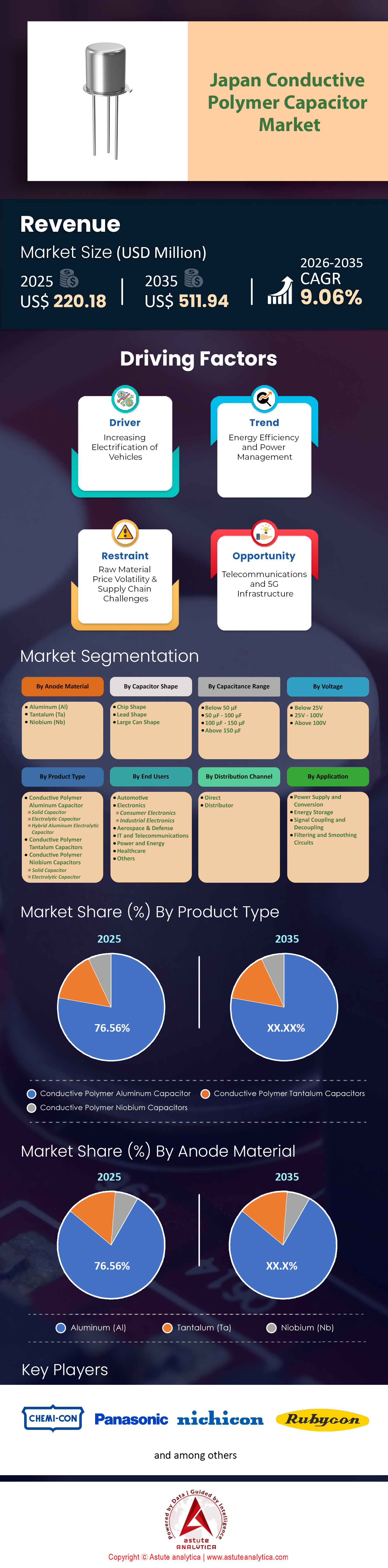
Japan conductive polymer capacitor market was valued at US$ 220.18 million in 2025 and is projected to hit the market valuation of US$ 511.94 million by 2035 at a CAGR of 9.06% during the forecast period 2026–2035.
Key Findings in Japan Conductive Polymer Capacitor Market
- By anode material, the Aluminum (Al) segment is expected to dominate the market with a share of around 76.56%.
- By product type, the conductive polymer aluminum capacitor segment is projected to lead the market with approximately 76.56% share.
- By capacitor shape, the Chip Shape segment will continue dominating the market with more than 70.90% share.
- By capacitance range, the 100 µF – 150 µF segment is anticipated to hold the largest share of about 39.54%.
- By voltage, the below 25V is expected to account for a major 62.29% share of the market.
- By application, the Filtering and Smoothing Circuits segment is estimated to capture around 31.78% share.
- By end users, the Electronics segment is likely to maintain its lead with a share of about 37.87%.
Japan remains the undisputed technological anchor of the global conductive polymer capacitor market. While the broader electronics manufacturing landscape has seen commoditized production migrate to cost-optimized hubs in China and Southeast Asia, Japan has successfully retained a dominant grip on the high-value, high-reliability segment. This is not a market characterized by nascent experimentation but rather one of deep establishment and advanced specialization.
Wherein, the domestic production of electronic components in Japan witnessed a crucial 5% recovery in 2024, rebounding from the inventory corrections of the previous year, and 2025 has consolidated this upward trajectory. The Japanese market serves as the global R&D laboratory where next-generation hybrid and solid polymer technologies are conceptualized before mass production. With the Asia-Pacific region commanding over 35% of the global market share, Japan’s role is pivotal, acting as the primary supplier for mission-critical components where failure is simply not an option. The industry here has effectively transitioned from a volume-based strategy to a value-based one, focusing on power density and thermal resilience that competitors struggle to replicate.
To Get more Insights, Request A Free Sample
Where is the Surge in Demand Coming From?
The demand profile within Japan conductive polymer capacitor market and its export markets has shifted aggressively toward high-reliability sectors, moving away from the volatile consumer electronics cycles of the past. The primary engine of this growth is undoubtedly the Next-Generation Automotive sector, particularly xEVs (electric and hybrid vehicles). A typical electric vehicle now utilizes over 100 conductive polymer capacitor packs solely for stabilizing voltage in Electronic Control Units (ECUs) and battery management systems. With the global EV market having grown at a CAGR of roughly 25% through 2025, the pressure on Japanese manufacturers to supply capacitors that can withstand extreme engine heat and vibration is immense. This automotive demand is not merely about volume; it is about performance assurance in ADAS (Advanced Driver Assistance Systems), where latency or power fluctuation can be fatal.
Simultaneously, a surprising yet potent driver in Japan conductive polymer capacitor market has been the explosion of Artificial Intelligence Data Centers. These high-performance computing environments require immense power stability and sophisticated heat management solutions. Manufacturers have noted a sharp uptake in demand for capacitors compatible with immersion-cooling systems, a necessary evolution for servers that radiate massive quantities of heat.
Which Capacitors are Ruling the Circuit Boards?
While standard capacitors remain ubiquitous, the Japanese conductive polymer capacitor market is undergoing a distinct "Hybrid Revolution." The Conductive Polymer Hybrid Aluminum Electrolytic Capacitors have emerged as the star performers, witnessing a robust projected CAGR of 13.1% from 2025 to 2031. By ingeniously combining the low Equivalent Series Resistance (ESR) of conductive polymers with the high leakage current stability of liquid electrolytes, these hybrids have become indispensable for 48V automotive systems. They effectively bridge the gap between the endurance of solid polymers and the catastrophic failure protection of traditional electrolytes. In terms of specifications, the capacitance "sweet spot" currently lies in the 100µF to 500µF range, which offers the optimal balance for power smoothing in automotive ECUs.
However, the technical frontier is constantly being pushed outward. Manufacturers in the Japan conductive polymer capacitor market are now successfully packing 390µF into compact 10x10mm casings, a feat that was previously difficult to achieve without compromising reliability. Regarding product type preferences, there is a clear divergence based on application. While solid polymer capacitors remain popular for consumer electronics like laptops and wearables due to their ultra-low profile, hybrid types are winning the battle in the industrial and automotive sectors. Their ability to handle higher voltages, specifically ranging from 25V to 80V, and endure severe temperature fluctuations makes them the preferred choice for engineers designing the next generation of power trains and industrial robotics.
Why Do Nippon Chemi-Con and Panasonic Wear the Crown?
Nippon Chemi-Con and Panasonic are not merely participants in the Japan conductive polymer capacitor market, they are the market architects who define the pace of innovation. Their dominance stems from a calculated combination of aggressive capacity expansion and unmatched technical certification. Panasonic Industry, for instance, cemented its lead in February 2024 by launching the ZL series, the industry’s first high-capacitance hybrid capacitor guaranteed to operate at 135°C. This product launch directly addressed the thermal challenges of downsizing automotive ECUs, a critical pain point for car manufacturers. Moreover, Panasonic initiated a massive capacity increase in their Malaysia facility in 2025 to mass-produce compact 6x6mm hybrid capacitors, ensuring they can meet the volume demands of global Tier-1 auto suppliers without bottlenecks.
Conversely, Nippon Chemi-Con has demonstrated remarkable strategic agility in the conductive polymer capacitor market. Despite a challenging 2024 where sales dipped 6.9% due to global inventory adjustments, the company pivoted aggressively toward high-margin segments. They are currently executing a mid-term plan to double their hybrid capacitor production capacity by FY2028. In October 2024, their new manufacturing wing at the Miyagi Plant went online, funded by a substantial 2.4 billion yen capital raise. Their strategy is crystal clear: sacrifice low-margin consumer volume for high-margin, automotive-grade dominance. By controlling the entire vertical supply chain, from electrode foil production to final assembly, these giants maintain a quality control moat that protects them from cheaper, less integrated competitors.
How Fierce is the Battle for Market Share?
The competitive landscape in Japan conductive polymer capacitor market is bifurcated, presenting two very different realities depending on the market segment. In the lower-end consumer segment, price competition is brutal, with Chinese manufacturers gaining significant ground by commoditizing standard polymer technologies. However, in the high-voltage (above 35V) and high-temperature (above 125°C) segments, the market operates as a disciplined oligopoly dominated by Japanese giants including Nichicon, Rubycon, and the aforementioned leaders. Here, competition is not fought on price, but strictly on specifications and reliability.
For example, while standard polymers might fail at 105°C, Japanese players in the conductive polymer capacitor market are standardizing 125°C and 135°C ratings as the new baseline. The barrier to entry in this upper echelon is formidably high; automotive certifications such as AEC-Q200 require rigorous testing regimes that new market entrants struggle to pass. Consequently, while the market appears competitive on the surface, established Japanese players enjoy a "quality moat" that protects their margins in the B2B sector. Tier-1 automotive suppliers are rarely willing to risk a recall by saving pennies on a capacitor, effectively locking them into long-term contracts with trusted Japanese vendors who offer proven longevity and failure rates measured in single digits per billion hours.
What Future-Shaping Trends are Redefining the Market?
As we move deeper into 2026, three major trends are fundamentally shaping the trajectory of the Japanese conductive polymer capacitor market.
- Widespread adoption of the "48V" Standard. As mild-hybrid and EV architectures shift toward 48V power systems to improve efficiency, the demand for capacitors rated at 63V and 80V is surging. Standard 25V capacitors are no longer sufficient for these modern powertrains, forcing a rapid industry-wide migration to high-voltage hybrid polymers.
- The trend of "Miniaturization without Compromise" is driving R&D. Panasonic’s recent push for 1.7x higher capacitance in the same footprint allows ECU designers to shrink board sizes significantly. This is critical for ADAS applications, where space behind the dashboard is practically nonexistent, yet computing power requirements continue to double.
- Supply Chain Resilience has become a dominant strategic theme. Following the geopolitical tensions and disruptions of the early 2020s, Japanese firms are actively "China-proofing" their supply chains. Investment capital is flowing back into domestic Japanese facilities, like the expansion in Miyagi, and into "friendly" nations like Malaysia. This ensures that the production of critical automotive components is insulated from trade shocks or logistical breakdowns.
Segmental Analysis
By Anode Material, Aluminum Anode Set to Dominate the Market with over 76.56% Market share
The dominance of the Aluminum anode segment (76.56%) in Japan conductive polymer capacitor market is driven by the domestic manufacturing strength of global heavyweights like Nippon Chemi-Con, Nichicon, and Panasonic, who have pioneered high-performance aluminum technologies. These Japanese manufacturers have aggressively advanced "Hybrid" aluminum electrolytic capacitors, which combine liquid electrolyte with conductive polymer. This innovation addresses the specific reliability requirements of the Japanese automotive sector (Toyota, Honda, Nissan), offering the self-healing properties of aluminum oxide with the high heat resistance required for under-the-hood applications.
This material is critical for Japan’s leadership in the Electric Vehicle (EV) and Hybrid Electric Vehicle (HEV) markets. Japanese Tier 1 suppliers like Denso and Aisin rely heavily on aluminum capacitors for DC-link applications in onboard chargers (OBCs) due to their ability to withstand high voltage surges while maintaining a compact footprint. Furthermore, Japan’s established supply chain for high-purity etched aluminum foil ensures production stability, insulating domestic manufacturers from the supply chain volatility associated with tantalum alternatives.
By Capacitor Shape, Chip Shape Control the Highest Market Share
The Chip Shape segment’s command of over 70.90% of the Japan conductive polymer capacitor market is a direct result of Japan’s mastery of high-density Surface Mount Technology (SMT) manufacturing. The country’s "Kei-haku-tan-sho" (light, thin, short, small) philosophy in product design drives the demand for chip capacitors that fit standardized footprints (e.g., 3216, 2012) compatible with high-speed mounters used by companies like Sony and Canon.
The "Chip" form factor is essential for the miniaturization trend in Japan’s portable electronics and medical device sectors. Wearable health monitors and compact IoT sensors developed in Japan have shrinking Printed Circuit Board (PCB) real estate, making radial leaded capacitors obsolete for logic applications. Furthermore, in the automotive sector, the shift toward Zone Control Units (ZCUs) in next-generation vehicle architectures requires the high component density that only chip-style capacitors can support. Domestic innovations in molded chip packaging continue to drive this segment’s overwhelming share.
By Capacitance Range, 100 µF – 150 µF Takes the Front Position in the Japan Conductive Polymer Capacitor Market
The 100 µF – 150 µF range captures the largest share (39.54%) because it represents the "sweet spot" for decoupling in Japan’s industrial automation and automotive control units. Japanese robotics giants like Fanuc and Yaskawa require stable voltage rails for servo drives and controllers, where a capacitance of 100-150 µF provides the necessary energy reservoir to smooth out transient loads without occupying the space of larger electrolytic cans.
Engineering data from Japanese power supply manufacturers confirms that this range is favored for "distributed power architectures" in server farms and telecommunications equipment. Designers often replace banks of smaller ceramic capacitors with a single 100-150 µF conductive polymer capacitor to save board space—a premium commodity in densely packed Japanese electronic designs. This range in the Japan conductive polymer capacitor market is also optimal for minimizing ripple voltage in DC-DC converters operating between 500 kHz and 1 MHz, effectively bridging the gap between high-frequency filtering and bulk energy storage.
Below 25V Leads the Market Thanks to Strong Demand Coming from Consumer and Automotive Systems
The dominance of the Below 25V segment (62.29%) reflects the fundamental operating voltages of Japan’s vast consumer electronics and automotive subsystems. While the country is pushing high-voltage EV powertrains, the massive volume of automotive infotainment, ADAS sensors, and dashboard electronics produced by companies like Pioneer and Alpine runs on standard 12V architectures, necessitating capacitors rated for 16V or 25V.
Additionally, Japan’s prowess in personal robotics and high-end photography (Canon, Nikon, Sony) drives demand for low-voltage components in the conductive polymer capacitor market. The logic levels for the sophisticated image processors and control chips in these devices are well below 5V, while their power distribution rails adhere to standard 5V or 12V specifications. The proliferation of battery-powered devices in Japan's aging-population support sector (assistive tech) also exclusively demands low-voltage capacitors to match lithium-ion battery outputs, ensuring the <25V category remains the primary volume driver.
By Application, Filtering and Smoothing Circuits Capturing 31.78% of the Market Share
Filtering and Smoothing Circuits capturing 31.78% of the conductive polymer capacitor market is justified by the universal reliance on Switch Mode Power Supplies (SMPS) across Japan’s industrial and consumer sectors. Leading Japanese power supply manufacturers like TDK-Lambda and Murata Power Solutions utilize these capacitors as the primary line of defense to smooth output voltage and shunt high-frequency noise in highly efficient converters.
The demand is further intensified by Japan’s strict Electromagnetic Compatibility (EMC) standards, overseen by the VCCI Council. Electronics ranging from home appliances to industrial robots must undergo rigorous EMI filtering to prevent interference. Consequently, conductive polymer capacitors are indispensable for noise suppression in these circuits. Furthermore, the expansion of Japanese data centers to support AI computing (led by Fujitsu and NEC) requires extremely clean power to prevent bit-flip errors, making aggressive filtering and smoothing a non-negotiable requirement in this market.
Customize This Report + Validate with an Expert
Access only the sections you need—region-specific, company-level, or by use-case.
Includes a free consultation with a domain expert to help guide your decision.
By Product Type, Conductive Polymer Aluminum Capacitor Leading the Market Due to Superior Stability and Low ESR for High-Frequency Power
The Conductive Polymer Aluminum segment’s leadership (76.56%) in the Japan conductive polymer capacitor market is justified by the critical need for Low Equivalent Series Resistance (ESR) in Japan’s high-tech electronics and gaming industries. Unlike traditional liquid-filled capacitors, Japanese innovations—such as Panasonic’s SP-Cap and OS-CON lines—utilize solid conductive polymers (like PEDOT) to improve conductivity significantly. This is essential for the domestic gaming console market (e.g., Sony PlayStation, Nintendo Switch), where processors require heavy ripple current handling without the thermal buildup that could compromise compact device architecture.
Recent data from the Japan Electronics and Information Technology Industries Association (JEITA) indicates a displacement of Multi-Layer Ceramic Capacitors (MLCCs) by polymer aluminum types in high-capacitance applications. This shift is driven by the need to eliminate the "DC Bias" effect and acoustic noise in high-fidelity audio equipment and 5G base stations deployed by carriers like NTT Docomo and KDDI. Additionally, the superior safety profile of polymer aluminum against ignition is a prerequisite for Japan’s rigorous industrial safety standards in factory automation and robotics.
To Understand More About this Research: Request A Free Sample
Top 5 Recent Developments in Japan CPC Market (2025)
- Panasonic Industry (Sep 18, 2025): Commercialized 50TQT33M and 63TQT22M POSCAP conductive polymer tantalum solid capacitors—industry's lowest 3mm profile for 50V/63V high-voltage USB-PD 3.1 power circuits in laptops/tablets. Mass production starts Dec in 2025.
- TAIYO YUDEN (Dec 2, 2025): Launched "HVX (-J)" and "HTX (-J)" series hybrid conductive polymer aluminum electrolytic capacitors with optimized ripple current in φ12.5x13.5mm AEC-Q200 packages for automotive ADAS/power steering. Mass production began in Sep 2025 at ELNA plants.
- TAIYO YUDEN (Aug 27, 2025): Announced participation in electronica India 2025 to showcase expanded hybrid capacitor lineup, projecting 2.5x demand growth by year-end for vehicle electronics reliability.
- Nippon Chemi-Con (Aug 3, 2025): Updated SMD HXF series conductive polymer hybrid aluminum electrolytic capacitors, emphasizing downsizing for carbon-neutral e-mobility in EV powertrains via enhanced catalog specs.
- Nichicon (Ongoing 2025 updates via product pages): Expanded PMK series low-ESR conductive polymer aluminum solid capacitors for automotive, achieving superior high-temp stability in EV/5G apps (cross-referenced in industry trackers).
Top Companies in the Japan Conductive Polymer Capacitor Market
- Panasonic Corporation
- Nippon Chemi-Con Corporation
- Murata Manufacturing Co., Ltd .
- TAIYO YUDEN CO., LTD
- Rubycon Corporation
- Other Prominent Players
Market Segmentation Overview
By Product Type
- Conductive Polymer Aluminum Capacitor
- Solid Capacitor
- Electrolytic Capacitor
- Hybrid Aluminum Electrolytic Capacitor
- Conductive Polymer Tantalum Capacitors
- Conductive Polymer Niobium Capacitors
- Solid Capacitor
- Electrolytic Capacitor
By Anode Material
- Aluminum (Al)
- Tantalum (Ta)
- Niobium (Nb)
By Capacitor Shape
- Chip Shape
- Lead Shape
- Large Can Shape
By Capacitor Range
- Below 50 µF
- 50 µF - 100 µF
- 100 µF - 150 µF
- Above 150 µF
By Voltage
- Below 25V
- 25V - 100V
- Above 100V
By Application
- Power Supply and Conversion
- Energy Storage
- Signal Coupling and Decoupling
- Filtering and Smoothing Circuits
By End Users
- Automotive
- Electronics
- Consumer Electronics
- Industrial Electronics
- Aerospace & Defense
- IT and Telecommunications
- Power and Energy
- Healthcare
- Others
By Distribution Channel
- Direct
- Distributor
FREQUENTLY ASKED QUESTIONS
Japan conductive polymer capacitor market projected to reach US$ 511.94 million by 2035 with a CAGR of 9.06%, the market is pivoting from volume-based consumer electronics to high-value automotive and industrial sectors requiring extreme reliability and power density.
They offer the best of both worlds: the low Equivalent Series Resistance (ESR) of polymers and the leakage stability of liquid electrolytes. This makes them indispensable for 48V mild-hybrid systems where safety is non-negotiable.
They possess a quality moat through vertical integration (foil to assembly) and rigorous AEC-Q200 automotive certifications. Their ability to mass-produce high-reliability components creates high barriers to entry for low-cost global competitors.
A massive role. AI servers generate immense heat and require stable power. This drives demand for immersion-cooling compatible capacitors and high-grade filtering components to prevent bit-flip errors in high-performance computing.
To support the automotive transition to 48V power architectures. Standard 25V capacitors cannot handle the voltage requirements of modern EV powertrains and mild-hybrid systems, necessitating a migration to higher voltage hybrids.
By China-proofing operations. Investments are flowing into domestic facilities (e.g., Miyagi) and friendly nations like Malaysia to insulate mission-critical automotive component production from geopolitical trade shocks and logistics breakdowns.
LOOKING FOR COMPREHENSIVE MARKET KNOWLEDGE? ENGAGE OUR EXPERT SPECIALISTS.
SPEAK TO AN ANALYST
.svg)

 Schedule a Meeting

Features | Type of License | ||||
 Data Book | Single User |   Multi User |  Corporate | ||
| e-Access | ✓ | ✓ | ✓ | ✓ | |
User Sharing | 1 User Only | 1 User Only | Up to 7 Users | Unlimited User Access | |
⨉ | ⨉ | ⨉ | ✓ | ||
Free Customization | No Free Customization | Up To 30 hrs work | Up To 60 hrs work | Up To 80 hrs work | |
Deliverable |
| ⨉ | ✓ | ✓ | ✓ |
| ✓ | ⨉ | ✓ | ✓ | |
| ⨉ | ⨉ | ⨉ | ✓ | |
Analyst Support | 2-Months Analyst Support | 4-Months Analyst Support | 7-Months Analyst Support | One Year Analyst Support | |
Free Report update in next update cycle | ⨉ | ⨉ | ⨉ | ✓ | |
Free Industry Update (Within 180 days) | ⨉ | ⨉ | ⨉ | ✓ | |
Benefit | Up to 10% off on Post Purchase | Up to 20% off on Post Purchase | Up to 30% off on Post Purchase | Up to 40% off on Post Purchase | |