Market Scenario
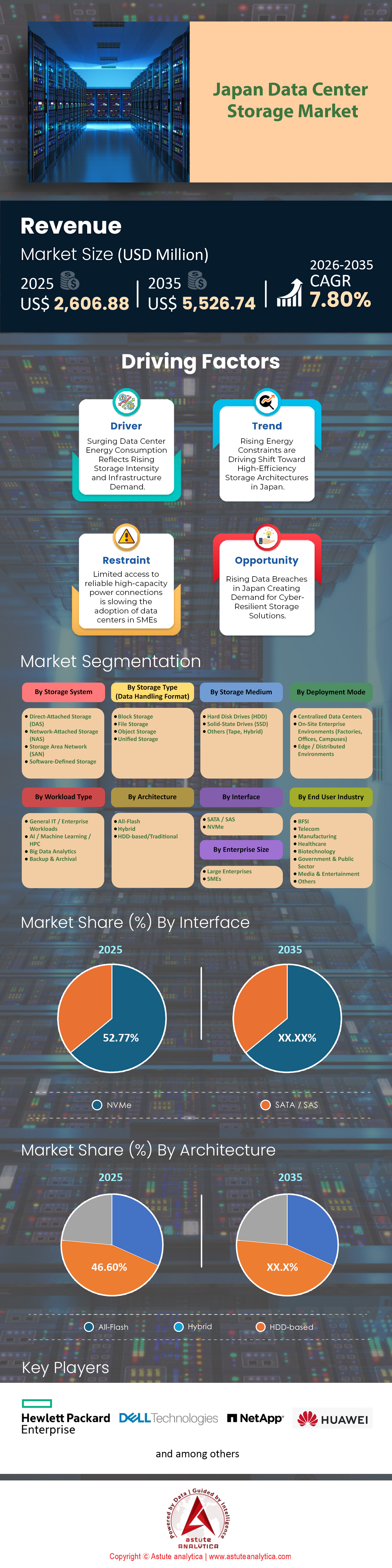
Japan data center storage market size was valued at USD 2,606.88 million in 2025 and is projected to hit the market valuation of USD 5,526.74 million by 2035 at a CAGR of 7.80% during the forecast period 2026–2035.
Key Market Insights
- Based on storage system, storage area network is set to control the largest 37.40% market share.
- Based on storage type, block storage accounted for 46.93% market share.
- Based on storage medium, hard disk drives (HDD) control the market dominance with over 47.27% market share.
- Based on deployment mode, centralize data centers emerged as the largest with over 69.80% market share.
- Based on architecture, all flash is set to remain the largest revenue contributor to Japan data center storage market by accounting for 46.60% market share.
- Based on interface, NVMe to capture the dominant position in the market.
- Based on enterprise size, large enterprises to hold the market prominence during the forecast period.
- Based on end use, BFSI to generate the most market revenue.
Japan data center storage market consistently faces massive digital data generation from various commercial entities daily. Managing this expanding footprint requires enterprises to deploy highly robust specialized storage infrastructure. Tokyo naturally serves as the primary hub for these vital colocation facility expansions.
Meanwhile, Osaka actively attracts significant capital investments for new disaster recovery site developments. These regional networks support vast consumer bases spanning finance, telecommunications, and government sectors. Consequently, total national rack capacity currently exceeds 350,000 individual units across all operators.
Escalating Workload Requirements Propel Massive Enterprise Storage Capacity Upgrades
Daily operational needs constantly outpace the current hardware capacities of existing regional sites in the Japan data center storage market. This rising demand potential aligns perfectly with nationwide digital transformation initiatives occurring locally. Supporting such massive infrastructure directly pushes total dedicated energy consumption toward 18 terawatt-hours. To manage these immense electrical loads, operators currently maintain 138 active regional facilities.
- Corporate entities fiercely prioritize high-availability solutions ensuring completely uninterrupted daily business continuity operations.
- Telecommunications providers actively expand rural broadband networks spanning roughly 1.2 million kilometers nationwide.
- Government digital agencies officially allocated 500 billion yen exclusively for public sector modernization.
Regional telecom networks consistently process 80 terabits per second during peak daily intervals. Handling this traffic alongside cloud adoption natively generated 45 exabytes of unstructured data. These impressive metrics clearly illustrate unprecedented foundational demand from domestic commercial user bases.
To Get more Insights, Request A Free Sample
How Does Regulatory Compliance Shape Infrastructure Deployment Patterns in Japan Data Center Storage Market?
Strict data residency laws officially mandate a 100-kilometer separation between primary and backup. These specific privacy regulations strongly compel local enterprises to maintain onshore digital repositories. Securing such information natively requires corporate governance frameworks to mandate highly auditable environments. For instance, healthcare sector operators must securely store 800 petabytes of localized records.
Similarly, financial institutions across the Japan data center storage market process 450 million daily transactions demanding immediate domestic archiving capabilities. Meeting these strict compliance parameters structurally defines modern colocation architectural designs across prefectures.
Stringent Domestic Data Sovereignty Mandates Force Immediate Infrastructure Architecture Redesigns
Regulated enterprise workloads regularly process 85 million database queries hourly across domestic networks. Protecting these immense operational flows helped local cybersecurity teams block 450 million incidents. These external threats also necessitate strict security compliance across 22 operational subsea cables. Because of such vulnerabilities, national digital ministries strictly enforce standardized public sector frameworks.
- Regulated industries in the data center storage market consistently deploy isolated digital environments completely segregating sensitive consumer personal information.
- Statutory data retention periods necessitate expanding massive long-term archival vaults across regional hubs.
- Auditors rigorously examine physical security perimeters surrounding sensitive government technological data center operations.
Dedicated backup storage in the Japan data center storage market vaults currently hold 15 exabytes securely under strict regulatory oversight. Legal frameworks explicitly dictate exact physical geographic locations for storing critical national databases. These stringent parameters undeniably force facility operators to completely rethink traditional deployment methodologies.
What Role Does Edge Computing Play in Regional Facility Expansion?
Modern distributed network architectures strongly encourage moving computational power closer to end users. Supporting this localized processing required the recent activation of 85 operational edge facilities. Manufacturing sectors across the data center storage market uniquely utilize these micro sites to analyze 3 exabytes of telemetry. Handling such massive data streams allows local peering exchanges to process 15 terabits.
Retail e-commerce also relies upon localized caching mechanisms to manage 15 billion transactions. Ultimately, these regional nodes actively eliminate unnecessary backhaul traffic toward central Tokyo hubs.
Decentralized Processing Hubs Significantly Reduce Latency for High-Performance Regional Applications in Japan Data Center Storage Market
National telecommunications providers recently deployed advanced 5G networks connecting 65 million endpoint devices. These connected IoT sensors autonomously generate 12 zettabytes of localized raw digital telemetry. Processing this immense volume locally dropped average regional network latency to 4 milliseconds. Achieving such impressive performance speeds forces providers to acquire commercial suburban real estate.
- Automated factory floors heavily depend upon localized compute resources for complex robotics management.
- Smart city infrastructure continuously feeds urban mobility tracking data into localized micro hubs.
- Content delivery networks extensively utilize distributed disk arrays for rapid media streaming services.
Recently, operators in the Kansai data center storage market added 65 megawatts of power supporting emerging edge initiatives. These specific micro facilities clearly bridge critical application performance gaps for enterprise users. Decentralized computing completely transforms traditional monolithic facility expansion strategies across domestic commercial markets.
How Do Workload Demands Alter Rack Density and Power Consumption?
Modern artificial intelligence applications inherently consume massive amounts of concentrated commercial electrical power. Accommodating these extreme requirements in the Japan data center storage market pushes average rack density toward 14 kilowatts locally today. Such high-density clusters actively support 800 petaflops of compute across specialized infrastructure environments. Sustaining this performance legally requires a strict 1.35 power usage effectiveness compliance ratio.
Furthermore, individual hyper-scale facilities must natively consume at least 50 megawatts to operate. Managing the resulting immense thermal outputs forces operators to deploy advanced liquid cooling.
High-Density Computational Requirements Radically Transform Traditional Facility Energy Management Frameworks
Foundational mechanical cooling infrastructure fundamentally requires 15,000 tons of localized thermal regulation capacity. Running these advanced thermal systems consumes roughly 45 million liters of water annually. For example, Inzai campus infrastructures alone support 120 megawatts of active server power. Offsetting this massive consumption in the Japan data center storage market requires strict adherence to aggressive national carbon reduction goals.
- Server deployments rapidly reached 2.5 million active hardware units within concentrated metropolitan campuses.
- Uninterruptible power supplies reliably provide 900 megawatts backup during unexpected commercial grid failures.
- Power distribution units number 650,000 installed smart devices managing complex cabinet electrical loads.
Renewable energy usage recently reached 250 megawatts total across highly sustainable facility portfolios. Upgrading these networks successfully added 400 megawatts recently to vital national power grids. These demanding enterprise workloads fundamentally dictate immediate critical upgrades to foundational mechanical cooling.
Why Are Certain Storage Systems Across the Japan Data Center Storage Market Gaining Unprecedented Adoption Rates?
Modern enterprise architectures increasingly demand highly resilient centralized repositories for critical database workloads. Based on storage system, storage area network is set to control the largest 37.40% market share. Facilitating these rapid system communications requires over 450,000 active network switches deployed currently.
Furthermore, dedicated hardware fabrics utilize 180,000 individual fibre cross-connects linking internal corporate networks. High-performance computing environments inherently depend upon these robust connections for continuous data availability. Consequently, organizations actively abandon isolated direct-attached systems for universally accessible shared network resources.
Enterprise Architectural Shifts Drive Massive Investments Into Highly Scalable Networked Solutions
Major hardware refresh cycles reliably occur every 48 months across massive enterprise deployments. During these upgrades in the Japan data center storage market, software-defined technologies seamlessly manage 18 exabytes natively within virtualized platforms. Financial institutions heavily depend upon such reliable networked configurations for guaranteed transactional integrity. System administrators leverage these architectures to effectively consolidate fragmented silos into unified pools.
- Database administrators strongly prefer networked robust architectures for simplified disaster recovery replication processes.
- Virtual machine density dramatically increases when effectively utilizing shared centralized backend disk arrays.
- Legacy system migrations continuously push corporate IT departments toward modernized fabric switching infrastructures.
These systemic infrastructure upgrades clearly demonstrate a massive national shift toward optimized environments. Corporate decision makers consistently prioritize proven structural reliability over experimental localized containment strategies. System baseline performance metrics undeniably validate these specific critical architectural choices for scalability.
How Are Enterprise Capacity Requirements Evolving Across Tiered Cities?
Corporate operational scales directly dictate exact technological adoption rates across domestic regional data center storage markets. Based on enterprise size, large scale enterprises commanded the absolute majority 71.57% market share. These massive corporations undeniably possess the immense financial resources necessary for extensive buildouts. Conversely, small businesses increasingly leverage remote managed services instead of deploying dedicated hardware.
Mid-market organizations continuously struggle balancing severely restricted capital budgets against rapidly escalating workloads. Multinational entities explicitly demand globally standardized architectural platforms connecting localized Japanese branches seamlessly.
Disproportionate Corporate Resource Allocations Heavily Favor Massive Enterprise Colocation Infrastructure Physical Dominance in Japan Data Center Storage Market
Large domestic conglomerates heavily invest 850 million yen annually building independent recovery topologies. Their dedicated corporate IT departments actively manage 4,500 active physical servers simultaneously without failure. Smaller entities functionally lack the technical manpower required for managing such complex environments. Consequently, regional government offices strictly partner with major integrators supporting local civic infrastructures.
- Enterprise data teams rigorously implement complex tiered architectures optimizing expensive solid-state hardware investments.
- Massive corporate budgets securely fund immediate institutional adoptions of advanced liquid cooling technologies in the Japan data center storage market.
- Global financial institutions strategically deploy proprietary encrypted racks within locked premium colocation cages.
These distinct organizational sizes fundamentally drive vastly different commercial infrastructure hardware procurement behaviors. Facility providers strategically target these massive corporate entities ensuring long-term highly stable revenues.
What Macroeconomic Drivers Sustain Ongoing Capital Expenditure Cycles?
Overall national economic stability directly encourages massive long-term technological capital expenditure investment strategies. Public digital agencies officially allocated 500 billion yen accelerating vital national government modernization. Corporate profitability effectively fuels this continuous reinvestment into core digital operational business assets. Foreign direct investments in the Japan data center storage market strongly target these expanding Japanese technological hubs for broader expansion.
Favorable corporate tax incentives aggressively encourage widespread adoptions of sustainable green infrastructure upgrades. Domestic economic policies deeply emphasize strict technological sovereignty regarding all critical national data.
Resilient National Economic Indicators Strongly Support Massive Uninterrupted Digital Infrastructure Development Initiatives
Inflationary pressures moderately impact building materials but completely fail to halt regional expansions. Specialized technological employment metrics remain exceptionally strong ensuring adequate skilled labor availability locally. Commercial real estate developers heavily pivot toward these highly lucrative premium colocation structural builds in the Japan data center storage market Institutional investors consistently provide necessary capital backing massive multi-megawatt structural campus construction projects.
- Government financial grants systematically reduce capital burdens associated with adopting sustainable cooling technologies.
- Strong domestic currency valuations historically optimized expensive international specialized backend hardware procurement efforts.
- National strategic initiatives legally mandate immediate widespread digitalization across outdated municipal bureaucratic platforms.
These powerful macroeconomic forces undeniably create a highly favorable operational environment for growth. Facility operators confidently execute aggressive ten-year capacity expansion blueprints disregarding minor economic fluctuations. Japan fundamentally remains an absolutely critical foundational pillar within global digital economic networks.
Competitive Landscape: Top 5 Players Capture over 58% Market Share of the Japan Data Center Storage Market
Global hardware vendors dominate Japanese enterprise data center storage because they align tightly with three core Japanese buyer priorities: risk‑averse operations, local service depth, and long‑term interoperability. Dell Technologies, HPE, NetApp, and Huawei are not just “big brands”; they have structured their Japan‑specific go‑to‑market models around those criteria, which directly translates into the share figures (Dell ~28.9%, HPE ~10.8%, NetApp ~9.9%, Huawei ~8.9%).
Deep localized support and risk mitigation
Japanese enterprises are highly conservative about operational downtime, so they favor vendors with large, city‑based engineering and field‑support teams in Tokyo, Osaka, Nagoya, and other key hubs. Dell, HPE, NetApp, and Huawei maintain localized service, spare‑pools, and NBD (next‑business‑day) replacement SLAs, which dramatically lower the risk of catastrophic storage‑array failures. This “physical” presence in Japan, combined with strict SLAs, makes procurement committees comfortable committing to multi‑year, multi‑petabyte contracts.
Segmental Analysis of the Japan Data Center Storage Market
By Storage Type: Which Storage Types Dominate Current Enterprise Data Management Strategies?
Domestic organizations in the Japan data center storage market rigorously evaluate different architectural methodologies for structuring massive digital information repositories. Based on storage type, block storage accounted for 46.93% market share. Relational databases explicitly demand this structured methodology for highly deterministic input and output. Meanwhile, versatile object repositories successfully process 150 billion disparate files for cloud applications.
Enterprise data lakes securely house 22 exabytes total utilizing highly adaptable file protocols. Despite these alternatives, administrators strongly favor structured formats for mission-critical corporate resource planning.
Critical Database Performance Requirements Solidify Ongoing Preferences for Traditional Structured Methodologies
Consistent transactional speeds remain crucially important for high-frequency trading platforms operating in Tokyo. Supporting these local operations requires hypervisors to natively utilize incredibly stable structured formats. Similarly, domestic semiconductor fabs actively produce 500,000 wafers monthly generating immense structured telemetry in the Japan data center storage market. Unstructured volumes grow rapidly yet lack the strict deterministic performance necessary for databases.
- Financial ledgers strictly require incredibly low system latency metrics for accurate record keeping.
- Media streaming platforms increasingly adopt object architectures for massive scalable localized content delivery.
- Corporate file shares still heavily rely upon traditional network-attached protocols for user accessibility.
These underlying technological preferences directly reflect foundational core business application requirements across Japan. IT managers continually balance absolute performance needs against overall infrastructure deployment expenditure budgets. Structured operational configurations will undoubtedly maintain heavy utilization across domestic legacy enterprise environments.
By Storage Medium: How Do Storage Mediums Compete for Enterprise Workload Optimization in Japan Data Center Storage Market?
Selecting appropriate physical media fundamentally dictates both system performance capabilities and infrastructure efficiency. Based on storage medium, hard disk drives (HDD) control the market dominance with over 47.27% market share. Manufacturers officially shipped 12 million magnetic units locally to support vast archival environments. Conversely, premium flash module shipments successfully surpassed 8 million units for high-performance tiers.
Capacity-optimized magnetic disks perfectly serve enormous long-term data retention requirements extremely cost-effectively today. Meanwhile, solid-state technologies aggressively capture performance-sensitive workloads demanding exceptionally high operational disk speeds.
Balancing Exceptional Performance Demands Against Economical Mass Capacity Retention Strategy Directives
Secondary disaster recovery sites require 75 megawatts of capacity powering massive magnetic arrays in the Japan data center storage market. Maintaining these complex localized setups currently employs 42,000 highly skilled data center professionals. These engineering teams strongly prefer inexpensive high-capacity drives for their secondary backup layers. Alternatively, all-flash arrays increasingly dominate primary architectural tiers supporting active transactional corporate databases.
- Archival vaults extensively utilize dense magnetic physical enclosures maximizing valuable rack space efficiency.
- Virtual desktop infrastructures exclusively mandate flash hardware components entirely eliminating severe boot storms.
- Hybrid array configurations effectively blend both distinct mediums optimizing overall organizational financial expenditures.
Technology providers continuously push physical engineering boundaries increasing maximum capacities per individual drive. Corporate data retention policies strongly guarantee continuous national demand for inexpensive magnetic options. Flash performance constraints simultaneously ensure solid-state adoption accelerates across major modernization projects nationwide.
By Industry Verticals: Which End-User Verticals Consume the Most Capacity Regionally?
Various distinct economic sectors in the Japan data center storage market constantly exhibit wildly different foundational technological infrastructure capacity requirements. Based on industry vertical, IT and telecommunications sector secured the maximum 42.15% market share. Financial sector operations continuously demand ultra-low latency infrastructure for their critical trading platforms. Healthcare administrators tightly manage highly regulated patient diagnostic imaging repositories alongside these systems.
Retail platforms inherently require massive scalable architectures specifically during intense seasonal shopping events. Meanwhile, manufacturing organizations increasingly adopt industrial internet technologies driving massive localized data creation.
Rapid Sectorial Digitalization Dramatically Accelerates Sector-Specific Computational Infrastructure Resource Consumption Volume
National government initiatives in the Japan data center storage market aggressively push legacy public administration systems toward modernized commercial facilities. Media organizations continually archive enormous volumes of uncompressed high-definition video broadcasting content locally. Educational institutions rapidly expand remote learning platforms requiring substantial centralized server resource allocations. Transportation networks effectively process immense logistical telemetry streams using advanced analytics disk arrays.
- Banking institutions strictly maintain 120 massive active-active cluster configurations ensuring continuous transactional availability.
- Telecommunications providers aggressively expand backend back-end systems supporting 42 million residential fiber connections.
- Automotive manufacturers explicitly require vast structural compute clusters simulating complex autonomous driving algorithms.
These diverse industry requirements completely dictate highly specialized architectural designs within colocation spaces. Facility operators continuously customize dedicated power layouts addressing specific unique vertical market demands. Pervasive digital transformation universally impacts every major commercial operational segment across Japan today.
Customize This Report + Validate with an Expert
Access only the sections you need—region-specific, company-level, or by use-case.
Includes a free consultation with a domain expert to help guide your decision.
By Deployment Mode: What Deployment Modes Are Preferred by Japanese Corporate Entities?
Corporate IT strategies heavily prioritize highly controlled physical environments for managing sensitive information. Based on deployment mode, centralize data centers emerged as the largest with over 69.80% market share of the Japan data center storage market. Osaka alone manages 45 active colocation hubs supporting these massive regional computing infrastructures. Accommodating such vast footprints actively increased total specialized floor space by 600,000 square meters.
Consolidated infrastructure distinctly provides superior administrative oversight compared to scattered remote business assets. Therefore, organizations continuously migrate their decentralized server rooms into highly secure premium campuses.
Massive Facility Consolidation Trends in the Japan Data Center Storage Market Reflect Strong Enterprise Desires for Operational Standardization
Regional government subsidies successfully provided 45 billion yen directly supporting major facility constructions. Centralized campuses completely dominate these current structural investments across major Japanese metropolitan regions. These premium colocation infrastructures seamlessly process 25,000 gigabytes per second across interconnected locations. Implementing unified campuses ensures security frameworks strictly maintain natively mandated physical access controls.
- Large enterprises effectively reduce overall structural redundancies in the Japan data center storage market through strategic physical corporate server consolidation.
- Dedicated private campus environments heavily attract highly risk-averse financial institutions seeking ultimate security.
- Centralized cooling architectures demonstrably improve overall facility energy efficiency metrics quite significantly locally.
These massive centralized sites definitively anchor the entire national digital infrastructure economic ecosystem. Deep economies of scale heavily reward organizations selecting unified campus deployment methodologies currently. Disparate regional hardware deployments simply cannot match the rigorous security of premium hubs.
To Understand More About this Research: Request A Free Sample
Top 3 Developments Shaping the Japan Data Center Storage Market
- KIOXIA – Super High IOPS GP‑Series SSD for AI‑GPU‑initiated workloads (March 2026)
KIOXIA announced its new GP Series Super High IOPS SSD, optimized for NVIDIA’s Storage‑Next architecture, enabling GPUs to directly access flash‑based memory as an extension of HBM in AI systems. This SSD targets Japan’s growing AI and HPC data centers that need low‑latency, high‑IOPS storage tightly coupled to GPU nodes. - KIOXIA – Expanded enterprise NVMe SSD portfolio for data centers (March 2026)
At NVIDIA GTC 2026, KIOXIA highlighted its refreshed enterprise and data center NVMe SSD portfolio, including CM9 and LC9 series drives, emphasizing high‑capacity QLC storage (up to 245.76 TB models) and AI‑ready flash designed for vector databases and large‑scale AI training in Japanese hyperscale and colocation environments. - NTT DATA – Keihanna OSK11 AI‑ready data center launch (April 2026)
NTT DATA announced the opening of the Keihanna OSK11 Data Center in Kyoto, a 30 MW AI‑ready facility operated via NTT Global Data Centers, featuring advanced cooling and high‑efficiency infrastructure to support hyperscalers and enterprises needing large‑scale, low‑latency storage‑intensive cloud and AI workloads in Japan’s Kansai region.
Top Companies in the Japan Data Center Storage Market
- NetApp
- EverPure (Formerly Pure Storage)
- Dell Technologies
- IBM
- Hewlett Packard Enterprise
- Hitachi Vantara
- Fujitsu
- NEC Corporation
- Lenovo Group
- Huawei
- Amazon Web Services
- Microsoft Azure
- Google Cloud
- Oracle
- Seagate Technology
- Western Digital
- Kioxia
- Infinidat
- Super Micro Computer
- Nutanix
- Other Prominent Players
Market Segmentation Overview
By Storage System
- Direct-Attached Storage (DAS)
- Network-Attached Storage (NAS)
- Storage Area Network (SAN)
- Software-Defined Storage
By Storage Type (Data Handling Format)
- Block Storage
- File Storage
- Object Storage
- Unified Storage
By Storage Medium
- Hard Disk Drives (HDD)
- Solid-State Drives (SSD)
- Others (Tape, Hybrid)
By Deployment Mode
- Centralized Data Centers
- On-Site Enterprise Environments (Factories, Offices, Campuses)
- Edge / Distributed Environments
By Workload Type
- General IT / Enterprise Workloads
- AI / Machine Learning / HPC
- Big Data Analytics
- Backup & Archival
By Architecture
- All-Flash
- Hybrid
- HDD-based/Traditional
By Interface
- SATA / SAS
- NVMe
By Enterprise Size
- Large Enterprises
- SMEs
By End User Industry
- BFSI
- Telecom
- Manufacturing
- Healthcare
- Biotechnology
- Government & Public Sector
- Media & Entertainment
- Others
FREQUENTLY ASKED QUESTIONS
Japan data center storage market size was valued at USD 2,606.88 million in 2025 and is projected to hit the market valuation of USD 5,526.74 million by 2035 at a CAGR of 7.80% during the forecast period 2026–2035.
Tokyo remains the absolute dominant hub for highly concentrated premium colocation infrastructure developments.
Operators must strictly maintain a 1.35 power usage effectiveness ratio for legal compliance.
Hard disk drives effectively maintain massive market dominance serving immense long-term archival needs.
Massive IoT telemetry generation requires immediate localized processing to completely eliminate network latency.
The IT and telecommunications sectors actively secure the absolute maximum market capacity shares.
LOOKING FOR COMPREHENSIVE MARKET KNOWLEDGE? ENGAGE OUR EXPERT SPECIALISTS.
SPEAK TO AN ANALYST
.svg)

 Schedule a Meeting

Features | Type of License | ||||
 Data Book | Single User |   Multi User |  Corporate | ||
| e-Access | ✓ | ✓ | ✓ | ✓ | |
User Sharing | 1 User Only | 1 User Only | Up to 7 Users | Unlimited User Access | |
⨉ | ⨉ | ⨉ | ✓ | ||
Free Customization | No Free Customization | Up To 30 hrs work | Up To 60 hrs work | Up To 80 hrs work | |
Deliverable |
| ⨉ | ✓ | ✓ | ✓ |
| ✓ | ⨉ | ✓ | ✓ | |
| ⨉ | ⨉ | ⨉ | ✓ | |
Analyst Support | 2-Months Analyst Support | 4-Months Analyst Support | 7-Months Analyst Support | One Year Analyst Support | |
Free Report update in next update cycle | ⨉ | ⨉ | ⨉ | ✓ | |
Free Industry Update (Within 180 days) | ⨉ | ⨉ | ⨉ | ✓ | |
Benefit | Up to 10% off on Post Purchase | Up to 20% off on Post Purchase | Up to 30% off on Post Purchase | Up to 40% off on Post Purchase | |