Market Snapshot
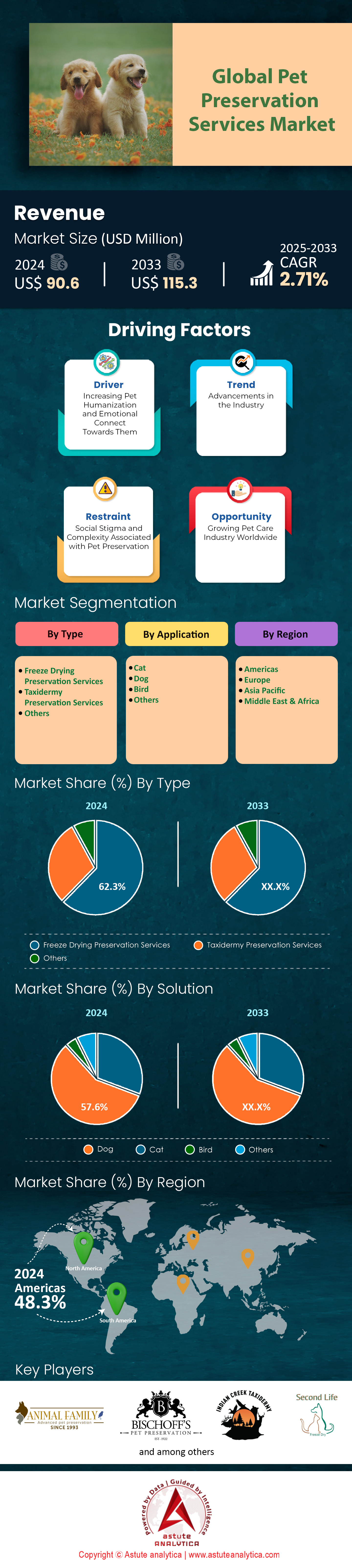
Pet preservation services market was valued at US$ 90.6 million in 2024 and is projected to surpass the market valuation of US$ 115.3 million by 2033 at a CAGR of 2.71% during the forecast period 2025–2033.
Key Findings
- Based on type, the global market is dominated by freeze drying preservation services by a commanding 62% revenue share.
- By application, the dog remains unsurprisingly at the center of the pet market by capturing a sizeable 57.6% market share.
- North America is the powerhouse of the market with 48.3% market share.
The pet preservation services market is currently executing a fundamental pivot from a localized utility service to a global luxury memorialization industry. This transition is underpinned by the "Pet Humanization" macro-trend, which has dramatically reduced price sensitivity regarding end-of-life expenses. The market is witnessing the emergence of a high-value "Legacy Economy" where emotional attachment translates directly into premium service acquisition. Investors and stakeholders are now viewing this sector not as waste management, but as a high-margin consumer lifestyle vertical with recession-resilient characteristics.
Trend Analysis: Disruptive Technologies Driving Asset Heavy Valuation
The pet preservation services market is bifurcating into biological preservation and transformative memorialization, driven by distinct technological advancements. Freeze-drying technology has successfully disrupted the traditional taxidermy sector by utilizing vacuum sublimation to remove moisture while retaining cellular structure. This capital-intensive process solves the "uncanny valley" aesthetic issue of traditional mounting, driving an annual growth rate of 8% to 10% in North American markets. Parallel to this, Alkaline Hydrolysis, commercially branded as Aquamation, is rapidly capturing the eco-conscious market share. This water-based technology offers a 90% reduction in carbon footprint compared to flame cremation, appealing to regulatory bodies and consumers alike.
The highest value segment involves commercial cloning and genetic banking, where firms are creating recurring revenue models through cell-line storage fees long before the actual cloning procedure occurs, effectively creating a "biological insurance" market.
To Get more Insights, Request A Free Sample
Consumer Psychographics and High Elasticity Spending Segments
Consumer behavior in the pet preservation services market is defined by emotional necessity rather than functional utility. The "Grief-Stricken Millennial" cohort, aged 25 to 40, currently acts as the primary volume driver for the industry. This demographic validates their "pet parent" identity through tangible memorialization, driving volume in aquamation and physical keepsake markets.
Conversely, the "Legacy-Minded High Net Worth Individual" drives the ultra-premium margin segment. For this demographic, price is inelastic; they are the primary consumers of synthetic memorial diamonds and genetic preservation services. This segmentation allows the market to operate on a dual-track revenue model: high-volume, mid-margin services for the mass market, and low-volume, ultra-high-margin services for the luxury tier.
Geographic Powerhouses and Regional Market Maturity
Five key nations are currently dictating global pet preservation services market trends, each offering unique entry points and maturity curves. The United States leads in total volume and capital expenditure, utilizing a hub-and-spoke logistics model where local veterinary networks feed into centralized industrial freeze-drying and aquamation facilities. South Korea serves as the global innovation lab, having pioneered "Death Beads" or Menehune, a process that transforms ashes into gem-like stones, effectively creating a new product category for home display.
China represents the highest velocity growth in global pet preservation services market, driven by rapid urbanization and a booming middle class that is embracing commercial cloning and grand-scale funeral services at a rate faster than Western counterparts. The United Kingdom remains the global leader in "Green Death" solutions, prioritizing natural burial grounds and biodegradable material innovation. Finally, Japan offers the most ritualized market structure, with a massive secondary market for home altars (Butsudan) and spiritual incense services, focusing on the metaphysical housing of the pet's spirit.
Global Pricing Architectures and Revenue Models
The economic structure of the pet preservation services market reveals a stark divide between developed and emerging economies, offering distinct arbitrage opportunities. At the apex of the pricing pyramid lies the genetic cloning sector, primarily dominated by US and Chinese firms, where services command between $35,000 and $50,000 per unit, often requiring upfront deposits that aid cash flow. Below this sits the luxury memorialization tier, including synthetic diamonds created from carbon ashes. In developed markets like the USA and UK, these services range from $2,500 to over $15,000 per carat, whereas emerging market alternatives using synthetic resins offer lower entry points at $100 to $300 but with significantly lower margins.
The mid-tier segment of the pet preservation services market is dominated by freeze-drying and advanced taxidermy. In developed nations with high labor costs, a standard 10lb pet preservation service commands $1,500 to $2,200. In contrast, emerging markets such as India, Brazil, or the Philippines rely on traditional taxidermy methods priced between $200 and $500, though quality variance remains a barrier to premium adoption. The volume foundation of the market remains private cremation and aquamation. In North America and Europe, private water cremation generates $300 to $600 per service. In developing nations, flame-based private cremation remains the standard, priced between $50 and $150, often subsidized by volume contracts with municipal veterinary bodies.
Opportunity Analysis: High Yield Investment Vehicles and Underserved Verticals
Significant capital appreciation opportunities exist in the "Pre-Need" financial product sector across the pet preservation services market. Integrating end-of-life preservation riders into standard pet insurance policies represents a massive, untapped recurring revenue stream. Currently, coverage is reactionary; shifting to a proactive "burial insurance" model for pets mirrors the stability of the human life insurance industry. Furthermore, a "Blue Ocean" strategy exists in B2B logistics for emerging markets. As veterinary infrastructure professionalizes in regions like Southeast Asia and Latin America, there is a critical lack of cold-chain logistics to transport deceased pets from clinics to preservation centers. Establishing this logistical middleware presents a scalable entry point with high barriers to entry for competitors.
Horizon 2030 and The Bio Digital Convergence
The pet preservation services market trajectory forecasts a merger between biological preservation and digital reality. Future market leaders will likely offer "Hybrid Memorial Packages" that bundle physical remains with Digital Twins—AI-driven avatars hosted in the metaverse, trained on the pet’s historical data. This transition moves the industry from a one-time transaction model to a subscription-based digital hosting model. Simultaneously, regulatory headwinds regarding carbon emissions will likely force a mandatory shift toward Aquamation and Natural Organic Reduction (composting) in urban centers, phasing out flame cremation and creating a winner-takes-all scenario for early adopters of green technology.
Segmental Analysis
Unmatched Realism Drives Massive Adoption of Freeze Drying Technology
Freeze-drying currently commands a dominant 62% revenue share in the global pet preservation services market, primarily because it offers a level of realism that traditional taxidermy simply cannot replicate. Unlike older methods involving skinning and mounting, lyophilization technology maintains the animal's actual skeletal structure and body mass by utilizing extreme cold temperatures of -40 degrees Celsius. Sublimation removes moisture from a frozen state, preventing the shrinking or warping of delicate features like eyelids and paw pads. Owners consistently prioritize Pet preservation services that utilize this method, as it ensures the final memorial retains the exact facial expressions and physical dimensions of their beloved companion.
- Technicians utilize custom-built support racks to hold the pet in a natural, relaxed pose throughout the drying phase.
- The absence of harsh chemicals like formaldehyde in the primary drying process appeals to safety-conscious households.
- Finalized specimens require minimal long-term maintenance beyond humidity control, offering a permanent physical memorial.
Consumers in the pet preservation services market increasingly view the preservation process as an art form intended to honor a life rather than a clinical procedure. The non-invasive nature of freeze-drying provides immense emotional comfort to grieving families who often reject the invasive techniques associated with traditional mounting. Consequently, the sector sees sustained growth as advanced vacuum pressure systems reduce processing times while ensuring delicate tissues remain undamaged. Emotional connections drive the industry, and Pet preservation services utilizing freeze-drying offer the most tangible, unaltered connection to a cherished pet, with specimens lasting decades in climate-controlled environments.
Unmatched Realism Drives Massive Adoption of Freeze Drying Technology
Freeze-drying currently commands a dominant 62% revenue share in the global pet preservation services market, primarily because it offers a level of realism that traditional taxidermy simply cannot replicate. Unlike older methods involving skinning and mounting, lyophilization technology maintains the animal's actual skeletal structure and body mass by utilizing extreme cold temperatures of -40 degrees Celsius. Sublimation removes moisture from a frozen state, preventing the shrinking or warping of delicate features like eyelids and paw pads. Owners consistently prioritize Pet preservation services that utilize this method, as it ensures the final memorial retains the exact facial expressions and physical dimensions of their beloved companion.
- Technicians utilize custom-built support racks to hold the pet in a natural, relaxed pose throughout the drying phase.
- The absence of harsh chemicals like formaldehyde in the primary drying process appeals to safety-conscious households.
- Finalized specimens require minimal long-term maintenance beyond humidity control, offering a permanent physical memorial.
Consumers in the pet preservation services market increasingly view the preservation process as an art form intended to honor a life rather than a clinical procedure. The non-invasive nature of freeze-drying provides immense emotional comfort to grieving families who often reject the invasive techniques associated with traditional mounting. Consequently, the sector sees sustained growth as advanced vacuum pressure systems reduce processing times while ensuring delicate tissues remain undamaged. Emotional connections drive the industry, and Pet preservation services utilizing freeze-drying offer the most tangible, unaltered connection to a cherished pet, with specimens lasting decades in climate-controlled environments.
Canine Companionship Fuels Major Segment Revenue Through Emotional Bonding
The dog segment captures a sizeable 57% share of the pet preservation services market, underscoring the profound role canines play in modern family structures. Dogs often spend over a decade in a household, forging deep psychological bonds that make the final separation incredibly difficult for owners. Such intense attachment translates directly into a higher propensity to invest in premium Pet preservation services, with owners spending approximately 15% more than guardians of other animals. Guardians of dogs are not merely looking for a keepsake; they seek to maintain the physical presence of a family member who provided daily emotional support and unconditional love.
- Specific breeds with unique fur patterns drive the need for high-fidelity preservation that generic urns cannot provide.
- The trend of preserving working dogs and service animals has gained traction as a way to honor their lifetime of service.
- Urban pet owners with limited outdoor space increasingly prefer indoor preservation memorials over traditional backyard burials.
Deeper analysis of the pet preservation services market indicates that the "man's best friend" cultural archetype heavily influences spending behavior in the aftercare sector. As younger generations delay parenthood and single-person households rise, dogs often fill the role of children, making their loss a significant life event requiring substantial memorialization. The sheer volume of orders from North America, combined with the willingness of owners to pay for extended timelines required for larger breeds, cements the dog's position at the center of the industry. Furthermore, Pet preservation services are seeing a spike in requests for dogs that passed from natural causes, highlighting a desire to remember them peacefully.
Customize This Report + Validate with an Expert
Access only the sections you need—region-specific, company-level, or by use-case.
Includes a free consultation with a domain expert to help guide your decision.
Canine Companionship Fuels Major Segment Revenue Through Emotional Bonding
The dog segment captures a sizeable 57.6% market share of the pet preservation services market, underscoring the profound role canines play in modern family structures. Dogs often spend over a decade in a household, forging deep psychological bonds that make the final separation incredibly difficult for owners. Such intense attachment translates directly into a higher propensity to invest in premium Pet preservation services, with owners spending approximately 15% more than guardians of other animals. Guardians of dogs are not merely looking for a keepsake; they seek to maintain the physical presence of a family member who provided daily emotional support and unconditional love.
- Specific breeds with unique fur patterns drive the need for high-fidelity preservation that generic urns cannot provide.
- The trend of preserving working dogs and service animals has gained traction as a way to honor their lifetime of service.
- Urban pet owners with limited outdoor space increasingly prefer indoor preservation memorials over traditional backyard burials.
Deeper market analysis indicates that the "man's best friend" cultural archetype heavily influences spending behavior in the aftercare sector, fueling the pet preservation services market growth. As younger generations delay parenthood and single-person households rise, dogs often fill the role of children, making their loss a significant life event requiring substantial memorialization. The sheer volume of orders from North America, combined with the willingness of owners to pay for extended timelines required for larger breeds, cements the dog's position at the center of the industry. Furthermore, the market is seeing a spike in requests for dogs that passed from natural causes, highlighting a desire to remember them peacefully.
To Understand More About this Research: Request A Free Sample
Regional Analysis
North America Spearheads Innovation Through Deep Emotional Spending
The North America currently dominates the pet preservation services market with over 48.3% market share. The regional market mainly benefits from a highly mature infrastructure where specialized lyophilization facilities are becoming as established as traditional crematoriums. High disposable income in the United States allows owners to overlook the steep price tags associated with preservation, often viewing the cost as a necessary final healthcare expense rather than a luxury. Granular trends suggest a massive surge in demand for "soft" preservation, where the internal structure is freeze-dried to retain a somewhat yielding, natural feel unlike the rigid hardness of traditional taxidermy.
The market here is exceptionally well-positioned because the cultural stigma surrounding keeping a deceased pet is rapidly vanishing, replaced by a desire for tangible continuity within the home. Service providers are effectively capitalizing on this by offering tiered packages that include grooming and cosmetic restoration, ensuring the pet looks exactly as it did in life.
Europe Navigates Regulatory Complexity Amidst Rising Pet Humanization
Pet preservation services market positioning in Europe faces a complex landscape where strict biological waste disposal regulations often bottleneck rapid commercial expansion compared to transatlantic counterparts. Service providers in the UK and Germany are successfully carving a niche by focusing on artisanal, high-fidelity preservation that appeals to a demographic valuing artistic craftsmanship over processing speed. Energy costs heavily impact the scalability of freeze-drying operations across the continent, forcing the market toward premium pricing models to maintain profitability.
Despite these logistical hurdles, the region shows significant promise as owners increasingly seek sophisticated alternatives to communal cremation. The sector is seeing a quiet but steady expansion in private preservation studios that operate under stringent biological safety standards, catering to a wealthy client base that demands eco-conscious and respectful handling of remains.
Asia Pacific Accelerates Adoption Through Urbanization And Cultural Shifts
Japan leads the regional pet preservation services market charge by seamlessly integrating advanced preservation techniques with deep-rooted cultural respect for the spirit of the animal. Extreme space constraints in dense urban centers like Tokyo and Shanghai make full-body preservation a practical alternative to burial plots, which are both scarce and prohibitively expensive. The market is positioned for rapid acceleration as the rising middle-class populations in China begin to emulate Western pet ownership trends, treating animals as status symbols worthy of eternalizing. However, distinct cultural nuances regarding death mean providers must offer discreet and highly ceremonial services to succeed. There is a notable preference for preserving smaller pets or specific anatomical keepsakes rather than large breeds, aligning with the compact living environments prevalent throughout the region’s major economic hubs.
Top 10 Recent Developments in Pet Preservation Services Market
- Colossal Biosciences Acquires ViaGen Pets (November 2025)
This strategic acquisition merges advanced genetic engineering with established commercial cloning, positioning genetic banking and "genetic rescue" as standard preservation offerings. - Gateway Services Inc. Faces FTC Action (September 2025)
North America's largest aftercare provider faced a regulatory crackdown regarding restrictive non-compete agreements, a move expected to increase market competition and labor mobility. - BluePearl Pet Hospice Launches "Comfort Care" (June 2025)
This nationwide program bridges the gap between veterinary care and euthanasia, strategically integrating preservation planning and palliative support earlier in the pet’s lifecycle. - Evvi Aftercare Acquires Resting Waters (April 2025)
This acquisition in the Pacific Northwest doubled the company’s aquamation capacity, establishing a dedicated facility to serve veterinary partners with eco-friendly water cremation. - Parting Stone Launches AI-Integrated Campaign (January 2025)
The "Death Rocks!" initiative utilized AI-generated imagery to rebrand solidified remains, aiming to normalize the product and increase B2B adoption among funeral homes. - Bio-Response Solutions Deploys Next-Gen PET-400 (2025)
The manufacturer rolled out energy-efficient aquamation units across 20 U.S. states, enabling providers to meet stricter municipal carbon emission standards with 90% energy savings. - Animal Family Pet Preservation Introduces VIP Rush Service (2025)
Addressing long lead times, the company monetized speed by offering a 6–8 week turnaround for freeze-drying at a 50% surcharge, alongside a new lifetime warranty. - Saint Diamonds Expands US-Swiss Operations (2025)
The firm solidified its luxury standing by integrating US client care with Swiss laboratory manufacturing, catering to high-net-worth clients demanding European certification for memorial diamonds. - Cuddle Clones Partners with Fields of Freedom (2025)
This Corporate Social Responsibility (CSR) initiative links product sales to the rescue of 3,000 animals, leveraging ethical consumerism to drive demand for plush preservation replicas. - Eterneva Wins BBB Torch Award for Ethics (2024)
Following a Series A funding round, the memorial diamond startup received high-level industry validation for transparency, distinguishing itself in a sector often critiqued for opacity.
Top Players in the Global Pet Preservation Services Market
- AEWS Pet Preservation
- Alessandra Dzuba
- Animal Family Pet Preservation
- Bischoff Pets
- Gotham Taxidermy
- Indian Creek Taxidermy
- Perpetual Pet
- Precious Creature
- Preserved Pets
- Second Life Freeze Dry
- WHAM Preservation LLC
- Wyrick
- Xtreme
- Other prominent players
Market Segmentation Overview:
By Type
- Freeze Drying Preservation Services
- Taxidermy Preservation Services
- Others
By Application
- Cat
- Dog
- Bird
- Others
By Region
America
- The U.S.
- Canada
- Mexico
- Brazil
- Rest of Americas
Europe
- The UK
- Germany
- France
Italy - Russia
- Rest of Europe
Asia Pacific
- China
- India
- Japan
- Australia
- South Korea
- Southeast Asia
- Rest of Asia Pacific
Middle East & Africa (MEA)
- GCC
- Egypt
- Turkey
- Israel
- South Africa
LOOKING FOR COMPREHENSIVE MARKET KNOWLEDGE? ENGAGE OUR EXPERT SPECIALISTS.
SPEAK TO AN ANALYST
.svg)

 Schedule a Meeting

Features | Type of License | ||||
 Data Book | Single User |   Multi User |  Corporate | ||
| e-Access | ✓ | ✓ | ✓ | ✓ | |
User Sharing | 1 User Only | 1 User Only | Up to 7 Users | Unlimited User Access | |
⨉ | ⨉ | ⨉ | ✓ | ||
Free Customization | No Free Customization | Up To 30 hrs work | Up To 60 hrs work | Up To 80 hrs work | |
Deliverable |
| ⨉ | ✓ | ✓ | ✓ |
| ✓ | ⨉ | ✓ | ✓ | |
| ⨉ | ⨉ | ⨉ | ✓ | |
Analyst Support | 2-Months Analyst Support | 4-Months Analyst Support | 7-Months Analyst Support | One Year Analyst Support | |
Free Report update in next update cycle | ⨉ | ⨉ | ⨉ | ✓ | |
Free Industry Update (Within 180 days) | ⨉ | ⨉ | ⨉ | ✓ | |
Benefit | Up to 10% off on Post Purchase | Up to 20% off on Post Purchase | Up to 30% off on Post Purchase | Up to 40% off on Post Purchase | |