Market Snapshot
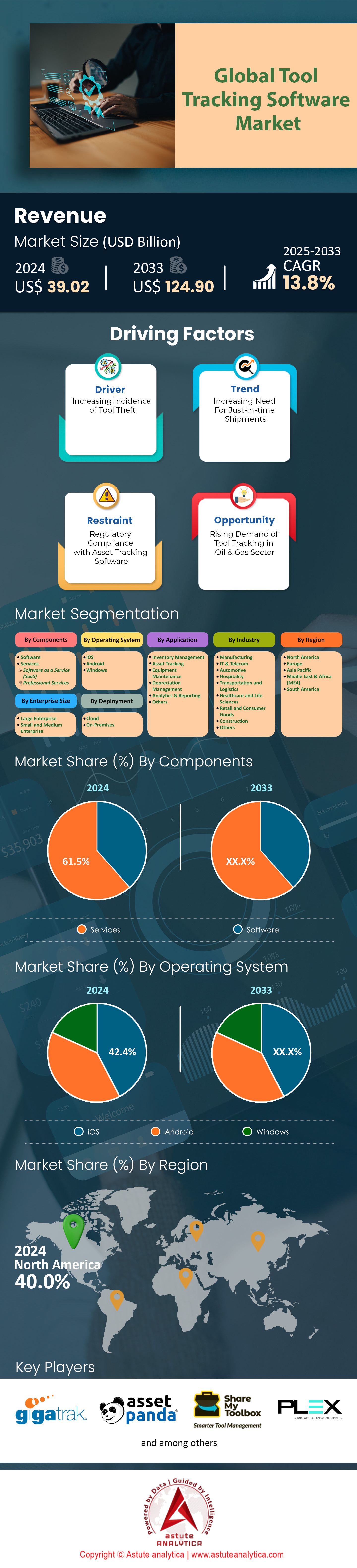
Tool tracking software market was valued at US$ 39.02 billion in 2024 and is projected to generate a revenue of US$ 124.90 billion by 2033 at a CAGR of 13.8% during the forecast period 2025–2033.
Key Findings
- Based on component, tool tracking software market is categorized into two main components: software and services. Among these, the services segment is expected to dominate the market and hold the largest 61.5% market share.
- When it comes to enterprise size, large enterprises are the primary consumers of the tool tracking software. In fact, they accounted for a significant 68.9% share of the market.
- Based on deployment, cloud-based solutions are expected to retain their 59.7% share of the market revenue.
- By application, the asset tracking segment remains the dominant market share holder with approximately 45.9% share.
- North America is holding lion’s share of over 40% in the market.
Global appetite for advanced asset management solutions is reaching unprecedented levels in late 2025. Organizations across construction, manufacturing, and logistics are aggressively adopting platforms within the tool tracking software market to combat the rising costs of lost equipment. Operational data indicates that firms no longer view these tools as optional luxuries but as critical infrastructure for balance sheet integrity. As a result, the demand is specifically spiking for solutions that offer real-time visibility, as companies seek to eliminate the "ghost assets" that artificially inflate insurance premiums and distort financial reporting.
Rising adoption rates represent a fundamental shift toward digital accountability rather than simple inventory counting. Stakeholders are prioritizing software that delivers immediate return on investment through theft deterrence and improved utilization rates. The tool tracking software market is witnessing a transition from passive spreadsheets to active, automated systems that flag discrepancies instantly. Such behavior underscores a broader industrial trend where efficiency acts as the primary lever for maintaining profit margins in a high-cost economic environment.
Market Valuation Exceeding Billions With Strong Projected Annual Growth Rates
Current valuations place the tool tracking software market at approximately USD 45.2 billion as of 2025, with a trajectory set for robust expansion. Industry analysts at Astute Analytica project the market to grow at a CAGR of 13.80% through the 2034. Wherein, the financial momentum is fueled by the rapid digitization of job sites and the integration of smart technologies into formerly analog workflows. Capital flows are capitalizing on the broader construction technology boom, where software spending is continuously outpacing hardware investment.
Revenue composition is also shifting, with service-based and subscription models capturing a larger share of the total value. Enterprise-grade contracts are becoming the norm, pushing the average deal size upward. As the tool tracking software market matures, the barrier to entry for new vendors is rising, favoring established players who can offer comprehensive, scalable platforms. Financial health in this sector signals a stable environment for long-term investment, attracting significant venture capital interest into the ecosystem.
To Get more Insights, Request A Free Sample
Cloud Native Solutions and Mobile Apps Dominating User Preference Globally
Prominent platforms currently witnessing higher demand are those prioritizing mobile-first experiences. Solutions like ShareMyToolbox and GigaTrak are gaining traction against legacy competitors by offering intuitive, app-based interfaces that field workers actually use. In the enterprise sector, Hilti ON!Track and Milwaukee One-Key continue to dominate by leveraging their massive hardware ecosystems. These platforms within the tool tracking software market are successful because they reduce the friction of data entry, allowing workers to scan tools with standard smartphones rather than proprietary ruggedized scanners.
User preference has decisively swung toward cloud-native architectures that support offline synchronization. A field worker needing to check out a tool in a remote area without cellular service and sync the data later is now a non-negotiable requirement. Consequently, the tool tracking software market is seeing a decline in on-premise software deployments. Buyers are voting with their wallets for platforms that offer ubiquitous access and seamless integration with existing cloud ERP systems like Procore or SAP.
Trend: Artificial Intelligence and Internet Of Things Fueling Rapid Industry Adoption
Two primary technological factors are fueling the current demand explosion: the ubiquity of cheap IoT sensors and the integration of Artificial Intelligence. Costs for Bluetooth Low Energy (BLE) tags have dropped significantly, allowing companies to tag even lower-value items economically. Hardware affordability is expanding the Total Addressable Market (TAM) for the tool tracking software market, as it becomes feasible to track consumables and smaller hand tools that were previously untracked.
Simultaneously, AI is transforming these platforms from passive logs into predictive engines. Advanced algorithms now analyze usage patterns to predict when a tool will fail or go missing before it happens. Predictive capability is a major selling point for the tool tracking software market, as it directly addresses downtime—the costliest enemy of construction projects. Stakeholders are increasingly demanding these intelligent features, pushing vendors to innovate rapidly beyond simple location tagging.
Inventory Audits and Predictive Maintenance Leading Application Usage Statistics
While theft prevention remains the headline benefit, the rapid adoption of these tools is being driven by inventory audits and maintenance scheduling. Automated auditing applications are revolutionizing how companies prepare for financial and safety inspections. In the tool tracking software market, the ability to generate a 100% accurate audit trail with a single click is a feature that wins contracts, particularly in regulated industries like aerospace and energy.
Predictive maintenance applications are also witnessing a sharp uptake. Instead of relying on rigid calendar-based service schedules, software now tracks actual tool runtime to trigger maintenance tickets. Application usage ensures that equipment is serviced only when necessary, extending its lifespan and reducing unnecessary labor. Shifting toward condition-based maintenance is a key efficiency driver, further cementing the value proposition of the tool tracking software market for asset-heavy enterprises.
Industry Titans and Agile Startups Competing For Enterprise Market Share
Competitive landscapes are defined by a clash between hardware giants and agile software-only startups. Major companies like Milwaukee Tool, DeWalt, and Hilti are leveraging their physical tool dominance to capture software market share, creating "walled gardens" of connected equipment. However, hardware-agnostic players like ToolWatch, Asset Panda, and EZOfficeInventory are carving out significant portions of the tool tracking software market by offering flexibility. These companies allow enterprises to track mixed-brand fleets without being locked into a single manufacturer’s ecosystem.
Dichotomies in the market force buyers to choose between deep integration and broad compatibility. Major hardware manufacturers are aggressively acquiring smaller software firms to bolster their agnostic capabilities. Consequently, the tool tracking software market is becoming increasingly consolidated at the top, while still leaving room for niche players who solve specific vertical problems, such as tracking for medical devices or IT assets.
Construction Enterprises and Field Service Teams Driving Primary Consumption Behaviors
Prominent consumers of this software remain large-scale construction firms and field service organizations. Behavior is shifting from top-down mandates to bottom-up adoption. Field superintendents and project managers are increasingly influencing purchasing decisions, demanding tools that solve their immediate daily frustrations. In the tool tracking software market, this has led to a focus on User Experience (UX) design that mimics consumer apps, as younger workers refuse to engage with clunky, legacy interfaces.
Consumers are also exhibiting a behavior known as "radical transparency." Field teams demand real-time dashboards that can be shared with clients to prove that the right tools were on site at the right time. Behavioral shifts are forcing vendors in the tool tracking software market to build more robust external reporting features. Modern buyers are not just looking for a tracking tool; they are looking for a competitive advantage that they can showcase in their own bids and proposals.
Capitalizing On Emerging Technologies and Untapped Small Business Sectors For Growth
Augmented Reality (AR) represents the next frontier for operational efficiency within the sector. Innovators are piloting AR overlays that allow workers to hold up a tablet and visually "see" the location of a missing tool through walls or inside crates, drastically reducing search times. Integrating these visual technologies with existing datasets offers a massive opportunity for vendors in the tool tracking software market to differentiate themselves. Early adopters leveraging these immersive tech features are already reporting higher engagement rates from younger, tech-native field workers.
Small and Medium Businesses (SMBs) currently represent a largely untapped reservoir for expansion. Historically priced out of enterprise-grade systems, tradespeople such as electricians, plumbers, and HVAC contractors are now accessible due to the lowering costs of SaaS subscriptions and BLE hardware. Vendors who strip away complex enterprise features to offer "lite," mobile-first versions of their platforms are finding rapid success. Capturing this segment of the tool tracking software market requires a focus on simplicity and self-service onboarding, unlocking a high-volume revenue stream that complements high-value enterprise contracts.
Segmental Analysis
Component Segment: Service Dominance and Operational Necessity
The tool tracking software market relies heavily on the services segment, which secures a dominant 61.5% market share due to the complexity of modern implementation. Companies require extensive support to integrate these systems into existing enterprise resource planning (ERP) frameworks. Consulting teams provide critical guidance on selecting the right hardware, such as RFID tags or Bluetooth beacons, ensuring compatibility with specific industrial environments. Maintenance services are equally vital, offering 24/7 troubleshooting to prevent downtime in high-stakes sectors like aerospace and construction. Furthermore, customized training programs are essential to bridge the knowledge gap for field workers transitioning from manual logs to digital interfaces.
Large-scale deployments often necessitate data migration services to transfer thousands of legacy records into new central databases without errors. Solution providers now offer "Solution-as-a-Service" models, bundling software updates with ongoing technical account management. Security auditing services also see high demand, ensuring that cloud-connected tool data remains protected against cyber threats.
- Dedicated implementation teams reduce initial setup time by weeks for multi-site operations.
- Regular hardware health checks extend the lifespan of physical tracking tags and scanners.
- Custom API development allows seamless communication between tracking tools and procurement systems.
Enterprise Size: Large Enterprises Drive Heavy Adoption
Large enterprises are the primary revenue generators, holding a substantial 68.9% share of the tool tracking software market due to the sheer volume of assets they manage. Corporations in the construction and manufacturing sectors often oversee inventories exceeding tens of thousands of individual items across global sites. The financial impact of lost equipment hits these giants hardest, with industry reports estimating annual theft losses at over USD 1 billion nationwide. Consequently, these firms invest heavily in robust tracking ecosystems to mitigate such massive financial risks. Beyond theft, the administrative burden of manual tracking is unsustainable at this scale; automated systems eliminate the need for hundreds of spreadsheet hours.
Advanced compliance requirements further compel large organizations to adopt sophisticated solutions. Strict safety regulations demand rigorous maintenance logs for power tools and heavy machinery, which manual methods cannot reliably provide. Enterprise-grade software ensures that every tool’s inspection history is audit-ready, preventing costly legal penalties.
- Large firms often integrate tracking data with payroll to monitor worker productivity levels.
- Automated alerts prevent equipment hoarding by identifying idle tools across different departments.
- Centralized dashboards allow headquarters to reallocate underutilized assets between regional branches.
Deployment: Cloud Solutions Revolutionize Accessibility
Cloud-based solutions are poised to retain their leading 59.7% share of the global tool tracking software market revenue by offering unmatched flexibility. Modern workforce dynamics require data accessibility from anywhere, whether in a corporate office or a remote mining site. Cloud deployment enables real-time synchronization, ensuring that a tool checked out in one location is immediately visible to all authorized personnel globally. This architecture significantly lowers the barrier to entry by removing the need for expensive on-premise servers and dedicated IT maintenance teams.
The scalability of cloud platforms allows businesses to add thousands of new assets to the system instantly without hardware upgrades. Field workers benefit from mobile app integrations that feed data directly to the cloud, eliminating travel time back to a central terminal. Furthermore, cloud providers deliver automatic security patches and feature updates, ensuring systems remain cutting-edge without user intervention.
- Remote access capabilities allow project managers to approve tool requests from off-site locations.
- Cloud architectures support rapid disaster recovery, protecting data against local hardware failures.
- Subscription-based pricing models shift costs from heavy capital expenditure to manageable operating expenses.
Customize This Report + Validate with an Expert
Access only the sections you need—region-specific, company-level, or by use-case.
Includes a free consultation with a domain expert to help guide your decision.
Application: Asset Tracking Secures Market Leadership
By application, the asset tracking segment remains the dominant share holder in the tool tracking software market with approximately 45.9% share, driven by the critical need to minimize operational waste. Industry findings show that construction workers spend approximately 38 hours annually just searching for misplaced tools, a staggering loss of productivity. Asset tracking applications directly address this inefficiency by pinpointing the exact location of equipment in real-time. In addition to locating items, these applications play a pivotal role in predictive maintenance, saving companies significantly by flagging tools for repair before they suffer catastrophic breakdowns.
Theft prevention is another massive driver of the segmental dominance in he tool tracking software market, as stolen tools delay project timelines and incur replacement costs. Modern applications utilize geofencing technology to trigger instant alerts if a high-value asset leaves a designated work zone. These features ensure that utilization rates remain high, preventing companies from purchasing unnecessary duplicate equipment when existing inventory is simply misplaced.
- Geofencing capabilities trigger immediate notifications for unauthorized asset movement outside working hours.
- utilization reports help procurement teams identify which tool brands offer the best longevity.
- Digital checkout logs create an unbreakable chain of custody for high-value equipment.
To Understand More About this Research: Request A Free Sample
Regional Analysis
North America Commanding Global Market Share Through Advanced Infrastructure Investment And Technology Adoption
North America firmly sits atop the hierarchy, currently controlling a massive 40% of the global tool tracking software market. This dominance is primarily fueled by the lingering effects of the USD 1.2 trillion Infrastructure Investment and Jobs Act, which has forced US and Canadian construction firms to digitize operations to meet strict federal reporting requirements. The region benefits from a mature ecosystem where 85% of construction sites now utilize mobile-first technologies, creating a fertile environment for SaaS adoption.
Key market giants like Milwaukee Tool and DeWalt call this region home, leveraging deep relationships with end-users in the oil, gas, and energy sectors to drive subscriptions. With software spending in US construction rising by 15% annually, the region remains the undeniable revenue engine of the global market.
Asia Pacific Accelerating Rapidly Due To Urbanization And Manufacturing Digital Transformation Initiatives
Asia Pacific tool tracking software market is rapidly closing the gap, currently witnessing the highest regional CAGR of 14.50% through 2025. This surge is driven by massive urbanization projects in China and India, which together account for nearly 60% of the world’s new construction volume. The region is moving beyond manual labor, with governments investing over USD 780 billion into smart city initiatives that mandate digital asset tracking for public works.
Japan and South Korea are also pivotal, contributing to the demand through high-tech manufacturing sectors that require precision tracking of expensive tooling. Major players here are integrating tracking data with Building Information Modeling (BIM) systems, pushing adoption rates in commercial real estate development to new heights.
Europe Prioritizing Regulatory Compliance And Industry 4.0 Integration Within Industrial Sectors
Europe secures its position in the tool tracking software market by focusing on regulatory rigidity and industrial automation, with Germany holding a significant 28% of the regional market share. The primary driver here is strict adherence to standards like ISO 55001 and GDPR, where non-compliance can lead to fines up to 4% of global turnover, compelling firms to adopt automated tracking for audit trails.
The region’s "Industry 4.0" initiatives have pushed manufacturing and automotive giants in France and the UK to target a 30% reduction in operational waste through digital tooling solutions. European end-users, particularly in aerospace and automotive sectors, prioritize high-fidelity data accuracy over speed, utilizing platforms like Hilti ON!Track to maintain 99.9% inventory accuracy for safety inspections.
Recent Developments in Tool Tracking Software Market
- Tenna Integrates with Gearflow (November 2025): Tenna announced a strategic integration with Gearflow, an AI-powered procurement platform. This allows fleet managers to automate parts procurement directly from the tracking dashboard when maintenance alerts are triggered, closing the gap between tracking and repair.
- Hilti ON!Track Launches "Kits" Feature (October 2025): Addressing a long-standing user complaint, Hilti updated ON!Track to support "Kits," enabling managers to track a container and all its contents (batteries, chargers, inserts) as a single asset unit rather than scanning individual items.
- Tenna Debuts "Dispatch Command Center" (October 2025): At the Utility Expo, Tenna revealed its new Dispatch Command Center, a major software overhaul that merges GPS tracking data with resource scheduling, allowing dispatchers to assign tools to jobs based on real-time location proximity.
- Asset Panda Releases "Asset Panda Pro" with Ursa AI (September 2025): Asset Panda launched its "Pro" platform featuring "Ursa," a new AI engine. Ursa automates data entry through natural language processing and offers a robust "Full Offline Mode" that allows complete database access without cellular connectivity in the tool tracking software market.
- DeWalt Launches Tool Connect-Ready Pipe Deburrer (September 2025): DeWalt released the industry’s first 20V Max Pipe Deburring Tool integrated with Tool Connect chips, expanding their connected ecosystem into specialized plumbing trades that were previously underserved by tracking tech.
- Trimble Introduces "Trimble Materials" (May 2025): Trimble launched an end-to-end purchasing and inventory solution that connects directly with its ERP systems. This moves tracking beyond location to include financial procurement data, offering a "procure-to-pay" audit trail.
- Tenna Releases TennaBLE Beacon SP2 (October 2025): Tenna launched the SP2, a specialized Bluetooth beacon designed specifically for tracking "dumb" iron assets like steel road plates and trench boxes, featuring a ruggedized casing to withstand extreme impact.
- ShareMyToolbox Launches New Task Manager Dashboard (January 2025): The company overhauled its mobile interface with a new "Task Manager" and "Active Locations" map, allowing field workers to see a consolidated view of pending transfers and audits on a single screen.
- Milwaukee Tool Expands ONE-KEY to M12 Force Logic (Late 2025): Milwaukee Tool announced the integration of ONE-KEY tracking into its new M12 Force Logic Hydraulic Press Tool, bringing digital tracking and security controls to high-value, compact precision tools.
Top Players in Global Tool Tracking Software Market
- Asset Panda, LLC
- CHECKROOM NV
- EZOfficeInventory
- GigaTrak
- GoCodes
- Plex Systems, Inc.
- ShareMyToolbox, LLC
- ToolHound
- ToolWorks (Meghsoft)
- WinTool AG
- Other Prominent Players
Market Segmentation Overview:
By Components
- Software
- Services
- Software as a Service (SaaS)
- Professional Services
By Enterprise Size
- Large Enterprise
- Small and Medium Enterprise
By Deployment
- Cloud
- On-Premises
By Operating System
- iOS
- Android
- Windows
By Application
- Inventory Management
- Asset Tracking
- Equipment Maintenance
- Depreciation Management
- Analytics & Reporting
- Others
By Industry
- Manufacturing
- IT & Telecom
- Automotive
- Hospitality
- Transportation and Logistics
- Healthcare and Life Sciences
- Retail and Consumer Goods
- Construction
- Others
By Region
- North America
- The U.S.
- Canada
- Mexico
- Europe
- Western Europe
- The UK
- Germany
- France
- Italy
- Spain
- Rest of Western Europe
- Eastern Europe
- Poland
- Russia
- Rest of Eastern Europe
- Western Europe
- Asia Pacific
- China
- India
- Japan
- Australia & New Zealand
- ASEAN
- Rest of Asia Pacific
- Middle East & Africa (MEA)
- UAE
- Saudi Arabia
- South Africa
- Rest of MEA
- South America
- Argentina
- Brazil
- Rest of South America
LOOKING FOR COMPREHENSIVE MARKET KNOWLEDGE? ENGAGE OUR EXPERT SPECIALISTS.
SPEAK TO AN ANALYST
.svg)

 Schedule a Meeting

Features | Type of License | ||||
 Data Book | Single User |   Multi User |  Corporate | ||
| e-Access | ✓ | ✓ | ✓ | ✓ | |
User Sharing | 1 User Only | 1 User Only | Up to 7 Users | Unlimited User Access | |
⨉ | ⨉ | ⨉ | ✓ | ||
Free Customization | No Free Customization | Up To 30 hrs work | Up To 60 hrs work | Up To 80 hrs work | |
Deliverable |
| ⨉ | ✓ | ✓ | ✓ |
| ✓ | ⨉ | ✓ | ✓ | |
| ⨉ | ⨉ | ⨉ | ✓ | |
Analyst Support | 2-Months Analyst Support | 4-Months Analyst Support | 7-Months Analyst Support | One Year Analyst Support | |
Free Report update in next update cycle | ⨉ | ⨉ | ⨉ | ✓ | |
Free Industry Update (Within 180 days) | ⨉ | ⨉ | ⨉ | ✓ | |
Benefit | Up to 10% off on Post Purchase | Up to 20% off on Post Purchase | Up to 30% off on Post Purchase | Up to 40% off on Post Purchase | |