Market Snapshot
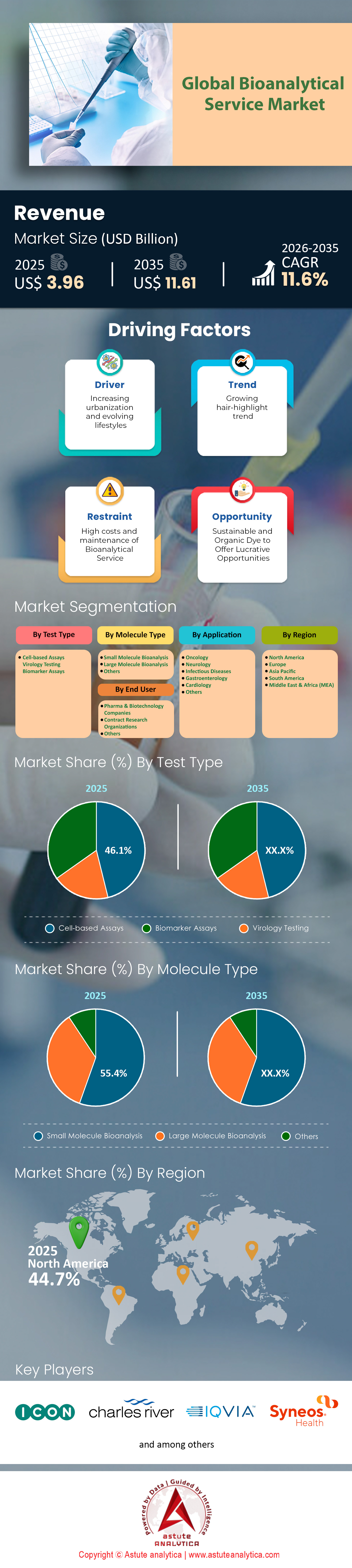
Bioanalytical services market is projected to make a forward leap in its revenue from US$ 3.96 billion in 2025 to US$ 11.61 billion by 2035 at a robust CAGR of 11.6% over the forecast period 2026-2035.
Key Findings
Bioanalytical services represent the scientific backbone of the drug development lifecycle. These specialized processes involve the quantitative measurement of drugs, their metabolites, and biomarkers within biological systems—such as blood, plasma, or tissue. As the pharmaceutical industry pivots from simple chemical compounds to complex biological structures, bioanalysis has evolved from a support function into a critical strategic capability. In 2025, the bioanalytical services market is no longer just about testing; it is about navigating the regulatory labyrinth to bring life-saving therapies to patients faster.
To Get more Insights, Request A Free Sample
Why is the demand for bioanalytical services skyrocketing?
The surge in demand is inextricably linked to the growing complexity of the global therapeutic pipeline. In 2024, the FDA’s Center for Drug Evaluation and Research (CDER) approved 50 new molecular entities (NMEs). Significantly, 18 of these were biologic entities (NBEs), which require far more rigorous and expensive assay work than traditional small molecules. Furthermore, the regulatory environment has intensified; 22 drugs received "First-in-Class" designation in 2024, signaling novel mechanisms of action that necessitate the development of entirely new analytical methods.
Biosimilars are another massive accelerator. As patents for blockbuster biologics expire, developers are rushing to market with lower-cost alternatives. The FDA approved a record 19 biosimilars in 2024, including 6 competitors for Stelara and 5 for Eylea. Each of these approvals requires extensive comparative bioanalytical testing to prove similarity to the reference product. Consequently, the bioanalytical services market is absorbing a tidal wave of samples from these comparative efficacy trials.
Which service segments are witnessing the highest traction?
While small molecule testing remains a volume driver, the highest growth and revenue intensity are found in Large Molecule Bioanalysis. Specifically, services related to Antibody-Drug Conjugates (ADCs) and cell/gene therapies are witnessing exponential demand. ADCs are notoriously difficult to analyze, often requiring three distinct assays—total antibody, conjugated payload, and free payload—to satisfy regulators. With the FDA granting 63 review designations specifically to ADCs in 2024, laboratories offering these complex hybrid assays are operating at near-full capacity.
Immunogenicity testing is another critical high-growth segment. As 8 new cell and gene therapies secured FDA approval in 2024, the need to monitor patient immune responses to these foreign viral vectors is paramount. WuXi AppTec, a bellwether for the industry, reported a pipeline of 276 TIDES (peptide and oligonucleotide) molecules as of Q1 2024. The sheer volume of these advanced modalities is pushing the bioanalytical services market toward highly specialized, high-sensitivity platforms like digital droplet PCR and advanced mass spectrometry.
Who are the primary end-users driving this consumption?
Pharmaceutical and biotechnology companies remain the dominant end-users, fueled by a strategic shift toward outsourcing. Facing the pressures of the Inflation Reduction Act (IRA) and the need to optimize R&D spend, sponsors are reducing internal infrastructure in favor of Contract Research Organizations (CROs). This trend is evident in clinical trial volumes; as of December 2024, there were 563,083 studies registered on ClinicalTrials.gov. Managing the bioanalysis for such a vast array of studies internally is financially unfeasible for most biopharma companies.
Specifically, the "Mid-Size" and "Emerging Biotech" segments are critical drivers. Lacking the capital to build 40,000-square-foot labs, these companies rely entirely on external partners. ICON plc, for instance, supported 1,270 clinical studies in 2024 involving over 416,000 patients. Without the bioanalytical services market, these smaller innovators would find it impossible to generate the data required for regulatory submission.
What recent developments have reshaped market dynamics?
The market is currently defined by a massive infrastructure "arms race" to localize testing capacity. Supply chain disruptions have taught CROs that proximity to clinical sites is crucial. In response, Frontage Laboratories opened a new 46,300 square-foot GMP facility in Exton, Pennsylvania, in May 2025. This site alone added 9 GMP suites and 3 analytical labs, directly addressing the US domestic capacity crunch.
International expansion is equally aggressive. LabCorp expanded its Singapore facility to 7,300 square meters in 2025, adding 90 high-skilled roles to serve the Asia-Pacific region. Simultaneously, WuXi AppTec broke ground on a new R&D site in Singapore in May 2024. These developments indicate that the bioanalytical services market is moving away from a centralized model toward a regional hub model, ensuring that samples from global trials can be processed within 24 to 48 hours regardless of origin.
Who are the top players and what are their key offerings?
The competitive landscape is dominated by large, diversified CROs that offer "end-to-end" solutions. Key players include WuXi AppTec, LabCorp, ICON plc, Eurofins, Syneos Health, and Frontage Laboratories.
WuXi AppTec leads in scale for advanced modalities. Their TIDES business generated RMB 5.80 billion in 2024, backed by a massive backlog of RMB 49.31 billion. They offer integrated development and manufacturing, streamlining the transition from bench to bedside.
LabCorp leverages its massive footprint, maintaining 8 million square feet of preclinical facilities globally. Their strength lies in their ability to handle high-volume clinical trials, supported by a staff of over 4,000 clinical testing professionals.
ICON plc differentiates through its scientific depth, maintaining a library of 1,500 validated assays ready for immediate deployment. This allows sponsors to bypass months of method development time.
Frontage Laboratories focuses on agility and specialized support for complex formulations, evidenced by their new Exton facility which includes dedicated high-potent and aseptic suites.
How are market players competing with each other?
Competition in the bioanalytical services market is no longer solely about price; it is about speed and scientific talent. The "war for talent" is fierce. Syneos Health, for example, boasts a workforce of 25,000 colleagues, while Frontage’s recent expansion created 100 new specialized jobs. Providers are competing to hire the PhD scientists necessary to run complex flow cytometry and LC-MS/MS assays.
Operational efficiency is another battleground. Companies are investing heavily to reduce "white space" in their pipelines. WuXi AppTec managed to onboard 1,000 new customers in 2024 alone, a feat achieved through rigorous process optimization. Moreover, 47 of the 50 FDA approvals in 2024 met their PDUFA dates, forcing CROs to align their internal timelines strictly with regulatory clocks. Players that miss deadlines are quickly losing market share to those with proven operational excellence.
What are the major trends and future opportunities?
The most lucrative opportunity lies in the intersection of rare diseases and precision medicine. In 2024, 25 of the FDA’s novel drug approvals were for rare diseases. These programs often utilize biomarkers as surrogate endpoints, placing immense value on the bioanalytical lab’s ability to validate these biomarkers.
Another emerging trend is the integration of manufacturing and testing. WuXi AppTec increased its peptide synthesizer volume to 32,000 liters in 2024, projecting 100,000 liters by 2025. By controlling the manufacturing, they secure the downstream bioanalytical work.
Furthermore, the rise of "Interchangeable Biosimilars" (like Simlandi, approved in 2024) creates a new tier of testing requirements. Stakeholders who invest in high-throughput immunogenicity screening today will capture the bulk of this biosimilar revenue tomorrow.
Where is this market going in the coming years?
Looking ahead, the bioanalytical services market is poised for sustained expansion driven by the TIDES revolution. With WuXi AppTec seeing 337 new molecules added to their pipeline in just Q1 2024, the volume of work entering the preclinical phase is staggering. We will likely see further consolidation as giants like Eurofins (who acquired Infinity Laboratories in 2024) continue to buy up niche specialty labs to fill technology gaps.
Ultimately, the market is shifting toward a partnership model. With pharmaceutical companies relying on data to make "Go/No-Go" decisions faster than ever, bioanalytical labs are becoming strategic advisors rather than mere service providers. As 2025 unfolds, those with the most robust infrastructure, the deepest talent pools, and the most advanced assay portfolios will define the future of drug development.
Segmental Analysis
Cell-Based Assays: The Frontrunner Controlling 46.1% of the Bioanalytical Landscape
Cell-based assays have firmly established themselves at the forefront of the industry, capturing a dominant 46.1% of the bioanalytical services market. Their leadership position is driven by their unique ability to provide physiologically relevant data, a critical requirement for modern drug discovery and development. The momentum behind this segment is evident in the surge of innovation, with over 2,000 new assay kits launched globally in 2023 alone.
The adoption of these assays is widespread; more than 1,000 pharmaceutical and biotechnology companies now integrate them into their R&D workflows to measure the efficacy and toxicity of new therapeutics. This growing demand has triggered a massive expansion in the service sector, with the number of specialized Contract Research Organizations (CROs) escalating to over 800 worldwide. Furthermore, the academic sector remains a key contributor, with more than 2,000 institutions employing cell-based assays for basic and translational research. With a global burden of over 1 billion patients suffering from chronic illnesses, the pressure to develop advanced treatments has placed these assays at the heart of pipelines containing over 8,000 compounds.
Small Molecules: The Market Giant Commanding a Massive 55.4% Share
Despite the rise of biologics, small molecules continue to dominate the bioanalytical services market, securing more than 55.4% of the share. This segment’s valuation reflects its vast significance, with worldwide small molecule bioanalytical services hitting approximately US$ 1.83 billion in 2023. The pipeline for these therapeutics remains robust, with more than 1,800 small molecule candidates currently undergoing clinical evaluation globally. Regulatory support matches this activity; in 2023, the FDA and other bodies sanctioned the marketing of over 45 new small molecule therapeutics, reinforcing the continued reliance on this modality.
The ubiquity of small molecules—typically characterized by a low weight of less than 900 Daltons and high cell permeability—is undeniable, accounting for 70% of all available pharmaceuticals in 2023. However, their complex pharmacokinetics and metabolism require sophisticated testing, utilizing more than 2,500 bioanalytical methods. The sector is also supported by substantial investment, with over US$ 120 million allocated specifically to small molecule R&D in 2023. To support this, infrastructure is expanding rapidly; more than 1,300 new high-resolution mass spectrometry and liquid chromatography instruments were installed in labs in 2023 to achieve picogram-level detection. Consequently, the outsourcing network has grown to more than 850 CROs, catering to a specialized pipeline that includes over 350 small molecules developed for targeted therapies.
Pharma & Biotech Firms: The Primary Catalyst Holding 52.9% Market Dominance
Pharmaceutical and biotechnology firms are the undisputed powerhouses of the bioanalytical services market, constituting approximately 52.9% of the total market share. Their dominance is fueled by immense financial commitment; in 2023, these companies collectively allocated $200 billion in R&D expenditures. This investment supports a massive global development pipeline featuring more than 8,000 drug candidates. To evaluate these potential treatments, companies launched more than 5,000 clinical trials in 2023 alone, all of which require precise bioanalytical strategies for pharmacokinetic and pharmacodynamic modeling.
The regulatory environment further entrenches this demand. Following the approval of more than 100 new drugs and biologics by the FDA and EMA—almost all of which required detailed bioanalytical studies—the bar for testing has been raised. The industry is also grappling with the complexity of more than 400 gene and cell therapies and more than 600 targeted therapies currently in development. To manage the high costs of development—averaging USD 1.5billionover 10 to 15years—companies are aggressively outsourcing. In 2023, pharma and biotech firms spent more than USD 800 million on CRO services to leverage specialized technology and accelerate timelines.
Access only the sections you need—region-specific, company-level, or by use-case.
Includes a free consultation with a domain expert to help guide your decision.
Oncology: The Leading Application Sector Capturing Over 32% of the Market
In 2025, oncology emerged as the most significant application segment, holding more than 32.42% of the bioanalytical services market share. This dominance is a response to the critical global health crisis, with cancer causing almost 10 million deaths and resulting in over 19 million new diagnoses in 2023. The sheer volume of cases drives extensive R&D activity. Breast cancer leads with nearly 2.03 million patients annually, followed by lung cancer with 2.2 million cases and 1.84 million deaths. Additionally, colorectal cancer accounts for 1.9 million new cases, and prostate cancer affects 1.4 million males worldwide.
The complexity of treating these conditions has spurred a massive demand for bioanalytical testing. The global oncology pipeline in 2023 included more than 5,000 drugs at various stages of development. Innovation is particularly strong in precision medicine, with more than 1,200 targeted therapies and immuno-oncology treatments under investigation, requiring sophisticated methods to assess biomarkers and drug interactions. This shift toward targeted therapy resulted in upwards of 500 biomarker-based clinical trials being conducted in 2023. Reflecting the urgency and scale of this sector, total expenditure on oncology research reached slightly over $50 billion for the year.
To Understand More About this Research: Request A Free Sample
Regional Analysis
North America Driving Dominance With Massive Clinical Volume and Infrastructure
North America commands a decisive 45% market share of the bioanalytical services sector in 2025, a position cemented by an unmatched clinical trial ecosystem. The region's dominance is anchored by the sheer density of research activity, with 162,904 clinical studies actively registered in the U.S. alone as of December 2024. This high volume of domestic trials creates a continuous, reliable sample stream for local laboratories. Furthermore, the regulatory environment acts as a catalyst; the FDA’s approval of 50 new molecular entities in 2024 has triggered immediate downstream demand for post-market surveillance and pharmacokinetics testing.
To support this workload, U.S.-based providers have aggressively expanded physical capacity. Frontage Laboratories’ opening of a 46,300 square-foot GMP facility in Pennsylvania and BioAgilytix’s USD 20 million investment in North Carolina exemplify the capital flowing into the region. These facilities are not merely shells; they are outfitted to handle the 429,987 interventional studies globally that often funnel data back to U.S. sponsors, ensuring North America remains the central nervous system of the global market.
Asia Pacific Capturing Share Through Manufacturing Integration and Strategic Hubs
Following closely, the Asia Pacific region is rapidly expanding its influence by integrating bioanalysis with drug manufacturing. China, led by giants like WuXi AppTec, is the engine of this growth. WuXi reported a staggering backlog of RMB 49.31 billion at the end of 2024, proving that global sponsors are heavily committing to APAC providers. The region’s strength lies in its dominance of the "TIDES" (peptides and oligonucleotides) sector, where WuXi alone generated RMB 5.80 billion in revenue.
Singapore has simultaneously emerged as a critical logistics hub for Western CROs. LabCorp’s expansion of its Singapore facility to 7,300 square meters in 2025, housing 440 staff, demonstrates a strategic pivot to capture regional trial data. By offering lower-cost yet high-quality testing close to emerging markets, APAC is successfully converting its manufacturing prowess into bioanalytical market share.
Europe Sustaining Market Relevance Via Specialized Scientific Talent and Assays
Europe maintains its strong foothold by focusing on high-complexity, scientific niche services rather than pure volume. The region’s competitive advantage is its deep pool of specialized talent, exemplified by ICON plc, which employs over 580 bioanalysis experts across its network. European labs are increasingly becoming centers of excellence for assay development; ICON, for instance, now offers a library of 1,500 validated assays, allowing sponsors to bypass lengthy development phases.
Market consolidation is further strengthening Europe’s position. Eurofins’ strategic integration of 100 additional staff in 2024 highlights the region's focus on scaling workforce capabilities to meet complex regulatory demands. This emphasis on scientific rigor ensures Europe remains the preferred destination for immunogenicity and biomarker studies that require deep distinct expertise.
Recent Developments Shaping the Competitive Landscape of the Bioanalytical Services Market
Top Players in the Bioanalytical Services Market
Market Segmentation Overview:
By Test Type
By Molecule Type
By Application
By End User
By Region
LOOKING FOR COMPREHENSIVE MARKET KNOWLEDGE? ENGAGE OUR EXPERT SPECIALISTS.
SPEAK TO AN ANALYST