Market Scenario
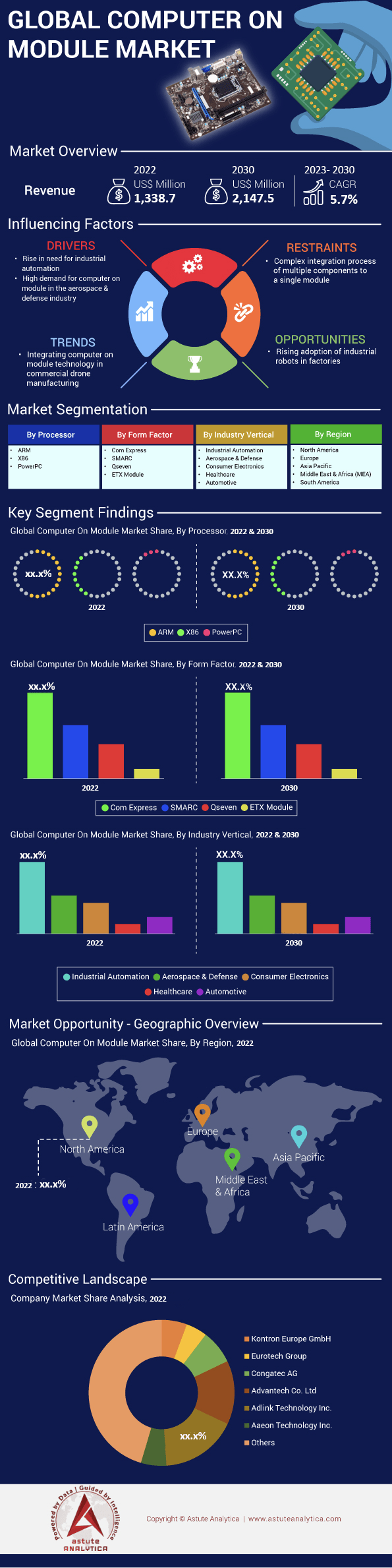
Global computer on Module market size was valued at USD 1,750 million in 2025 and is projected to hit the market valuation of USD 3,996 million by 2035 at a CAGR of 8.60% during the forecast period 2026–2035.
Key Market Insights
- By form Factors, COM express set to remain the largest contributor to the market by generating over 54.70% market revenue.
- By processor architecture, x86 architecture captures over 62% market share.
- By application, control & automation systems accounts for over 17.33% market share.
- By end use industry, industrial automation is projected to continue dominating the market by holding over 33% market share.
- North America to is the largest contributor with over 58% market share.
- Asia Pacific is projected to remain the fastest growing region with over 10.76% market share.
Market Definition
COM stands for Computer on Module: a small compute board that contains the processor, memory, and core system functions, while a separate carrier board provides the application-specific I/O and connectors. In simple terms, it is a reusable computer core that helps companies build embedded products faster.
To Get more Insights, Request A Free Sample
Market Definition
COM stands for Computer on Module: a small compute board that contains the processor, memory, and core system functions, while a separate carrier board provides the application-specific I/O and connectors. In simple terms, it is a reusable computer core that helps companies build embedded products faster.
Why Demand is Rising for COM?
The demand is rising because COM modules reduce development time, lower redesign risk, and let OEMs reuse a proven compute platform across multiple products. They also make it easier to scale to new performance needs, since standards like COM-HPC, SMARC, and OSM continue adding support for newer interfaces and system requirements.
What is Driving Adoption?
The biggest drivers are edge computing, industrial automation, AI at the edge, telecom, medical devices, and rugged embedded systems. Buyers want compact hardware that can still handle high bandwidth, remote management, and long product lifecycles, and COM architectures fit that need well.
How Does The Computer-on-Module (COM) Market Address Complex High-Performance Edge Server Demands?
Edge servers are becoming module-first
The Computer-on-Module (COM) market addresses edge server complexity by shifting performance into standardized compute blocks. That lets OEMs shorten design cycles while still scaling bandwidth, memory, and processor power. COM-HPC exists specifically to serve high-performance compute needs at the edge, where systems must be compact but still behave like servers. The result is a market response to a difficult balance: more compute density without forcing a full custom motherboard redesign.
Interconnect density is the real battleground
Modern edge workloads in the computer-on-Module (COM) market do not just need faster processors. They need wider I/O pipes, more displays, richer storage, and stronger remote management. COM-HPC revision 1.3 adds PCIe Gen 6, CXL, modern standby, and new camera-related support, showing how the standard is moving with system bottlenecks instead of lagging behind them. That matters because edge AI, industrial servers, and telecom nodes increasingly fail on I/O limits before they fail on raw CPU limits.
The business case is straightforward. Vendors can package a high-performance processor on a reusable module, while customers keep carrier-board flexibility. That lowers engineering risk, reduces time-to-market, and makes successive product upgrades less disruptive. In practical terms, COM-HPC turns edge-server complexity into a modular supply-chain advantage rather than a one-off engineering burden.
Why is the Computer-on-Module (COM) Market Embracing Open Standard Module Hardware Formats?
Manufacturing simplicity is driving adoption
The appeal of OSM begins with how it is built. SGET positions OSM as a directly soldered module format that removes the need for traditional board-to-board connectors. That instantly improves manufacturability, reduces connector wear, and supports more automated assembly. For buyers, this is not a cosmetic preference; it is a cost, reliability, and production-volume decision.
Reliability matters more in harsh deployments
OSM is especially attractive in environments where vibration, shock, or repeated handling can degrade connector-based designs. Direct soldering in the computer-on-Module (COM) market eliminates friction-based failure points and improves mechanical robustness. It also supports more compact footprints, which is important in sensor-rich edge devices and embedded control systems. SGET’s ongoing updates to OSM, including Specification 1.2 and Design Guide 1.1, indicate that the ecosystem is still maturing rather than standing still.
From a business perspective, OSM gives OEMs a path to standardized embedded design without the cost and fragility of conventional module interconnects in the Computer-on-Module (COM) market. It is especially relevant where products must be assembled quickly and repeated at scale. That makes OSM more than a miniature format; it is a production strategy for constrained and rugged hardware programs.
What Drives the Market To Adopt Advanced SMARC Technology Standards?
Compact platforms still need serious interface breadth
SMARC stays important in the Computer-on-Module (COM) market because it solves a different problem from COM-HPC. Instead of targeting pure high-end compute, it balances low power, small footprint, and broad connectivity for embedded systems. SGET’s SMARC 2.2 update shows that the standard is still actively maintained and aligned with evolving module requirements. This is critical in markets where product lifecycles are long and customers value interface continuity.
The standard is built for embedded product families
SMARC is attractive because it supports a wide spread of deployment types, from industrial controllers to vision systems and mobile edge nodes. The design guide for SMARC 2.1.1 emphasizes carrier-board guidance across Arm and x86-based implementations. That cross-architecture flexibility gives OEMs a cleaner way to manage product line variations without rebuilding the whole system stack. In commercial terms, SMARC helps companies preserve platform reuse while still serving different compute classes.
SMARC’s market momentum comes from this middle-ground positioning. It is not trying to win every high-end server workload, but it remains highly relevant where size, power, and interface diversity must coexist. That makes it one of the most commercially practical standards in the COM ecosystem.
How Will The Computer-on-Module (COM) Market Sustain Growth Through COM Express Evolution?
Evolution is preserving installed-base value
COM Express continues to matter because it evolves without forcing customers to abandon existing system knowledge. PICMG’s COM.0 R3.1 update adds PCIe Gen 4, USB4 support, and interface refinements that keep the standard compatible with more modern edge demands. That is valuable in industrial and embedded markets, where replacement cycles are long and redesign costs are high. Buyers often prefer a standard that upgrades gracefully rather than one that resets the architecture every few years.
Type-based segmentation keeps it commercially flexible
COM Express survives because the family is not one-size-fits-all. Type 6, Type 7, and Type 10 each address different performance, size, and I/O priorities. Type 7 supports server-like networking and remote management needs, while Type 6 and Type 10 fit more compact or display-focused designs. That lets vendors target distinct verticals without leaving the standard ecosystem.
The Computer-on-Module (COM) market growth here is simple. COM Express remains the bridge between legacy reliability and newer interface expectations. This balance is why it still attracts industrial OEMs, network equipment makers, and system integrators who value both continuity and upgradeability. In a market where platform stability has real procurement value, that is a strong competitive position.
Where Does the Market Intersect With Modern Artificial Intelligence Needs?
AI is reshaping module priorities
AI workloads are changing what buyers in the Computer-on-Module (COM) market expect from embedded modules. They no longer judge a platform only by CPU speed; they also look at inference acceleration, storage throughput, memory bandwidth, and deterministic latency. COM-HPC’s support for PCIe Gen 6, CXL, and newer I/O models shows how the standard is adapting to these requirements. That matters because edge AI frequently needs local decision-making rather than cloud dependency.
Edge intelligence needs both speed and control
AI at the edge is not only about running models. It also requires predictable timing, secure remote management, and robust data movement across cameras, networks, and storage. PICMG’s COM-HPC platform management work supports out-of-band control, which is essential in remote AI deployments. Meanwhile, SMARC and COM-HPC continue to expand support for camera and high-speed interface patterns in the Computer-on-Module (COM) market that matter in vision-heavy systems.
This is where the market becomes strategically important. It gives AI device builders a way to scale from compact inference nodes to heavier edge servers using standardized hardware foundations. That reduces integration friction across multiple AI product tiers.
Which Specific Industry Requirements Force The Computer-on-Module (COM) Market Towards Custom Interconnectivity?
Vertical markets are dictating interface design
Different industries are pulling the Computer-on-Module (COM) market in different directions. Telecom wants dense networking and remote administration. Industrial automation wants deterministic timing and robust field connectivity. Medical and surveillance applications want high-resolution video pipelines and reliability under continuous operation. The standards are responding by adding richer I/O options and management features instead of staying narrow.
Modularity is becoming a customization layer
The deeper trend is that customers increasingly want custom interconnectivity without custom compute design. COM architectures let OEMs standardize the processor module while tailoring the carrier board to the application. That separation is especially valuable in regulated or vertically specialized markets, where validation and compliance costs are high. It also helps companies manage product variation without multiplying development overhead.
This is the strategic reason the market keeps expanding across segment after segment. It gives users the ability to customize where differentiation matters, while still reusing a trusted compute core. In business terms, that is a strong formula for scale.
Segmental Analysis of the Computer-On-Module (COM) Market
By Form Factor: COM Express Leads Form Factor Segment Generating Over 54.70% Market Revenue
In the global Computer-on-Module (COM) Market, the COM Express standard dominates modern edge deployments by generating over 54.70% market revenue. The broader market leverages this financial lead to effectively standardize rugged industrial environments. Enterprises aggressively deploy these modules to utilize high-bandwidth PCIe Gen 4 lanes and 10GbE network interfaces without abandoning existing carrier boards. The 2026 adoption of the Revision 3.1 specification securely extended this dominance by natively integrating modern high-speed USB 4.0 data transmission lines. Such architectural updates explicitly prevent risky migration toward unproven alternative form factors.
- Integrates CEI side-band-signaling to flawlessly optimize high-speed 10GbE network throughput.
- Deploys exactly 32 native PCIe lanes exclusively serving headless edge server operations.
- Supports extreme -40°C to +85°C temperatures utilizing conformal-coated robust PCB layers.
- Eliminates PCI Express Graphics multiplexing bottlenecks to safely maximize direct display bandwidth.
By Application: Control & Automation Systems Lead Applications Holding 17.33% Market Share
Control & automation systems firmly anchor the application sector within the Computer-on-Module (COM) Market by accounting for over 17.33% market share. Expanding rapidly, the modernizing market directly depends on these robust, real-time hyper-automated smart manufacturing workflows. System integrators heavily deploy standardized modular compute nodes to aggressively virtualize traditional hardware programmable logic controllers, drastically cutting physical footprints. By tightly leveraging integrated Time-Sensitive Networking protocols, these reliable modules deliver deterministic sub-millisecond network latencies fundamentally required for synchronizing robotic arms. This ongoing commercial consolidation of real-time control logic securely solidifies the application segment’s unmatched global financial leadership.
- Executes deterministic sub-millisecond hardware instructions via natively supported Time-Sensitive Networking protocol stacks.
- Virtualizes legacy physical automation hardware directly onto modernized centralized real-time embedded hypervisors.
- Integrates exactly 12 General Purpose Input/Output hardware pins for uninterrupted physical connectivity.
- Utilizes dual-channel LVDS native interfaces to securely drive large-scale industrial human-machine displays.
By Industry Vertical: Industrial Automation Remains End-Use Leader Capturing Over 33% Market Share
Industrial automation currently remains the foremost commercial catalyst driving the global Computer-on-Module (COM) Market, projected to successfully maintain dominance by holding over 33% market share. Consequently, the heavy manufacturing segment of the Computer-on-Module (COM) Market actively utilizes modular compute nodes to enable aggressive Industry 4.0 digitalization agendas. Plant operators heavily depend on ruggedized, fully machine-solderable computing footprints to reliably deploy local edge inference algorithms facilitating continuous predictive maintenance. Because automated factory facilities strictly endure severe electromagnetic interference and intense physical vibrations, standard industrial connectorless modules consistently provide unparalleled localized structural durability against mechanical degradation.
- Leverages localized multi-TOPS Neural Processing Units for accurate predictive machinery maintenance algorithms.
- Prevents physical mechanical failure using machine-solderable hardware components engineered against heavy vibration.
- Replaces traditional commercial communication cabling utilizing natively supported high-speed CAN-FD protocol buses.
- Integrates direct Baseboard Management Controllers allowing administrators robust remote firmware-over-the-air network updates.
Customize This Report + Validate with an Expert
Access only the sections you need—region-specific, company-level, or by use-case.
Includes a free consultation with a domain expert to help guide your decision.
By Processor Architecture: x86 Architecture Dominates Processing With Over 62% Market Share
The x86 instruction architecture unequivocally controls the computational core of the Computer-on-Module (COM) Market by capturing over 62% market share globally. Furthermore, the high-performance Computer-on-Module (COM) Market fundamentally relies on vast x86 ecosystems to ensure absolute legacy code compatibility. This structural dominance arises from installed industrial software foundations requiring native Windows IoT and standard RTLinux operating environments. By heavily utilizing modern Intel Core and AMD Ryzen processors, OEMs rapidly deploy immense multi-core processing power directly at the local edge. The sheer hardware maturity of this architecture enables accelerated commercial deployment cycles while restricting ARM processors to basic endpoints.
- Sustains absolute backward compatibility with critical legacy industrial automation software frameworks.
- Accommodates strict 80-watt thermal design power hardware limits for high-end operations.
- Executes complex multi-thread hypervisor virtualization for directly consolidating hardware programmable logic controllers.
- Integrates hardware-based hyper-threading natively supporting intensive parallel computer vision inference operations.
To Understand More About this Research: Request A Free Sample
Regional Analysis of the Computer-on-Module (COM) Market
North America: The Current Stronghold of the Computer-on-Module Market
North America currently holds the dominant position in the global market by capturing over 58% market share, driven by the rapid integration of advanced edge computing and industrial automation technologies. The region's stronghold is primarily fueled by extensive investments in mission-critical sectors such as aerospace, defense, autonomous vehicle development, and advanced healthcare imaging systems. North American enterprise buyers consistently demand highly ruggedized, high-performance computing modules that can operate reliably in extreme environments without thermal throttling. Furthermore, the early and aggressive adoption of edge Artificial Intelligence (AI) and the transition towards the high-bandwidth COM-HPC standard have solidified the region's market leadership.
Tier-1 Original Equipment Manufacturers (OEMs) in the United States and Canada computer-on-Module (COM) market are heavily leveraging COM architectures to accelerate product time-to-market and reduce complex custom engineering costs associated with localized manufacturing constraints. Additionally, the strict regulatory certification environments in North American medical and military sectors heavily favor the pre-validated, isolated computing core approach provided by standard COM form factors. Despite this deeply established market presence, the region faces intensifying global volume competition, pushing North American vendors to increasingly focus on premium, ultra-high-performance modular hardware designs.
Asia Pacific: The Rapidly Emerging Powerhouse Set to Overtake the Market
The Asia Pacific region is rapidly transforming into the primary growth engine for the global Computer-on-Module (COM) market, fueled by unprecedented industrial digitalization. Extensive market studies suggest that the Asia Pacific is set to successfully overtake North America's long-standing dominance by 2029, expanding at a remarkable CAGR of 10.76%. This explosive regional growth is anchored by the massive electronics manufacturing hubs located across Taiwan, China, Japan, and South Korea, which dominate global baseboard fabrication. The relentless regional push towards Industry 4.0, smart factory automation, and heavy industrial robotics requires immense volumes of compact, scalable edge computing nodes.
Consequently, regional demand for ultra-compact, low-power standard footprints like Open Standard Module (OSM) and SMARC is skyrocketing among local hardware developers. Furthermore, the aggressive rollout of regional 5G telecommunication infrastructure and expansive smart city initiatives necessitates massive edge server deployments utilizing scalable modular formats. Asia Pacific buyers are significantly accelerating the adoption of cost-effective, ARM-based modular architectures optimized for machine vision and massive Internet of Things (IoT) connectivity. With deep localized supply chains and unmatched manufacturing scale, the Asia Pacific ecosystem will capture definitive global market leadership.
Top 5 Recent Developments Shaping the Computer-on-Module (COM) Market
- congatec launched its broadest Intel Core Ultra Series 3 COM portfolio, announcing five new COMs across four form factors with up to 180 TOPS for edge AI workloads on January 6, 2026.
- congatec expanded its COM portfolio with 18 new JUMPtec product families on January 8, 2026, giving customers a wider set of COM-HPC, COM Express, SMARC, and Qseven modules.
- congatec introduced conga-TCRP1 COM Express Compact modules based on AMD Ryzen AI Embedded P100 processors on January 20, 2026, targeting rugged industrial AI use cases with -40 to +85 °C operation.
- PICMG released COM-HPC revision 1.3 on March 10, 2026, a standards update that matters directly to COM vendors and platform designers building next-generation modular systems.
- SolidRun and Peridio announced Avocado OS availability on SolidRun’s RZ/V2N-based platforms on June 4, 2026, strengthening the software stack around SOM-style module deployments for Physical AI applications.
Top Companies in the Computer on Module Market
- ADLINK Technology Inc.
- Eurotech S.p.A.
- Advantech Co., Ltd.
- SECO S.p.A.
- Kontron AG
- AAEON Technology Inc.
- Digi International Inc.
- congatec GmbH
- American Portwell Technology, Inc.
- CompuLab
- Blue Chip Technology Ltd
- Other Prominent Players
Market Segmentation Overview
By Form Factor
- COM Express
- SMARC
- Qseven
- COM-HPC
- ETX
- XTX
By Processor
- x86 Architecture
- ARM Architecture
- Power Architecture
By Cooling Type / Thermal Design
- Passive
- Active
By Application
- Control & Automation Systems
- Data Processing & Communication
- Embedded Edge & IoT Systems
- Navigation & Control Systems
- Transaction & Interface Systems
- Research & Data Acquisition Systems
- Human-Machine Interface (HMI)
- Monitoring & Diagnostic Systems
- Imaging & Visualization Systems
- Consumer & Interactive Systems
- Energy Management Systems
By End Use Industry
- Industrial Automation
- Medical Devices
- Transportation
- Telecommunications
- Consumer Electronics
- Energy
- Retail & Point-of-Sale
- Security & Surveillance
- Agriculture
- Defence & Aerospace
- Scientific Research
By Region
- North America
- The U.S.
- Canada
- Mexico
- Europe
- Western Europe
- UK
- Germany
- France
- Italy
- Spain
- Rest of Western Europe
- Eastern Europe
- Poland
- Russia
- Rest of Eastern Europe
- Western Europe
- Asia Pacific
- China
- India
- Japan
- South Korea
- Australia & New Zealand
- ASEAN
- Indonesia
- Malaysia
- Thailand
- Singapore
- Rest of ASEAN
- Rest of Asia Pacific
- Middle East & Africa
- Saudi Arabia
- South Africa
- UAE
- Rest of MEA
- South America
- Argentina
- Brazil
- Rest of South America
REPORT SCOPE
| Report Attribute | Details |
|---|---|
| Market Size Value in 2025 | US$ 1,750 Mn |
| Expected Revenue in 2035 | US$ 3,996 Mn |
| Historic Data | 2020-2035 |
| Base Year | 2025 |
| Forecast Period | 2026-2035 |
| Unit | Value (USD Mn) |
| CAGR | 8.60% |
| Segments covered | By Form Factor, By Processor, By Cooling Type / Thermal Design, By Application, By End Use Industry, By Region |
| Key Companies | ADLINK Technology Inc., Eurotech S.p.A.., Advantech Co., Ltd., SECO S.p.A., Kontron AG, AAEON Technology Inc., Digi International Inc., congatec GmbH, American Portwell Technology, Inc., CompuLab, Blue Chip Technology Ltd, Other Prominent Players |
| Customization Scope | Get your customized report as per your preference. Ask for customization |
FREQUENTLY ASKED QUESTIONS
Global computer-on-Module (COM) market size was valued at USD 1,750 million in 2025 and is projected to hit the market valuation of USD 3,996 million by 2035 at a CAGR of 8.60% during the forecast period 2026–2035.
Asia Pacific leads, expanding at a 10.76% CAGR driven by vast regional electronics manufacturing scale.
It supports up to 65 PCIe Gen 5 lanes, facilitating massive localized AI server workloads safely.
Open Standard Modules utilize direct machine-solderable BGA contacts, completely eliminating costly physical friction connectors.
The x86 architecture heavily leads due to multi-core capabilities and absolute legacy industrial software compatibility.
Yes, SMARC enforces strict 3.0V to 5.25V inputs, drastically minimizing battery power consumption for untethered remote deployments.
LOOKING FOR COMPREHENSIVE MARKET KNOWLEDGE? ENGAGE OUR EXPERT SPECIALISTS.
SPEAK TO AN ANALYST
.svg)

 Schedule a Meeting

Features | Type of License | ||||
 Data Book | Single User |   Multi User |  Corporate | ||
| e-Access | ✓ | ✓ | ✓ | ✓ | |
User Sharing | 1 User Only | 1 User Only | Up to 7 Users | Unlimited User Access | |
⨉ | ⨉ | ⨉ | ✓ | ||
Free Customization | No Free Customization | Up To 30 hrs work | Up To 60 hrs work | Up To 80 hrs work | |
Deliverable |
| ⨉ | ✓ | ✓ | ✓ |
| ✓ | ⨉ | ✓ | ✓ | |
| ⨉ | ⨉ | ⨉ | ✓ | |
Analyst Support | 2-Months Analyst Support | 4-Months Analyst Support | 7-Months Analyst Support | One Year Analyst Support | |
Free Report update in next update cycle | ⨉ | ⨉ | ⨉ | ✓ | |
Free Industry Update (Within 180 days) | ⨉ | ⨉ | ⨉ | ✓ | |
Benefit | Up to 10% off on Post Purchase | Up to 20% off on Post Purchase | Up to 30% off on Post Purchase | Up to 40% off on Post Purchase | |