Market Snapshot
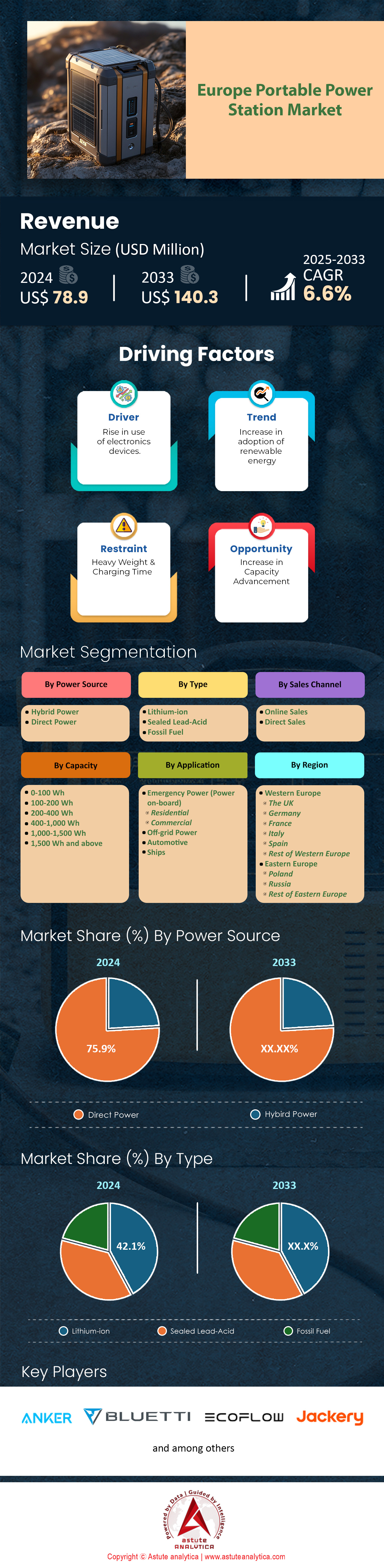
Europe portable power station market generated a revenue of US$ 78.9 million in 2024 and is estimated to reach a valuation of US$ 140.3 million by 2033, at a CAGR of 6.6% over the forecast period 2025–2033.
Key Findings in Europe Portable Power Station Market
- Based on the power source, direct power held 75.9% of the Europe market.
- Based on type, the Lithium-ion segment held a 42.1% share.
- Based on capacity, the 1000-1500 segment held a 29.1% share of the Europe market.
- By application, emergency power generated revenue of around 78.6%.
- Based on sales channel, the online sales segment dominated the Europe market.
Across Europe portable power station market, a quiet revolution is happening in how people think about power, and it's fueling an incredible surge in demand for portable power stations. This isn't just about new gadgets, it's a fundamental shift driven by a growing anxiety over energy security. This feeling is backed by hard numbers: a 2024 survey showed that a striking 67 out of 100 Europeans now see home backup power as a basic necessity. This concern stems directly from events like the 142 significant grid disturbances recorded in 2024 and the stark memory of Storm Babet leaving over 250,000 households in the dark. At the same time, the very definition of the workplace has dissolved for millions, with 2.1 million digital nomads and 11.3 million remote workers now needing the freedom to power their lives from anywhere.
To Get more Insights, Request A Free Sample
Layered on top of this is Europe's deep-seated love for the outdoors, which has become a massive commercial force. The camping and hiking equipment segment alone is a juggernaut, generating around USD 38.4 billion in 2024. For this huge consumer base, portable power is no longer a luxury but an essential piece of gear in the Europe portable power station market. Crucially, these consumers are making a conscious choice for sustainability. They are actively moving away from old-school gas generators, seeking the silent, clean energy that modern power stations provide. This demand for green solutions is being met by technology, with new LiFePO4 batteries now lasting over 3,000 charge cycles—a lifespan of a decade or more—which perfectly aligns with the continent's goals under the European Green Deal.
Ultimately, this boom is made possible by technology that is finally catching up to consumer ambition. Today's devices are more powerful and portable than ever before, solving problems for every type of user. You have beasts like the 2025 Bluetti Elite 400 with a 3,900W surge capacity for serious backup needs, and then you have featherweights like the 1.8 kg Bluetti Elite 10 for true mobility. This innovation isn't happening in a vacuum; it's supported by policies like the EU Work Plan for Sport (2024-2027), which actively encourages the outdoor lifestyles that are helping to define the modern Europe portable power station market.
Segmental Analysis
Direct Power's Reign Comes From Its Plug-and-Play Simplicity
Holding a massive 75.9% of the market, direct power sources dominate the Europe portable power station market because they are incredibly straightforward and reliable. European consumers appreciate the simple plug-and-play functionality, which works seamlessly with existing home grids. A need for dependable energy is more critical than ever, especially after the EU experienced 142 significant grid disturbances in 2024. In Germany alone, 14 major grid instability events pushed people toward backup solutions they can trust. A robust design makes these power stations exceptionally reliable for emergencies, and their universal compatibility with Europe’s power grid is a major selling point. Looking ahead, the foundation for direct power’s future is solid, with expectations for electricity's share of final energy consumption to reach as high as 60 percent by 2050.
The user base for direct charging is already immense across the Europe portable power station market. Back in 2020, there were 1.7 billion external power supplies in use across the EU27, averaging 6.5 units per household. Such a figure shows deep familiarity with the technology. EU regulations like the Environmental Noise Directive also indirectly support direct power by limiting the use of louder, engine-based hybrid models in residential areas. Another significant boost comes from the explosion in residential solar power. Over 3.2 million new home PV systems were installed in 2024, which can directly charge a Europe portable power station.
- Europe’s electric vehicle charging network, which grew beyond 1 million public charge points in 2024, strengthens the entire ecosystem for direct AC charging.
- The growing population of digital nomads, reaching 2.1 million in the EU in 2024, relies heavily on the consistent power these stations provide.
- Silent, emission-free operation makes them the only practical choice for indoor use during blackouts in apartments and city homes.
The 1000-1500Wh Range Offers the Perfect Balance of Power
Capturing a 29.1% market share, the 1000-1500Wh capacity range is the undeniable sweet spot for consumers in the Europe portable power station market. Units in a segment offer a perfect blend of portability and power. They can run essential household appliances like refrigerators and Wi-Fi routers, or even medical devices like CPAP machines, for anywhere from 6 to 48 hours during an outage. Its appeal is also strong among the 11.3 million EU residents who worked from home frequently in 2024, as it provides reliable energy for laptops and other professional gear. In fact, the 1000Wh model has been identified as the single most-sold capacity in Europe, proving its mass appeal. Major retailers like Decathlon and MediaMarkt have taken notice, focusing their product selections around this popular capacity range.
The incredible versatility of the 1000-1500Wh segment is a major reason for its success in the Europe portable power station market. These power stations are useful for far more than just home backup. They provide enough energy for outdoor film shoots to power drones and lighting rigs. They are also increasingly common on temporary construction sites before a grid connection is established. Furthermore, the affordability of units, with prices typically falling between 400 and 900 euros, makes them a practical investment for countless households and small businesses.
- A capacity in the range is perfect for weekend camping trips, easily powering small cooktops, lights, and phones.
- It is an ideal power source for food trucks and market stalls, keeping blenders, cash registers, and signs running all day.
- For electric vehicle owners, a 1000-1500Wh power station can offer a vital few kilometers of emergency range when needed most.
Emergency Preparedness Now an Unquestionable Market Driving Force
Emergency power’s astonishing 78.6% revenue share in the Europe portable power station market reflects a deep shift in how Europeans think about personal preparedness. The growing frequency of extreme weather has made grid failures a real and widespread worry. Recent events have shown just how vulnerable power grids can be. Storm Babet in 2023 knocked out electricity for over 250,000 households in the UK and Germany. Similarly, wildfires in Greece and Portugal led to preemptive grid shutdowns affecting more than 120,000 people. With 142 significant grid disturbances recorded across the EU in 2024, these are not isolated incidents. In response, France's civil security directorate supplied over 4,000 portable power stations to fire departments in high-risk areas in 2024.
A growing sense of risk is fundamentally reshaping the Europe portable power station market. A 2024 Eurobarometer survey found that most EU citizens now believe having a home backup power source is a necessary precaution. People are not just looking for convenience; they are seeking safety, especially to keep essential home medical devices running during a blackout. Recognizing a critical need, the EU even started the RESCUE project in 2025 with a 5 million euro budget to develop new portable power solutions for disaster response. A new focus on resilience has cemented the role of these devices as a vital part of any modern emergency kit.
- Some local governments in wildfire or storm-prone areas have started subsidizing certified power stations for their most vulnerable residents.
- The quiet, fume-free operation of these units makes them the only safe choice for providing backup power inside urban apartments.
- Beyond major weather events, power stations provide critical power during planned grid maintenance or unexpected equipment failures.
Customize This Report + Validate with an Expert
Access only the sections you need—region-specific, company-level, or by use-case.
Includes a free consultation with a domain expert to help guide your decision.
Lithium-ion Batteries Are the Undisputed Heart of Modern Power
The Lithium-ion segment’s dominance in the Europe portable power station market with over 42.1% market share is a clear result of its superior performance and safety. A key advantage is a much longer lifecycle. Lithium Iron Phosphate (LFP) cells, a popular choice, can handle 3,000 to 5,000 charge cycles. That is a huge leap from the 300 to 500 cycles offered by older sealed lead-acid batteries. The vast majority of the 2.3 million portable power stations shipped to Europe in 2024 were built with lithium-ion technology, cementing it as the industry standard. The technology is also impressively resilient. LiFePO4 chemistry is particularly popular for its durability and high heat resistance, making it a safer option for tough jobs. The entire energy storage sector is following suit, with the EU’s newly installed capacity reaching 175.4 GWh in 2024, driven almost entirely by lithium-ion advancements.
Constant innovation helps keep lithium-ion at the top of the Europe portable power station market. In January 2024, for example, Goal Zero launched its new Yeti series with industry-leading charging speeds, showing how quickly the technology is moving forward. Regulations are also being built around this dominant technology. The EU Battery Regulation, set to take full effect in February 2025, will mandate a digital "battery passport" for lithium-based units over 2 kilowatt-hours. Meanwhile, the push for better performance has led to incredible gains in both energy density and charging speeds, making these devices more powerful and convenient for everyone.
- Ongoing research is leading to lighter and more compact units that don’t have to sacrifice any power output.
- The amazing versatility of lithium-ion batteries allows them to safely power everything from sensitive laptops to heavy-duty power tools.
- Falling production costs for lithium-ion cells are making these advanced power stations much more affordable for the average European family.
To Understand More About this Research: Request A Free Sample
Country Analysis
Western Europe's Powerhouses: How Germany and the UK Fuel Market Dominance
The overwhelming concentration of the Europe portable power station market, where Germany and the United Kingdom generate over 83.7% of sales revenue, is rooted in a powerful combination of economic strength, specific cultural trends, and pressing energy concerns. These two nations act as the market's dual engines, driven by uniquely favorable conditions that foster widespread adoption among both residential and recreational users.
In the United Kingdom, a robust e-commerce landscape facilitates easy access for a tech-savvy population. This is amplified by a flourishing "staycation" and "van life" culture, which, as of early 2025, includes over 250,000 registered motorhomes, creating a massive, mobile consumer base in constant need of off-grid power. Furthermore, the UK's vulnerability to storm-related power outages, a recurring theme in 2024, directly fuels demand for Europe portable power station market from homeowners seeking reliable emergency backup systems, a purchase decision supported by the nation's high disposable income.
Germany's dominance, on the other hand, stems from its deep commitment to the Energiewende (energy transition). The country boasts one of Europe's largest outdoor and camping markets. More importantly, the "balcony power plant" revolution has exploded, with over 500,000 mini-solar systems officially registered by early 2025. This phenomenon has created a highly educated consumer base that understands and values energy storage, making portable power stations a logical and popular purchase for both complementing their solar setups and for recreational use. This synergy of green enthusiasm and purchasing power solidifies Germany's position as a market leader.
Competitive Analysis
Titans of Power: Five Brands Command the European Portable Power Station Market
The European portable power station arena is dominated by a tight-knit group of innovators. EcoFlow, BluettiPower, Duracell, Jackery, and Lion Energy are not just leading; they are collectively shaping the market's future, commanding over 40% of the global share. Their distinct strategies reveal a fierce battle fought on multiple fronts, moving beyond simple product specifications into ecosystem development and brand identity.
EcoFlow continues its aggressive push in the Europe portable power station market with industry-leading charging speeds and a deep focus on creating an integrated home and mobile energy ecosystem. BluettiPower counters by championing battery longevity and modularity, making a strong case for its expandable AC-series and the durability of its LiFePO4 technology. Jackery, a pioneer in the outdoor segment, maintains its stronghold by cultivating a powerful brand identity synonymous with adventure and seamless solar integration.
Meanwhile, legacy players like Duracell leverage immense brand trust to penetrate the home backup market, while Lion Energy carves out a niche centered on safety and user-friendly energy independence. This intense competition forces constant innovation in battery chemistry, power output, and smart features, ultimately driving the entire market forward.
Recent Developments Shaping the Europe Portable Power Station Market
- German portable battery manufacturer Instagrid secured a substantial USD 95 million in a Series C funding round to expand its commercial portable power solutions.
- Industrial giant Atlas Copco acquired El-Björn, a leading Swedish company specializing in temporary and portable power solutions for construction and events.
- Swedish battery titan Northvolt secured a monumental USD 5 billion in debt financing to expand its gigafactory, bolstering Europe's battery supply chain.
- Global chemical company BASF acquired TWAICE, a German battery analytics software firm, to integrate predictive battery health technology into its portfolio.
- The venture arm of the VW Group made a significant investment in Numbat, a German startup combining battery storage with high-power charging technology, pushing the Europe portable power station market growth further.
- German solar unicorn Enpal raised an additional €1.1 billion in debt financing from major global banks to expand its renewable energy solutions, including battery storage.
- Eturnity, a Swiss software company specializing in solar and heating system management, successfully closed a new financing round to fuel its European growth.
- The Swedish integrated solar roof company Sunroof announced it raised €13.5 million to expand its innovative building-integrated photovoltaic solutions.
- Sunvigo, a Cologne-based solar-as-a-service provider, secured €10 million in a Series B funding round to accelerate its rollout of home solar and storage systems.
- German climate tech firm Ecoworks raised €40 million to scale its business of retrofitting buildings with energy solutions, including solar power and storage.
List of Key Companies Profiled:
- BluettiPower
- Jackery
- Goal Zero
- Duracell
- EcoFlow
- Lion Energy
- Milwaukee Tool
- Anker Technology
- AllPowers Industrial International
- Other Prominent Players
Market Segmentation Overview
By Power Source
- Hybrid Power
- Direct Power
By Type
- Lithium-ion
- Sealed Lead-Acid
- Fossil Fuel
By Capacity
- 0-100 Wh
- 100-200 Wh
- 200-400 Wh
- 400-1,000 Wh
- 1,000-1,500 Wh
- 1,500 Wh and above
By Application
- Emergency Power (Power on-board)
- Residential
- Commercial
- Off-grid Power
- Automotive
- Ships
By Sales Channel
- Online Sales
- Direct Sales
Europe
- Western Europe
- The UK
- Germany
- France
- Italy
- Spain
- Rest of Western Europe
- Eastern Europe
- Poland
- Russia
- Rest of Eastern Europe
REPORT SCOPE
| Report Attribute | Details |
|---|---|
| Market Size Value in 2024 | US$ 78.9 Million |
| Expected Revenue in 2033 | US$ 140.3 Million |
| Historic Data | 2020-2023 |
| Base Year | 2024 |
| Forecast Period | 2025-2033 |
| Unit | Value (USD Mn) |
| CAGR | 6.6% |
| Segments covered | By Power Source, By Type, By Capacity, By Application, By Sales Channel |
| Key Companies | BluettiPower, Jackery, Goal Zero, Duracell, EcoFlow, Lion Energy, Milwaukee Tool, Anker Technology, AllPowers Industrial International, Other Prominent Players |
| Customization Scope | Get your customized report as per your preference. Ask for customization |
LOOKING FOR COMPREHENSIVE MARKET KNOWLEDGE? ENGAGE OUR EXPERT SPECIALISTS.
SPEAK TO AN ANALYST
.svg)

 Schedule a Meeting

Features | Type of License | ||||
 Data Book | Single User |   Multi User |  Corporate | ||
| e-Access | ✓ | ✓ | ✓ | ✓ | |
User Sharing | 1 User Only | 1 User Only | Up to 7 Users | Unlimited User Access | |
⨉ | ⨉ | ⨉ | ✓ | ||
Free Customization | No Free Customization | Up To 30 hrs work | Up To 60 hrs work | Up To 80 hrs work | |
Deliverable |
| ⨉ | ✓ | ✓ | ✓ |
| ✓ | ⨉ | ✓ | ✓ | |
| ⨉ | ⨉ | ⨉ | ✓ | |
Analyst Support | 2-Months Analyst Support | 4-Months Analyst Support | 7-Months Analyst Support | One Year Analyst Support | |
Free Report update in next update cycle | ⨉ | ⨉ | ⨉ | ✓ | |
Free Industry Update (Within 180 days) | ⨉ | ⨉ | ⨉ | ✓ | |
Benefit | Up to 10% off on Post Purchase | Up to 20% off on Post Purchase | Up to 30% off on Post Purchase | Up to 40% off on Post Purchase | |