Market Scenario
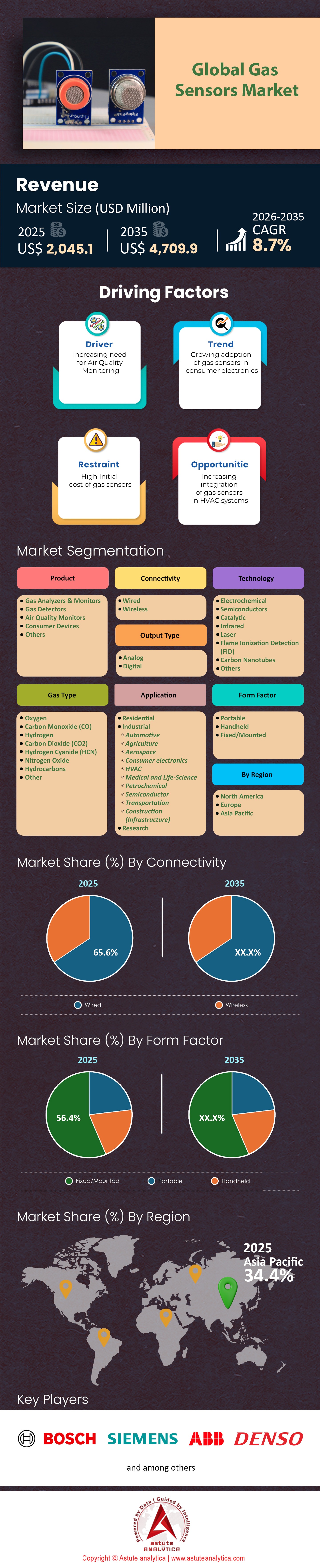
Global gas sensors market was valued at US$ 2,045.1 million in 2025 and is projected to hit the market size US$ 4,709.9 million by 2035 at a CAGR of 8.7% during the forecast period 2026–2035.
Key Market Highlights
- By type, gas analyzers and monitors represented nearly 33.1% of all sales worldwide.
- By technology, electrochemical technology held a staggering 36.7% of the total market share in 2025.
- By connectivity, wired segment ruled the global gas sensors market with a market share of 65.6%.
- By output type, analog output accounted for over 68% market share.
- Asia Pacific region had a 34.4% share in the global gas sensors market.
The global gas sensors market is currently undergoing a fundamental bifurcation. Historically viewed as a monolithic industry driven by industrial safety compliance, the market in 2025 has split into two distinct ecosystems: the high-value, high-fidelity industrial sector and the high-volume, cost-sensitive consumer sector.
Why is Demand Surging Now? (The Macro-Drivers)
Three specific macro-economic shifts are forcing an upgrade cycle in gas sensors market infrastructure:
- The Hydrogen Economy (The H2 Factor): The global push for Green Hydrogen has created a massive safety gap. Hydrogen is leaky, invisible, and explosive across a wide range (4% - 75%). Traditional catalytic bead sensors struggle with the rapid response times needed for H2 electrolyzers and transport hubs. This is driving demand for new palladium-alloy thin-film sensors.
- The "Well Building" Standard (Post-COVID HVAC): The ASHRAE and WELL Building Standards have permanently altered commercial real estate. CO2 monitoring is no longer optional; it is a proxy for ventilation quality. Demand Controlled Ventilation (DCV) systems using NDIR CO2 sensors are now standard in Class A office builds.
- EV Thermal Runaway: Lithium-ion batteries release off-gases (CO, VOCs, H2) seconds before thermal runaway occurs. Automotive OEMs are mandating gas sensors inside battery packs (BMS) to provide an "Early Warning System" that temperature sensors cannot offer.
To Get more Insights, Request A Free Sample
MEMS vs. Traditional: Who is Winning the Tech War?
The battle for gas sensors market share is effectively a battle of form factors: Macro vs. Micro.
- The Incumbents (Electrochemical & Catalytic Bead): These remain the gold standard for heavy industry due to accuracy and specific gas selectivity. However, they are bulky, power-hungry, and require frequent calibration (high OPEX).
- The Challenger (MEMS - Micro-Electro-Mechanical Systems): MEMS technology, particularly in Metal Oxide (MOX) and NDIR variants, is the growth engine for the gas sensors market.
- Why MEMS is winning: Size (smaller than a fingernail), Power (microwatts vs. milliwatts), and SMT (Surface Mount Technology) compatibility allowing automated PCB assembly.
- The Shift: We are seeing a massive replacement cycle where portable multi-gas detectors are switching to MEMS-based architectures to extend battery life from 18 hours to 7+ days.
How is the IIoT Revolutionizing Gas Detection?
As of January 2026, the gas sensors market is shifting from "Gas Detection" (Alarms) to "Gas Monitoring" (Data Analytics).
In 2025, a standalone sensor is a commodity, a connected sensor is a solution. The integration of LPWAN (Low Power Wide Area Network) technologies—specifically LoRaWAN and NB-IoT—has allowed refineries and chemical plants to deploy wireless gas sensor meshes.
- WirelessHART & ISA100.11a: These remain dominant in critical process control, but LoRaWAN is capturing the "non-critical" monitoring market (e.g., perimeter fence line monitoring).
- The "Gas-as-a-Service" Model: Manufacturers like MSA and Honeywell are pivoting to subscription models. Instead of selling a $500 detector, they sell a "Safety Subscription" that includes hardware, automated compliance reporting, and cloud connectivity.
Which Gases are Driving the Highest Revenue?
While Oxygen (O2) sensors have the highest volume (due to confined space regulations), they have the lowest profit margins in the gas sensors market. The revenue drivers are:
- Carbon Dioxide (CO2): The volume king. Driven by HVAC and Agriculture (greenhouses). Technology: NDIR is the standard here.
- Methane (CH4): The regulatory target. With the US EPA’s "Super Emitter" program and new EU methane rules, the demand for high-fidelity methane sensors (Laser-based) for leak detection and repair (LDAR) has spiked 15% YoY.
- Volatile Organic Compounds (VOCs): The health proxy. PID (Photoionization Detection) sensors are seeing adoption in environmental monitoring stations and high-end air purifiers.
- Hydrogen (H2): The highest CAGR segment (12%+).
Oil Rigs or Smart Homes: Where is the Money Flowing in the Global Gas Sensors Market?
Industrial Sector (45% Share):
- Upstream O&G: High demand for H2S (Hydrogen Sulfide) and Wireless CH4 detectors in the global gas sensors market.
- Semiconductor Mfg: Extremely high-value market. Fabs require PPB (Parts Per Billion) level detection for toxic hydrides (Arsine, Phosphine). A single sensor here can cost $2,000+.
Consumer Electronics (20% Share):
- Smart Home: The integration of MOX sensors into thermostats (Nest/Ecobee) and air purifiers (Dyson).
- Wearables: The "Digital Nose" in smartphones is the Holy Grail. While currently limited, 2025 is seeing renewed R&D from Samsung and Apple in breath analysis integration.
Automotive (15% Share):
Cabin Air Quality Systems (AQS) and Battery Management Systems.
How are ASPs (Average Selling Prices) Shifting in the Global Gas Sensors Market?
As per Astute Analytica’s recent findings, there is a massive bifurcation in the pricing of various gas sensors. Following analysis gives the clearer picture about current ASPs in the market.
- Commoditized Sensors (MOX): The ASP has crashed to $1.50 - $4.00 per unit. This price elasticity allows ubiquitous deployment in IoT devices.
- Mid-Range (Electrochemical): Stable ASP at $15 - $40.
- Premium (Optical/Laser): High ASP retention at $150 - $800. These sensors (like Tunable Diode Laser Absorption Spectroscopy - TDLAS) are immune to poisoning and do not require calibration, justifying the high CAPEX by lowering long-term OPEX.
APAC, US, or Europe: Who Holds the Dominance?
- Asia-Pacific (APAC): The Manufacturing Hub. China dominates the production of low-cost MOX sensors and consumer electronics integration. Japan (Figaro, Nemoto) remains the leader in high-quality electrochemical innovation.
- North America: The Revenue Leader in the global gas sensors market. Driven by stringent OSHA regulations and the booming US oil and gas shale market. The US leads in the adoption of high-end wireless industrial systems.
- Europe: The Green Driver. The EU’s "Green Deal" is the primary driver for hydrogen sensor adoption and automotive emission sensors.
Is Regulation the Ultimate Maker in Gas Sensors Market?
In the gas sensor market, legislation is more powerful than innovation.
- US EPA OOOOb/c (2024/2025): These rules mandate rigorous monitoring of methane emissions from oil and gas facilities. It has effectively criminalized "fugitive emissions," forcing operators to buy high-accuracy optical sensors.
- EU REACH: This regulation is actively phasing out lead (Pb). Historically, O2 sensors were lead-based (galvanic). The industry is now forced to pivot to Lead-Free electrochemical or Optical O2 sensors, creating a massive replacement cycle.
- IEC 60079-29-1: The performance standard for combustible gas detectors. Compliance is mandatory for market entry in hazardous environments.
Titans vs. Disruptors: Who Owns the Market Share?
The gas sensors market is consolidated at the top but fragmented at the component level.
The Tier 1 Integrators (The "Big 4"):
- Honeywell Analytics: Broadest portfolio, strong in industrial wireless.
- MSA Safety: Dominant in fire service and portable detection.
- Dräger: The European standard for medical and industrial safety.
- Industrial Scientific: Leaders in "Gas Detection as a Service."
The Component Giants (Chip Makers):
- Sensirion (Switzerland): The leader in environmental sensing (MEMS).
- Bosch Sensortec: Dominating the consumer/mobile space.
- Amphenol: Aggressively acquiring sensor companies (acquired SGX Sensortech, Piher, etc.).
The Disruptors:
- Aernos & Aryballe: Startups utilizing bio-mimicry to create "Digital Noses" using peptides and AI, aiming to digitize smell completely.
Where are the Vulnerabilities in the Supply Chain?
- Noble Metals: Catalytic and Electrochemical sensors in the gas sensors market rely on Platinum, Palladium, and Ruthenium. Geopolitical instability in major mining regions (Russia/South Africa) creates price volatility.
- ASIC Shortages: Modern sensors are not just chemical pastes, they are coupled with Application-Specific Integrated Circuits (ASICs) for signal processing. The lingering "lag effects" of semiconductor allocation still impact the lead times of high-end MEMS sensors.
- Calibration Gas Logistics: market players cannot sell a sensor without calibration gas. The transport of hazardous calibration cylinders (Class 2.2 goods) is a logistical bottleneck, pushing the market toward "Self-Calibrating" sensors.
Can AI Adoption and Integration Eliminate the "False Positive" Nightmare in the Gas Sensors Market?
The #1 pain point for facility managers is False Alarms. A sensor detecting hairspray and calling it a gas leak halts production and costs money. To overcome this challenge, edge AI is being embedded directly into the sensor microcontroller (MCU). It works fine in the following manner.
- Pattern Recognition: Instead of a simple threshold (If > 50ppm then ALARM), AI analyzes the slope and signature of the reaction.
- Interference Rejection: Algorithms can now distinguish between the target gas (e.g., Methane) and interferents (e.g., Ethanol or Humidity) by analyzing the transient response of the sensor.
- Predictive Maintenance: AI monitors the sensor's health, predicting "Sensor Death" weeks in advance, preventing downtime.
Segmental Analysis
Gas Analyzers and Monitors Lead Sales via Industrial Safety Compliance
Gas analyzers and monitors represent the largest sales volume in the gas sensors market due to stringent global industrial safety regulations enforced by bodies like OSHA and the EPA. In 2025, market leaders such as MSA Safety and Honeywell reported robust growth in their fixed and portable monitor divisions, driven by mandated upgrades in oil, gas, and chemical facilities. These devices are indispensable for real-time detection of oxygen depletion and explosive atmospheres, a non-negotiable safety standard in heavy industry.
New product lines released in 2025 feature integrated cloud connectivity, allowing safety managers in the gas sensors market to visualize fleet data instantly, which has accelerated replacement cycles for older standalone units. The segment’s dominance is further backed by the 2025 surge in green hydrogen projects, which require specialized high-sensitivity analyzers to prevent leaks, ensuring these monitors remain the primary revenue generator in the safety ecosystem.
Electrochemical Technology Dominates Toxic Gas Detection with Unmatched Sensitivity
Electrochemical technology holds the staggering 36.7% share of the gas sensors market because it remains the gold standard for detecting toxic gases like Carbon Monoxide (CO), Hydrogen Sulfide (H2S), and Chlorine. Unlike infrared or catalytic bead sensors, electrochemical cells consume very little power and offer high specificity to target gases, which is critical for preventing false alarms in crowded industrial plants. In 2025, sensor manufacturer City Technology (a Honeywell company) confirmed that electrochemical cells remain their highest-volume product category, specifically for personal protection equipment (PPE).
The technology's dominance is reinforced by its cost-effectiveness; 2025 pricing data shows electrochemical sensors remain significantly cheaper to manufacture than optical alternatives while meeting the rigorous performance standards required by the mining and petrochemical sectors. This balance of price, performance, and low power consumption keeps them atop the market.
By Connectivity, Wired Connectivity Rules Infrastructure in the Gas Sensors Market Due to Reliability and Security
The wired segment rules with over 65% market share because critical safety infrastructure demands the 100% reliability and zero-latency data transmission that only physical cabling can guarantee. While wireless tech is emerging, 2025 industry reports from players like Dräger and Emerson indicate that "brownfield" industrial sites continue to specify wired configurations for their primary fire and gas systems to avoid signal interference and battery maintenance issues. Wired systems provide continuous power and power-over-ethernet capabilities, which are essential for 24/7 continuous monitoring in hazardous Zone 1 environments.
Furthermore, 2025 cybersecurity standards for critical infrastructure have slowed the adoption of wireless in some sectors, as wired loops are viewed as less vulnerable to external hacking. This preference for "fail-safe" architecture ensures wired connections remain the dominant choice for permanent industrial installations.
Customize This Report + Validate with an Expert
Access only the sections you need—region-specific, company-level, or by use-case.
Includes a free consultation with a domain expert to help guide your decision.
By Output, Analog Output Remains the Industry Standard for Legacy System Integration
Analog output accounts for over 68% of the gas sensors market because the 4-20mA current loop standard is deeply entrenched in the global industrial installed base. Despite the rise of digital protocols like Modbus, the vast majority of Programmable Logic Controllers (PLCs) and Distributed Control Systems (DCS) in operation today are built to receive analog signals.
In 2025, retrofitting activities in the oil and gas sector favored analog sensors because they allow plants to upgrade detection capabilities without replacing expensive central control hardware. Feedback from instrumentation engineers in 2025 confirms that analog sensors are preferred for their "plug-and-play" simplicity and immunity to digital noise interference over long cable runs. This legacy compatibility ensures that analog output remains the volume leader, as complete digital transformation of heavy industrial plants is a slow, multi-decade process.
To Understand More About this Research: Request A Free Sample
Regional Analysis of the Gas Sensors Market
Asia Pacific: The Global Manufacturing Hub Driving Industrial Safety
Asia Pacific continues to dictate the trajectory of the global gas sensors market, commanding a verified 34.40% market share fueled by rapid industrialization and stringent occupational safety enforcement in China and India. The region's dominance is not merely a function of manufacturing volume but a result of aggressive government interventions to curb urban pollution and improve industrial safety standards. In 2025, the India gas sensor market alone generated $161.2 million in revenue, driven largely by the implementation of continuous emission monitoring systems (CEMS) in thermal power plants and the chemical sector.
China remains the manufacturing engine, where the "14th Five-Year Plan" has mandated rigorous gas detection protocols in mining and petrochemical industries, directly converting regulatory pressure into sensor orders. The consumer electronics boom in South Korea and Japan also contributes significantly, as miniaturized gas sensors are increasingly integrated into air purifiers and smart home HVAC systems. The region is evolving from low-cost manufacturing to high-value sensor application, particularly in monitoring PM2.5 and volatile organic compounds (VOCs) in "Smart City" projects.
North America: Methane Regulations and Energy Compliance Propelling Regional Gas Sensors Market Growth
North America stands as the second-largest market, characterized by high-value adoption in the Oil & Gas sector, driven by immediate regulatory financial penalties. The market landscape shifted dramatically with the U.S. EPA’s Waste Emissions Charge, which imposes a fee starting at $1,200 per metric ton of reported methane emissions in 2025 (escalating to $1,500 in 2026). This punitive regulation has forced upstream and midstream operators to invest heavily in advanced methane leak detection sensors, moving beyond voluntary compliance to financial necessity.
Furthermore, the region sees substantial demand from the automotive sector and building automation. The focus here is on high-fidelity, wireless gas sensing networks that integrate with Industrial Internet of Things (IIoT) platforms. Unlike the volume-driven APAC market, North America focuses on sensor sensitivity and data integration, particularly for environmental compliance in shale gas extraction zones.
Europe: The Hydrogen Transition and Automotive Rigor
Europe represents the third pillar of the gas sensors market, distinguished by its aggressive transition toward green energy and ultra-low emission vehicles. The European hydrogen market was valued at $40.2 billion in 2024, creating a specialized demand sub-segment for hydrogen gas sensors required for the production, transport, and storage of green hydrogen. Safety concerns regarding hydrogen leakage are paramount, making high-precision sensors a requisite for the EU’s "Hydrogen Backbone" infrastructure projects.
Simultaneously, the automotive sector remains a critical driver as manufacturers prepare for Euro 7 standards, which will require vehicles to remain compliant with emission limits throughout their lifecycle. This has spurred a projected demand for emission compliance technologies that will reach 14.1 million units by 2035. Europe’s market is defined by "legislated innovation," where gas sensors are not just safety tools but essential components for meeting the continent's ambitious net-zero targets.
Top Players in the Global Gas Sensors Market
- ABB Ltd.
- AlphaSense Inc.
- AlphaSense Inc.
- Dynament Ltd.
- Emerson Electric, Co. Ltd.
- Figaro Engineering
- GASTEC Corporation
- Honeywell Analytics
- MEMBRAPOR AG
- MSA Safety Inc.
- Nemoto & Co. Ltd
- Robert Bosch GmbH
- Sensirion
- Siemens
- DENSO Corporation
- Other Prominent Players
Market Segmentation Overview:
By Product
- Gas Analyzers & Monitors
- Gas Detectors
- Air Quality Monitors
- Consumer Devices
- Others
By Technology
- Electrochemical
- Semiconductors
- Catalytic
- Infrared
- Laser
- Flame Ionization Detection (FID)
- Carbon Nanotubes
- Others
By Connectivity
- Wired
- Wireless
By Output Type
- Analog
- Digital
By Form Factor
- Portable
- Handheld
- Fixed/Mounted
By Gas Type
- Oxygen
- Carbon Monoxide (CO)
- Hydrogen
- Carbon Dioxide (CO2)
- Hydrogen Cyanide (HCN)
- Nitrogen Oxide
- Hydrocarbons
- Other
By Application
- Residential
- Industrial
- Automotive
- Agriculture
- Aerospace
- Consumer electronics
- HVAC
- Medical and Life-Science
- Petrochemical
- Semiconductor
- Transportation
- Construction (Infrastructure)
- Research
By Region
- North America
- The U.S.
- Canada
- Mexico
- Europe
- The UK
- Germany
- France
- Italy
- Spain
- Russia
- Rest of Europe
- Asia Pacific
- Japan
- China
- India
- Australia & New Zealand
- Korea
- ASEAN
- Rest of Asia Pacific
- Middle East & Africa (MEA)
- UAE
- Saudi Arabia
- South Africa
- Rest of MEA
- South America
- Argentina
- Brazil
- Rest of South America
FREQUENTLY ASKED QUESTIONS
Valued at US$ 2,045.1 million in 2025, it's projected to reach US$ 4,709.9 million by 2035, growing at a CAGR of 8.7% (2026-2035), driven by hydrogen safety and IIoT.
Gas analyzers & monitors hold 33.1% share, dominating via OSHA/EPA-mandated industrial safety upgrades for real-time O2/explosive detection in oil, gas, and chem plants.
At 36.7% share, it excels in toxic gas (CO, H2S) sensitivity, low power, and cost vs. optical rivals, powering PPE and mining with minimal false alarms.
Wired holds 65.6% share for zero-latency reliability in critical infrastructure; preferred over wireless for cybersecurity, power continuity, and legacy PLC integration.
APAC claims 34.4% share as manufacturing hub; China's mining mandates and India's CEMS drive $161M+ revenue in 2025, blending volume with smart city VOC monitoring.
Hydrogen leaks (12%+ CAGR), EPA methane rules, and EV battery off-gas detection; MEMS/IIoT shift cuts ASPs to $1.50/unit, enabling ubiquitous deployment.
LOOKING FOR COMPREHENSIVE MARKET KNOWLEDGE? ENGAGE OUR EXPERT SPECIALISTS.
SPEAK TO AN ANALYST
.svg)

 Schedule a Meeting

Features | Type of License | ||||
 Data Book | Single User |   Multi User |  Corporate | ||
| e-Access | ✓ | ✓ | ✓ | ✓ | |
User Sharing | 1 User Only | 1 User Only | Up to 7 Users | Unlimited User Access | |
⨉ | ⨉ | ⨉ | ✓ | ||
Free Customization | No Free Customization | Up To 30 hrs work | Up To 60 hrs work | Up To 80 hrs work | |
Deliverable |
| ⨉ | ✓ | ✓ | ✓ |
| ✓ | ⨉ | ✓ | ✓ | |
| ⨉ | ⨉ | ⨉ | ✓ | |
Analyst Support | 2-Months Analyst Support | 4-Months Analyst Support | 7-Months Analyst Support | One Year Analyst Support | |
Free Report update in next update cycle | ⨉ | ⨉ | ⨉ | ✓ | |
Free Industry Update (Within 180 days) | ⨉ | ⨉ | ⨉ | ✓ | |
Benefit | Up to 10% off on Post Purchase | Up to 20% off on Post Purchase | Up to 30% off on Post Purchase | Up to 40% off on Post Purchase | |