Aperçu du marché
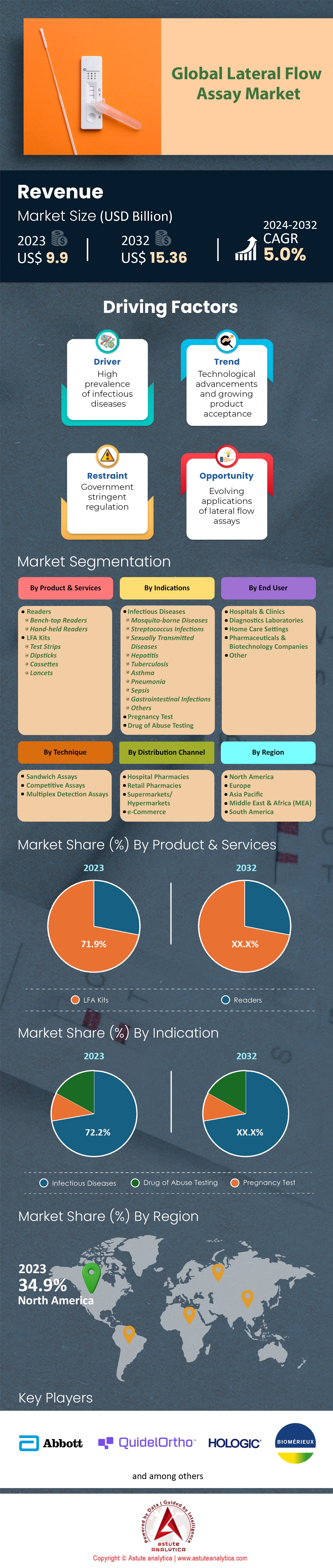
Le marché des tests de flux latéral était évalué à 10,84 milliards de dollars en 2025 et devrait atteindre une valeur de 17,66 milliards de dollars d'ici 2035, avec un TCAC de 5,0 % sur la période prévisionnelle 2026-2035.
Principales conclusions
- En termes de produit, le marché des tests de flux latéral est largement dominé par les kits LFA, dont la part de marché dépasse 71,9 %.
- En termes d'indication, le diagnostic des maladies infectieuses domine le marché en détenant la plus grande part de marché, soit 72,2 %.
- En termes de technique, la technique de dosage sandwich contrôle près de 48 % de parts de marché.
- Du point de vue des utilisateurs finaux, les hôpitaux et les cliniques dominent le marché en représentant plus de 38,8 % des parts de marché.
Depuis 2025, les tests de flux sanguin (LFA) ont dépassé leur réputation traditionnelle de simples tests rapides pour devenir des outils de diagnostic sophistiqués et performants. Il s'agit fondamentalement de plateformes sur papier qui détectent la présence (ou l'absence) d'un analyte cible — tel qu'un pathogène, une hormone ou un biomarqueur du cancer— dans un échantillon liquide, sans nécessiter d'équipement spécialisé.
Bien que le test de grossesse demeure l'exemple le plus répandu, la technologie a considérablement évolué. D'ici 2025, la définition d'un test de flux latéral (TFL) s'est élargie pour inclure les bandelettes immunochromatographiques de nouvelle génération, intégrées à des lecteurs numériques et compatibles avec les smartphones. Le marché des tests de flux latéral ne se limite plus aux résultats binaires « oui/non » ; il s'oriente vers une analyse semi-quantitative, grâce à la technologie des nanoparticules qui permet d'atteindre une limite de détection (LD) de 0,01 pg/mL. Cette évolution de l'analogique au numérique constitue le fondement de l'expansion actuelle du marché.
Pour en savoir plus, demandez un échantillon gratuit
Pourquoi la demande mondiale de tests de diagnostic rapide s'accélère-t-elle ?
L'évolution de la demande sur le marché des tests de flux latéral est principalement due à une restructuration fondamentale des modèles de soins de santé post-pandémiques, orientée vers la décentralisation des tests. Les systèmes de santé s'efforcent activement de désengorger les hôpitaux, rendant les solutions de diagnostic rapide au chevet du . Les données de 2024 soulignent cette urgence : on estime à 40 millions le nombre de cas de grippe aux États-Unis seulement, entraînant 470 000 hospitalisations. Pour gérer de tels volumes, les professionnels de santé ont besoin d'outils permettant un triage immédiat.
Par ailleurs, la menace persistante des virus respiratoires a engendré un marché durable et « endémique » pour les tests de flux latéral. L’Amérique du Nord devrait atteindre 124,5 millions de cas cumulés de COVID-19 d’ici juin 2025, rendant indispensable une surveillance continue. À cela s’ajoutent les avantages économiques des tests de flux latéral. Les agences de santé publique privilégient ces dispositifs en raison de leur rentabilité et de leur facilité de déploiement à grande échelle ; les contrats gouvernementaux garantissent actuellement une capacité de production de 150 millions de tests afin de se prémunir contre de futures épidémies. Ainsi, la combinaison d’une forte demande clinique et d’une rentabilité optimale constitue un double moteur de croissance pour ce marché.
Quelles sont les applications cliniques qui gagnent des parts de marché ?
Bien que des maladies infectieuses demeurent la principale source de revenus sur le marché des tests à flux latéral, leurs applications se diversifient rapidement. La saison des infections respiratoires a rendu nécessaire le développement de panels multiplex. En 2025, la norme s'est orientée vers des panels quadruples capables de détecter simultanément la grippe A, la grippe B, le VRS et la COVID-19 en un seul test de 20 minutes. Cette combinaison de cibles permet d'améliorer l'efficacité et d'augmenter les prix unitaires.
Au-delà de la santé humaine, le secteur vétérinaire s'impose comme un acteur majeur et inattendu du marché des tests de flux latéral. S'affranchissant des contraintes réglementaires du diagnostic humain, des entreprises ont lancé en juillet 2024 des tests de diagnostic multipanels pour animaux de compagnie, capables de détecter 12 infections distinctes. Par ailleurs, le secteur de la santé des femmes, et notamment le marché de la FemTech, connaît une innovation croissante, allant au-delà des tests de grossesse classiques. En témoigne l'octroi par les NIH de 8 millions de dollars en 2024 pour des technologies de diagnostic rapide en santé maternelle. Même la prise en charge des maladies chroniques adopte les tests de flux latéral : de nouveaux tests pour l'antigène de surface de l'hépatite B ont atteint une valeur prédictive négative (VPN) de 98 % lors des évaluations cliniques de 2025.
Que révèlent les dépôts de brevets sur l'innovation future ?
Les tendances en matière de propriété intellectuelle indiquent que le marché des tests de flux latéral se tourne résolument vers l'intégration numérique et l'ultra-sensibilité. Le volume d'activité est impressionnant : l'USPTO a publié 147 164 demandes de brevets au cours de l'exercice 2024. Une analyse plus approfondie de ces dépôts révèle une véritable bataille pour le marché des « lecteurs numériques ». Des géants technologiques comme Samsung ont déposé 6 660 brevets en 2024, signe que l'avenir des tests de flux latéral repose sur l'interprétation assistée par semi-conducteurs plutôt que sur la seule lecture visuelle.
De plus, la science des matériaux sous-jacente à ces tests fait l'objet d'un important processus de brevetage. Au troisième trimestre 2024, l'industrie médicale a déposé 30 461 demandes de brevets, dont beaucoup portent sur les tests compagnons à base d'ARNm et les améliorations apportées par les nanoparticules. BioNTech et Moderna ont déposé respectivement 36 et 34 nouvelles familles de brevets en 2024, ce qui indique que les tests de flux latéral (LFA) deviendront probablement les principaux tests compagnons des thérapies à base d'ARNm de nouvelle génération. Ces dépôts confirment que le marché évolue vers un écosystème de haute technologie où la bandelette de test n'est qu'un élément d'une plateforme de santé numérique plus vaste.
Qui sont les principaux consommateurs et où la demande est-elle forte ?
Le marché des tests de flux latéral s'est scindé en deux segments distincts mais lucratifs : les établissements de santé et le marché de la vente directe aux consommateurs. Dans les établissements de santé, les hôpitaux et les centres de soins d'urgence utilisent des lecteurs à haut débit pour gérer le flux de patients. Cependant, le segment de la vente directe aux consommateurs connaît une expansion rapide, soutenue par des politiques de remboursement avantageuses. Par exemple, au Royaume-Uni, le NHS a fixé le remboursement des pharmacies à 4,10 USD par test de flux latéral à compter d'avril 2025, incitant ainsi à la distribution en pharmacie.
Géographiquement, l'Amérique du Nord conserve la plus grande part des revenus du marché des tests de flux latéral, grâce à des dépenses de santé élevées et à un environnement réglementaire favorable qui a approuvé 1 507 demandes d'autorisation 510(k) au cours du seul premier semestre 2024. Cependant, la région Asie-Pacifique consolide son rôle de pôle mondial de production. Elle bénéficie d'investissements importants dans ses infrastructures, avec 170 nouveaux projets d'usines de semi-conducteurs et de technologies prévus en 2025 pour soutenir la chaîne d'approvisionnement des lecteurs de diagnostic numérique.
Quels sont les principaux acteurs qui dominent et pourquoi ?
Le marché des tests de flux latéral est dominé par des géants tels que QuidelOrtho, Abbott et Roche, qui s'imposent grâce à leur envergure et leur expertise réglementaire. QuidelOrtho, par exemple, a enregistré un chiffre d'affaires récurrent de 1,74 milliard de dollars depuis le début de l'année 2024, dont 141 à 143 millions de dollars pour son seul segment respiratoire au quatrième trimestre 2024. Ces entreprises maintiennent leur position dominante car elles disposent des capitaux nécessaires pour naviguer dans des procédures réglementaires complexes – comme le délai d'examen moyen de 168,9 jours pour l'autorisation 510(k) de la FDA – tout en finançant d'importants investissements en R&D.
Abbott illustre parfaitement cette position dominante, en s'appuyant sur un chiffre d'affaires trimestriel de 263 millions de dollars provenant des tests COVID-19 pour financer sa diversification vers d'autres domaines thérapeutiques. Sa capacité à mettre en œuvre des initiatives d'économies de coûts générant 100 millions de dollars par an lui permet de proposer des prix compétitifs tout en maintenant des marges élevées. Les acteurs plus modestes peinent souvent à égaler cette efficacité opérationnelle et la résilience de leur chaîne d'approvisionnement, ce qui assure une relative sécurité aux leaders du marché.
Comment les tendances récentes influencent-elles la dynamique de croissance du marché des tests de flux latéral ?
La tendance la plus marquante sur le marché des tests de flux latéral est la recherche d'une sensibilité équivalente à celle des tests de laboratoire, dans un format portable. En 2024, la validation de tests de flux latéral basés sur la technologie CRISPR, atteignant un seuil de sensibilité de 0,25 copie/µL, a remis en question la domination de la PCR pour certaines applications. Parallèlement, l'expérience utilisateur est optimisée pour garantir l'adhésion au protocole. Les nouveaux tests salivaires et les kits d'autotest offrent désormais des résultats en seulement 15 minutes, un délai nettement plus court que les générations précédentes.
Une autre tendance cruciale est la stabilisation des procédures réglementaires. Le passage de la FDA de l'autorisation d'utilisation d'urgence (EUA) à l'autorisation complète 510(k) a permis la maturation du marché. Avec plus de 430 tests de dépistage de la COVID-19 examinés en vue de leur approbation complète d'ici fin 2024, le marché élimine progressivement les concurrents de faible qualité. Ce choix de privilégier la qualité à la quantité garantit la pérennité des produits robustes et cliniquement validés, renforçant ainsi la confiance des professionnels de santé et des patients. La convergence de la haute technologie, de la rigueur réglementaire et de la connectivité numérique assure le dynamisme et la rentabilité du marché pour les années à venir.
Analyse segmentaire
Par produit, les ventes récurrentes de consommables confirment la domination écrasante des kits à flux latéral
Le marché des tests de flux latéral est fondamentalement porté par un modèle commercial de grande consommation, basé sur la vente de kits à usage unique (71,9 %). Si les lecteurs et les logiciels constituent l'infrastructure nécessaire, le chiffre d'affaires du secteur repose sur la consommation continue et régulière de bandelettes de test jetables. Les principaux fabricants de dispositifs de diagnostic s'appuient sur ce flux de revenus régulier, où l'installation d'un seul lecteur permet l'achat continu de milliers de kits à usage unique tout au long de sa durée de vie. Cette dynamique est particulièrement visible dans le domaine du diagnostic respiratoire, où la demande de tests de grippe A/B, de streptocoque et de VRS alimente une croissance annuelle constante du secteur du diagnostic rapide.
De plus, la domination des kits sur le marché des tests de flux latéral est renforcée par les achats massifs effectués à l'échelle mondiale pour les initiatives de santé publique. Contrairement aux équipements lourds, qui représentent un investissement unique, des millions de kits jetables sont achetés chaque année pour gérer les épidémies saisonnières et les programmes de dépistage. La large diffusion des autotests, des consommables professionnels pour les soins de proximité et des consommables de culture cellulaire génère un volume de revenus considérable, impossible à égaler pour les équipements lourds. Par conséquent, l'avantage économique indéniable des consommables à forte rotation garantit aux kits le maintien de leur position de leader incontesté en termes de revenus dans le secteur du diagnostic.
Selon Indication, la charge mondiale d'agents pathogènes infectieux alimente une part de marché inégalée pour les diagnostics
Le diagnostic des maladies infectieuses représente 72,2 % du marché des tests de flux latéral, une position dominante qui s'explique par le rôle crucial de cette technologie dans la gestion des crises sanitaires mondiales. Le leadership de ce segment n'est pas uniquement dû aux virus respiratoires saisonniers, mais également aux programmes internationaux de dépistage continus des maladies à forte incidence. À titre d'exemple, la distribution mondiale de centaines de millions de tests de diagnostic rapide (TDR) du paludisme chaque année illustre l'ampleur considérable de ce segment. La capacité des tests de flux latéral à fournir des résultats immédiats dans des contextes aux ressources limitées en fait l'outil principal de lutte contre les maladies transmissibles là où les laboratoires centralisés sont inaccessibles.
Dans les économies développées, la « triple épidémie » de COVID-19, de grippe et de VRS a conforté le rôle primordial des tests de flux latéral dans le diagnostic et le traitement. La rapidité et la portabilité de ces tests sont indispensables pour une prise en charge immédiate, contrairement à la gestion des maladies chroniques. Par ailleurs, les investissements importants dans les programmes de dépistage du VIH et de la tuberculose reposent sur la rapidité d'obtention des résultats grâce aux tests de flux latéral. Face à l'imprévisibilité des épidémies et à la nécessité de réaliser des volumes de tests massifs pour les maîtriser, ce segment de marché continue de représenter la plus grande part du marché.
Grâce à une technique de pointe, une sensibilité supérieure aux antigènes viraux assure le leadership technique du test sandwich
La technique de dosage sandwich domine près de 48 % du marché des tests de flux latéral, car elle constitue la méthode de référence pour la détection d'analytes de haut poids moléculaire, qui représentent la part la plus importante des cibles du secteur. Ce format, où l'analyte cible est lié entre un anticorps de capture et un anticorps de détection marqué, offre une spécificité et une sensibilité supérieures pour les protéines critiques. Il constitue la technique de base pour la détection d'antigènes viraux, tels que la nucléocapside du SARS-CoV-2, et d'hormones essentielles comme la gonadotrophine chorionique humaine (hCG), utilisée dans les tests de grossesse.
Cette supériorité technique se traduit directement par une domination commerciale. Les diagnostics et les tests de grossesse constituant les principales sources de revenus du marché des tests de flux latéral, la technique sandwich domine naturellement le secteur. Les méthodes concurrentes, telles que les tests d'inhibition compétitive, sont généralement réservées aux petites molécules comme les drogues, qui représentent une part plus faible du volume total de tests. Tant que l'industrie du diagnostic privilégiera la détection des protéines virales et des hormones, la capacité du format sandwich à fournir des résultats intuitifs et très sensibles (« deux lignes ») conservera son statut de technologie de référence en matière de diagnostic rapide.
Personnalisez ce rapport + faites-le valider par un expert
Accédez uniquement aux sections dont vous avez besoin : par région, au niveau de l’entreprise ou par cas d’utilisation.
Comprend une consultation gratuite avec un expert du domaine pour vous aider à prendre votre décision.
Selon les utilisateurs finaux, les soins intensifs et le triage décentralisé consolident la position de leader des hôpitaux et des cliniques sur le marché
Les hôpitaux et les cliniques dominent le marché des tests de flux latéral avec une part de 38,8 %, principalement parce que les établissements de santé professionnels utilisent des diagnostics multiplexés à haute valeur ajoutée, dont le prix de vente moyen est nettement supérieur à celui des autotests. Malgré la croissance des tests en vente libre, le segment hospitalier reste solide grâce à l'utilisation de systèmes de triage professionnels pour le dépistage des pathologies cardiaques et toxicologiques critiques. Dans ces contextes d'urgence, la précision, la sensibilité et l'intégration aux systèmes d'information hospitaliers sont primordiales, justifiant le coût élevé des kits de flux latéral de qualité professionnelle.
De plus, la décentralisation des soins de santé a concentré les volumes de tests dans les cliniques de soins d'urgence, confortant ainsi la position dominante de ce segment sur le marché des tests de flux latéral. Les environnements cliniques sont essentiels pour confirmer les diagnostics – notamment pour différencier la grippe du VRS – ce qui est souvent une condition préalable à la prescription d'antiviraux. Si les autotests offrent un avantage pratique, les hôpitaux et les cliniques fournissent la validation médicale nécessaire à l'intervention et au remboursement par l'assurance maladie. Cette dépendance aux diagnostics « confirmés » garantit que les établissements de santé professionnels restent le principal contributeur financier du secteur, surpassant les canaux de vente directe aux consommateurs.
Pour en savoir plus sur cette recherche : demandez un échantillon gratuit
Analyse régionale
L'Amérique du Nord s'assure une place de premier plan grâce à des cadres réglementaires solides et à un système de remboursement
L'Amérique du Nord domine largement le marché des tests de flux latéral, avec une part de 34,90 %, grâce à l'efficacité réglementaire des États-Unis et à l'importance de leur utilisation clinique. Au cours du seul premier semestre 2024, la FDA a approuvé 1 507 demandes d'autorisation de tests de diagnostic, créant ainsi la voie d'accès la plus rapide au monde pour les nouvelles technologies. Cette rapidité réglementaire répond directement à une forte demande intérieure : avec 40 millions de cas de grippe estimés chaque année et 470 000 hospitalisations enregistrées lors de la dernière saison, le système de santé américain a intégré les tests rapides comme étape de triage obligatoire.
De plus, les structures financières fédérales consolident cette position dominante. Des agences comme la BARDA ont mis en œuvre avec succès des contrats tels que celui de 40,9 millions de dollars pour les tests de nouvelle génération fin 2024, garantissant ainsi un financement adéquat de l'innovation aux États-Unis. Cette combinaison d'une forte prévalence de la maladie et de marchés publics soutenus fait de l'Amérique du Nord le principal moteur de revenus de l'industrie mondiale.
Le marché des tests de flux latéral en Asie-Pacifique connaît une expansion rapide grâce à l'augmentation des capacités de production et à l'intégration des semi-conducteurs
Si l'Amérique du Nord stimule la consommation, la région Asie-Pacifique s'est imposée comme le centre mondial de production et de développement technologique du diagnostic. La croissance de cette région est alimentée par une transition majeure vers les composants de diagnostic numérique, soutenue par 170 nouveaux investissements dans des installations technologiques recensés en 2025 afin de renforcer les chaînes d'approvisionnement. La Corée du Sud est à la pointe de cette évolution technologique : des géants comme Samsung ont déposé 6 660 brevets en 2024 pour intégrer la technologie des semi-conducteurs aux lecteurs de tests à flux latéral.
Dans le même temps, la Chine continue de dominer le marché des matières premières. Cette priorité accordée à une production à grande échelle et de haute technologie permet à la région de répondre aux demandes mondiales à l'exportation, notamment en satisfaisant aux exigences de capacité de test de 150 millions d'unités souvent stipulées dans les contrats des gouvernements occidentaux. La région opère ainsi une transition efficace, passant d'une simple phase d'assemblage à un rôle de source de propriété intellectuelle de diagnostic à forte valeur ajoutée.
Le marché européen des tests de flux latéral maintient sa croissance grâce à des marchés publics standardisés et des chaînes d'approvisionnement souveraines
Contrairement à l'Asie, axée sur la production industrielle, l'Europe maintient sa position dominante grâce à des stratégies de santé publique centralisées et à la maîtrise de sa chaîne d'approvisionnement. Le NHS britannique a stabilisé le marché régional en fixant le remboursement des médicaments à 4,10 USD par transaction pour la période de service 2025, créant ainsi un revenu minimum garanti qui encourage la participation des fabricants.
Sur le continent, l'autonomie stratégique est prioritaire ; la loi européenne sur les puces a financé cinq nouveaux pôles régionaux en 2025 afin de produire localement des puces de diagnostic essentielles, réduisant ainsi la dépendance aux importations, souvent instables. L'Allemagne demeure un pôle d'innovation crucial dans ce contexte, comme en témoigne le dépôt par BioNTech de 36 nouvelles familles de brevets en 2024 pour faire progresser les tests compagnons d'ARNm. Cette approche synergique, fondée sur des chaînes d'approvisionnement protégées et des modèles de prix standardisés, assure la grande résilience et l'attractivité du marché européen pour les investisseurs.
Les 5 principaux développements récents du marché des tests de flux latéral
- Autorisation de la FDA pour BD (juillet 2025) : Becton Dickinson a reçu l'autorisation 510(k) de la FDA pour son système BD Veritor pour le SARS-CoV-2, un test immunologique à flux latéral numérique pour la détection rapide du COVID-19 au point de soins à partir d'écouvillons nasaux dans des environnements exemptés de CLIA.
- Test de nucléosomes VolitionRx (juillet 2025) : VolitionRx a annoncé un test de flux latéral révolutionnaire quantifiant les nucléosomes dans le sang total en quelques minutes au point de soins, facilitant le diagnostic de la septicémie et l’accès aux soins dans les zones à faibles ressources.
- Brevet américain d'Uniogen (avril 2025) : Uniogen a obtenu le brevet américain 12 228 743 B2 pour une innovation optique améliorant les performances des lecteurs à flux latéral sur les longueurs d'onde UV à IR, améliorant la précision de détection pour la fluorescence et la technologie Upcon.
- Accord Sapphiros-Roche (novembre 2025) : Sapphiros a signé un accord stratégique avec Roche, lui donnant accès à 1 milliard de tests de flux latéral par an via une fabrication bobine à bobine, ainsi qu’à une future technologie moléculaire multiplex pour les tests POC/autotests.
- Partenariat BBI Solutions-Lateral Dx (décembre 2025) : BBI Solutions et Lateral Dx se sont associés pour proposer des solutions de flux latéral complètes, combinant la conception de tests et une fabrication à grande échelle pour les diagnostics de santé, vétérinaires, de sécurité alimentaire et environnementaux.
Principales entreprises du marché des tests de flux latéral :
- Laboratoires Abbott
- bioMérieux SA
- Laboratoires Bio-Rad Inc.
- Société Danaher
- F. Hoffmann-La Roche Ltd.
- Hologic Inc.
- Merck KGaA
- PerkinElmer Inc.
- Qiagen NV
- Quidel Corporation
- Siemens Healthineers
- Thermo Fisher Scientific, Inc.,
- Autres joueurs importants
Aperçu de la segmentation du marché :
Par produits et services :
- Lecteurs
- Lecteurs de table
- Lecteurs portables
- Kits LFA
- Bandelettes de test
- Jauges
- Cassettes
- Lancettes
Par indications :
- Maladies infectieuses
- Maladies transmises par les moustiques
- Infections à streptocoques
- Maladies sexuellement transmissibles
- Hépatite
- Tuberculose
- Asthme
- Pneumonie
- État septique
- Infections gastro-intestinales
- Autres
- Test de grossesse
- Tests de dépistage de drogues
Par technique :
- Essais sandwich
- Essais compétitifs
- Tests de détection multiplex
Par l'utilisateur final :
- Hôpitaux et cliniques
- Laboratoires de diagnostic
- Soins à domicile
- Entreprises pharmaceutiques et biotechnologiques
- Autre
Par canal de distribution :
- Pharmacies hospitalières
- Pharmacies de détail
- Supermarchés/ Hypermarchés
- commerce électronique
Par région :
- Amérique du Nord
- Les États-Unis.
- Canada
- Mexique
- Europe
- Europe occidentale
- Le Royaume-Uni
- Allemagne
- France
- Italie
- Espagne
- Le reste de l'Europe occidentale
- Europe de l'Est
- Pologne
- Russie
- Le reste de l'Europe de l'Est
- Asie-Pacifique
- Chine
- Inde
- Japon
- Australie et Nouvelle-Zélande
- ASEAN
- Reste de l'Asie-Pacifique
- Moyen-Orient et Afrique (MEA)
- Émirats arabes unis
- Arabie Saoudite
- Afrique du Sud
- Reste du Moyen-Orient
- Amérique du Sud
- Argentine
- Brésil
- Le reste de l'Amérique du Sud
QUESTIONS FRÉQUEMMENT POSÉES
Le marché mondial était évalué à 10,84 milliards de dollars en 2025 et devrait atteindre 17,66 milliards de dollars d'ici 2035. Cette expansion reflète un TCAC de 5,0 % entre 2026 et 2035, principalement due à l'évolution permanente vers des modèles de tests de diagnostic décentralisés.
Le marché évolue des bandelettes analogiques binaires vers des outils numériques semi-quantitatifs. Parmi les innovations actuelles figurent l'intégration de nanoparticules permettant d'atteindre des limites de détection aussi précises que 0,01 pg/mL et la connectivité smartphone, permettant ainsi aux tests rapides d'offrir une sensibilité comparable à celle des tests de laboratoire, directement sur le lieu de soins.
Le dépistage des maladies infectieuses demeure le principal moteur de croissance, notamment grâce aux nouveaux tests respiratoires multiplex à 4 paramètres pour la grippe, le VRS et la COVID-19. Cependant, les diagnostics vétérinaires et la santé des femmes connaissent une forte croissance, soutenue par un financement fédéral important pour les technologies de soins maternels.
Les tests LFA détiennent plus de 71,9 % du marché grâce au modèle économique basé sur la consommation de bandelettes jetables. Si l'achat d'un lecteur représente un investissement initial unique, la consommation régulière et importante de ces bandelettes génère un flux de revenus stable et régulier pour les fabricants.
L'Amérique du Nord détient 34,90 % du marché des tests de flux latéral grâce à une réglementation efficace et dynamique, comme en témoignent plus de 1 500 autorisations de la FDA début 2024. Cette situation est renforcée par une forte prévalence de la maladie et d'importants contrats gouvernementaux qui réduisent les risques liés à l'innovation et garantissent les volumes de production.
Le passage aux tests en magasin et à domicile a permis de stabiliser les revenus en diversifiant les utilisateurs finaux au-delà des hôpitaux. Les structures de remboursement fixes, telles que les tarifs standardisés mis en place par le NHS, offrent aux fabricants des prix planchers prévisibles, encourageant ainsi les investissements à long terme dans les chaînes d'approvisionnement de la distribution.
VOUS RECHERCHEZ UNE CONNAISSANCE APPROFONDIE DU MARCHÉ ? FAITES APPEL À NOS SPÉCIALISTES EXPERTS.
PARLEZ À UN ANALYSTE
.svg)

 Planifiez une réunion

Caractéristiques | Type de licence | ||||
 Livre de données | Utilisateur unique |   Multi-utilisateurs |  Entreprise | ||
| e-accès | ✓ | ✓ | ✓ | ✓ | |
Partage d'utilisateurs | Un seul utilisateur | Un seul utilisateur | Jusqu'à 7 utilisateurs | Accès utilisateur illimité | |
Imprimer | ⨉ | ⨉ | ⨉ | ✓ | |
Personnalisation gratuite | Personnalisation non gratuite | Jusqu'à 30 heures de travail | Jusqu'à 60 heures de travail | Jusqu'à 80 heures de travail | |
Format |
| ⨉ | ✓ | ✓ | ✓ |
| ✓ | ⨉ | ✓ | ✓ | |
| ⨉ | ⨉ | ⨉ | ✓ | |
Soutien aux analystes | Assistance analyste pendant 2 mois | Assistance analyste pendant 4 mois | Assistance analyste pendant 7 mois | Assistance analyste pendant un an | |
Mise à jour gratuite du rapport dans la prochaine cycle de mise à jour | ⨉ | ⨉ | ⨉ | ✓ | |
Mise à jour gratuite sur l'industrie (Dans un délai de 180 jours) | ⨉ | ⨉ | ⨉ | ✓ | |
Avantage | Jusqu'à 10 % de réduction après l'achat | Jusqu'à 20 % de réduction sur les achats effectués après l'achat | Jusqu'à 30 % de réduction après l'achat | Jusqu'à 40 % de réduction sur les achats effectués après l'achat | |